Showing posts with label religion. Show all posts

Sunday, April 16, 2017

Dayeinu

13th century Seder, via Treehugger

I went to a Seder this week, my first one. I was a little bit nervous, at first--I was raised Irish (OK, Roman) Catholic culture that will not share Holy Communion with outsiders

I was welcomed by all, not unexpected, but still nice.

I read (and learned) from the Haggadah, something I did not know even existed a week ago.

Turns out Judaism (at least my brief exposure to it) values questioning (the Haggadah) over education (Confraternity of Christian Doctrine), and (dare I say) kids over priests.


I think I am now a better teacher for it...
(Oh, and one more thing--turns out I love gefilte fish and matzoh stuffing.)

Friday, August 5, 2016

Science, dogma, and the American Way

I posted this about 8 years ago.
I needed the reminder.


The bishop has often compared our churches to a herd of horses grazing in a pasture. It is a beautiful picture to see them all grazing together contentedly. Everything seems to be going fine. But then there are always those who try to reach across the fence and get something they shouldn't have. These have to be brought back into the group. If they aren't, they will soon break down the fence, and then there is trouble. Not only will they slip out of the field, but they will open the way for the rest to get out as well.
From The Amish in Their Own Words, compiled by Brad Igou, Herald Press, Scottdale, Pa 1999


If you want to explain science as a process, you are going to run into questions about faith  or religion or natural  or some other vague word spouted off by an adolescent whose vocabulary does not yet include the (very useful) word "dogma."

I can play it safe:
This is science class. Science deals with the observable universe, and it has limits. Religion seeks other kinds of truths and uses different rules. Science and religion are separate disciplines that serve independent functions. (Go ask your mother)

That usually quiets the truly curious, though the thoroughly evangelical child may still be a bit pesky when evolution is the topic (which is pretty much always in biology).

I hesitate to give the science/religion dichotomy speech, though, because it's not true, and lying to kids in a class designed to teach them a way to discern what's true about our universe should earn me a trip to hell in a purple handbasket.

Science does lead to questions about origins and meaning, and we fail as teachers if we do not distinguish scientific reasoning from dogma.

Now, I am not about to challenge specific acts of dogma in science class, not directly (Holy See, Báb, Mohammad, Enki, Jesus, Abraham, Tlaloc, An, the Holy Ghost, Shangd, Moses, the Protogenoi, Bhagavan, Buddha....so many authorities, so little time), nor am I going to question any child's acceptance of whatever dogma happens to rule her clan.

I am not going to pretend, however, that science does not challenge what most students believe.

And I am taking it one step further this year.

I am explicitly telling them there are going to be times when what
what we know through science contradicts what they know through dogma. Which brings me to the parable. It is told by a bishop. It is a tale designed to help the parish stay true to dogma.

You could apply the same parable to public education. Students are a lot safer if they stick with the herd and keep away from the edges. They are more likely to earn good grades. They will, on average, earn more money than those students who do poorly in school. They certainly aren't going to break any fences.

If you're looking for Socrates, for Galileo, for Newton, for Einstein, for Feynman, you may as well find the hole in the fence and start walking.

I'm not trying to create any Einsteins in my class. I'm just trying to get them through one more year believing there might be something outside this particular pasture.


Top photo is one room schoolhouse in Lancaster, Pennsylvania,
the bottom photo is little girl at a horse farm, both from the 
National Archives collection


Monday, April 6, 2015

The knowledge economy is neither


We will pay for our hubris, as has every other civilization that presumed to know more than is knowable.

"Education is still the key to eliminating gender inequities, to reducing poverty, to creating a sustainable planet, and to fostering peace.... "
Arne Duncan, November 4, 2010

On our dollar bill, via Wikimedia

I am charged with teaching young adults biology in a culture that thrives on fantasy. Education could help eliminate gender (and race) inequities, reduce poverty, and create a sustainable planet, but in its current incarnation, it plays a larger role in maintaining the status quo.

But it's the next line by Mr Duncan where he jumps off the plane of reality altogether:
"And in a knowledge economy, education is the new currency by which nations maintain economic competitiveness and global prosperity. "

People ask me if I get flack for teaching evolution--I get some, but not much, and ignorance of our origins hardly harms any of us in the long run. Creationists get to pray for our souls, we get to chuckle in the teachers' lounge, and life goes on. To be fair, most non-apocalyptic religions recognize and trust life's cycles, recognize mortality and limits, and, until humans muck things up, have their hearts in the right places.

Here's something biology teachers should tackle head on: the knowledge economy, the mantra of the newly ordained masters of money.

Where did today's dinner come from? Where was your water a month before you drank it?
Why doesn't air get used up? Where did your shit go last time you flushed?

Where does your gasoline come from? The tires on your car?
How about your electricity you're using right now? The plastic case holding your screen?

The knowledge economy is about extracting as much goods and services from the people who do the actual work of extracting what we need.
Lewis Hine, "Power house mechanic working on steam pump" 1920.Records of the Work Projects Administration.
The most advanced genetically modified plants we know still depend on sunlight, on soil, on water, on carbon dioxide from the countless beings around us breaking down what other beings put together. And I still have a class full of kids who know more about the structure of a DNA molecule than they do about wheat flour.

Here's the dirty secret we keep from our kids, and worse, keep from ourselves. There are limits, real limits, and they will come to bear when the hubris is no longer enough. True perpetual economic growth is a fantasy.

In a land where the dominant religion has joined with the dominant political and economic forces, free market capitalism has become sacred--to say otherwise is heresy. But there are limits.
Salted almonds, via Wikimedia

California continues to water its almond groves--about 10% of its water.
Most of these almonds go out of the States--and a few Californians make a lot of money.
Our knowledge economy cannot replace the water any faster than the clouds can, yet California continues to divert water for nuts.

And the poor go thirsty because a few educated folk figured out how to extract water faster than their neighbors--"Shallow wells have run dry, depriving several poor communities of water."

Read that line again--people in our land are losing their access to water because of technology developed by educated people to serve the global economy.

The rest of us will pay for this later this year when food prices go through the roof. But we will pay, because we need to eat.

But you'll pay a little less if you learn a thing or two about biology. Here, let me share a few seeds--they cost me nothing....

Basil seeds from the garden in my hand.
Everything comes from something. Stuff comes from stuff. Our screens, while entertaining, remain just that--pieces of glass and plastic sandwiching liquid crystals. If you want to see the magic, break one.

When you do, there is nothing to see, the magic is gone, because, well, that's how magic works.


Stop inviting kids into the looking glass.


Saturday, May 5, 2012

A world divided

I was forbidden to accept science and still believe in the lyrical poetry, the song that pushes the dance of cosmology or the story of descent with modification -- first by the science teacher and then by the church....

I never chose between the two and, on some level, I've never felt at home in either world.


Science is not about the "real" world but about the natural world--and there lies a world of difference. Your science teacher was mistaken when he divided the world.

The church, too, is mistaken, when it seeks to cleave what we want to be true from what we know to be true. The prophets lyrically warned us, but we do it anyway. (Which is, I guess, the whole point of prophets.)

If science is seen as a process--and it is, a particular process of developing stories to help us grasp the natural world--then "scientific belief" is nonsensical.

Art and science are both better defined by process than by ends--no one asks me if I "believe in" Picasso's Guernica. It's a silly question.


***


Neither science nor art require "belief" and neither invalidate any particular belief systems that tolerate truth. Both art and science are dangerous because both privilege truth.


This is why I believe in taboo. There are some things humans best leave alone, in science and art.

The Picasso piece is obvious; the other drawing is by Charles Darwin--turns out we're all related.


Sunday, February 12, 2012

Quahogs, Darwin, and grace

Today is Darwin Day, honoring a complex man with a stunningly simple idea that replaced the need for magical thinking.

Folks may hold on to their magic, I know I do, but they can no longer use rational thinking to hold on to the idea that the Hand of God was necessary to craft our appearance here.

The theory of evolution cannot disprove God—no science can. That was never Darwin’s intent.

See, if you grasp science, you grasp that it is not designed to disprove anything outside the realm of the natural world.

It’s not science using theology that causes all the trouble. It’s theology insisting that its stories are scientifically sound. 

I like hot sauce and I like  fruit, but I don't splash Tabasco on my blueberries.
I like fables, and I like science. I try not to confound the two.
 ***


Yesterday the soft gray wintry sky spit on the flint gray water. The air was chilly, but the water was still mid-40's, balmy for February.

Clamming in February, somewhere in Cape May County

I pulled just over a dozen quahogs out of the mix of muck and sand that gives them life. My hands were numb, too numb to feel the slice of flesh, but not so numb that I could not feel the sure shape of a cherrystone nestled in my hand. Perfect.

The more you look at these critters, the more beautiful and sophisticated they appear.

I gently tucked the oldest one back into the muck, one much older than the students I teach. I also tossed back the smallest, not out of sentiment--the small ones are tasty--but out of respect for the law.

Within a few hours, what was left of them sat in our bellies.
***


Here's the thing about science, something Darwin knew, something too many today do not--something does not have to be empirically demonstrated and peer-reviewed to be true, even matters of the natural world.

The natural world exceeds our collective imagination. The science world is limited to the parts of the natural world we have bothered to see. Since what we bother to see is influenced heavily by the wages we get to see it, what we look at represents a tiny, biased view of our universe.

This is true of scientists, this s true of the clergy, this is true of butchers, bakers, and candlestick makers. It's also true of me, and (if I may be so presumptuous) you.

Pulling up a quahog from the muck on a wet wintry day interests me. Quahogs interest me enough to know, from personal study, that many of the chowder clams I toss back are older than me, no matter what science says.
If I had pursued science research as a career, I would not be playing with quahogs, I'd be playing with telomeres--not because telomeres are more interesting, but because telomeres may unlock the fountain of youth, and (subsequently and more importantly)  have some heavy finanacial interests invested in them.

My sophomores feel this. What we call science in high school biology narrows their world view. Their wages (in this case grades) depend on reducing life to a series of incomprehensible and unpronounceable words attached to illustrations of things no human or mammal or any living thing at all has ever seen.
***


You can tell how old a clam is by checking its rings. I have seen several quahogs well into their 60's and 70's, and I mostly toss them back, again not (mostly) out of sentiment, but because they tend to be chewy.

If you Google northern quahog age you'll learn that until recently, "researchers" stated that the oldest northern  quahogs were around 40. I knew otherwise, as does anyone else who bothers to gather clams in places too shallow for dredgers, but I lack the sophisticated "sclerochronological analysis" employed by scientists. I do have eyes, though, and a large sample size

An hour ago, they were still in the mud.


Less than a year ago, researchers discovered that my quahogs can live over a hundred years:
Annually resolved growth lines in the hinge region and margin of the shell were identified and counted; the age of the oldest clam shell was determined to be at least 106 y. This age represents a considerable increase in the known maximum life span for M. mercenaria, more than doubling the maximum recorded life span of the species (46 y).


I could roll my eyes, but this is how science works. And now the "known" recorded life span has more than doubled.
***

But this has always been true. Natural selection has always been true. Gravity has always been true. Our understanding is more recent.

What separates science from the rest of what we know is that it depends on faith in the natural world, and faith in the idea that certain patterns have always been true, and will remain true.

God may (or may not) be a human construct--there's no way to test this empirically, and because it's untestable, it's not only uninteresting to science, it can never be science.

When I feel the perfect heft of an ancient quahog in my hand on a mid-winter day, 
when I become part of the gray light, part of the muddy smell, 
when my edge of self blends in with the detritus of life in the chilly mud between my toes, 
I am unconscious of the rational.

Mercenaria mercenaria, Homo sapiens

I am also ridiculously happy, happy to be part of this thing, whatever this thing is, that connects me and the clams and everything that lives to a world we've done nothing to deserve.

Read Charles Darwin's words. Know that he was happiest when absorbing the  incomprehensible variety of life around us, of us. The first love of his life left him because he preferred collecting bugs to meeting her family during winter break at college.

Happy Birthday, Charles Darwin.


 Darwin did not kill God.
Those who persist in using science to prove God exists, though, just might.


Clam photos by us taken yesterday. 
Yes, I know, I fubared the html--still working on it....

Friday, December 30, 2011

Faith based science


Everywhere I look I see signs of spontaneous generation. Scum blooms in a puddle of water, flies erupt from a wintry beach, and I once found a possum carcass writhing with maggots obviously emanating from its flesh.

We see this, but we all know that spontaneous generation does not happen. We know this with a certainty, a certainty that confounds me given the evidence to the contrary all around me.

Comb jelly spontaneously generating from wet sand.


A colleague reproduced Pasteur's experiment with the gooseneck flask and chicken broth. We both watched the open flask for a full school year. We both knew in our heads that nothing would grow, yet we were surprised anyway.


I have yet to meet a child, however, who believes in spontaneous generation. We've knocked it out of our culture, more through magic than science.

We tell kids every year that every cell comes from a pre-existing cell, and every year the students write this down like ancient Irish scribes, preserving truth without question, to be recited as Gospel, never questioning where the first cell came from.

Here in urban New Jersey, evolution gets presented with hardly a murmur. Most students think it's obvious, this evolution thing, and if surveyed by Gallup would call themselves "believers."

My frustration with those who accept the theory of evolution is not that descent with modification is invalid. It's not--it's a wonderful schema that makes sense of all of biology. No, my frustration is that most adults I know do not grasp the fundamental idea behind Darwin's work, the same fundamental idea he wrestled with for decades:
While natural selection is not random, the genetic variation it acts upon is random.
Humans, it turns out, were not inevitable. Evolution has no goal.And our demise is inevitable.

I am not saying we should teach children that life springs up from spontaneous generation, and that evolution's goal is to produce the perfect human. That would be silly, and grounds for my dismissal.

If a child accepts evolution  and denies that spontaneous generation occurs before dabbling in anything resembling science, then my job is paradoxically much more difficult.

Science starts with your relationship with your senses, not your culture. We're raising priests, not science literacy.


Good Lord, it's gorgeous outside--see you again when winter returns. 
Pasteur's flask came from Microbiology GPC.


Saturday, October 8, 2011

"Eyn chaya kazo"

"There can be no such creature."
Daniel Shechtman, 2011 Chemistry Nobel Prize


I am attempting to teach my lambs the concept of atoms. Their concept of the atom is much like that of the adults around them--nucleus of protons and neutrons in the middle, scattered electrons zipping around the "outside."


Their misconceptions are understandable--their synapses have been wended together by a combination of bad schooling and laughable pop culture that confounds abstractions with reality.

I've only managed to get them to recede into older models--some now "believe in" the plum pudding model, which is a start, I suppose. Many were stunned to hear that our models of atoms are just that--models. How many children believe you can see atoms with a microscope? How many adults?

If I present a Rutherford model of an atom in its textbook form, ask young children to memorize its parts, and get them to internalize the concept as real before they lose their baby teeth I'm pushing religion, not science.

Their performance on the state test would likely be worse now than it would have been a month ago, but this is fine with me--I'd rather a kid be confused by reality than sure of misunderstood models.

(If any parents are reading this, it's all good--the test is still 7 months away.)
***


The quote above is by a man who played with aluminum alloys during his sabbatical and found "crystal" patterns that his field of science did not believe could exist. He had trouble believing this as well, leading to his quote.

High school students do not need to know anything about the nature of crystals to learn something about the nature of science in  this tale. This is the universe--here it is. The universe has a bad habit of intruding on our models. Even professional scientists occasionally find this annoying.

We create abstract models that feel as real as the tree I see through the window, forgetting, over and over again, that our view of the world, as detailed and lovely and solid as it seems, is not the world.

Every year I tell my students the story of Erasto Mpemba, a high school student in Tanzania who (back in 1963) trusted his eyes more than his teacher. Mpemba noticed that his warm ice cream mix froze faster than cooler batches.

Aristotle apparently knew this already, and even up to Descartes' time, the cognoscenti accepted it, but part of being modern is being sensible, and Mpemba was ridiculed by his teacher and his peers.

Under certain conditions the same volume of warm water will freeze faster than cold water. This phenomenon is now known as the Mpemba effect, but no one is sure why it happens.

But it does.

And that's the point--science is about attempting to understand why the world behave as it does, and our understanding of the world will always be a bit fuzzy.

If you want the security of facts, of a concrete reality, of a world where the abstract is the reality, well, the First Amendment makes it easy to do this in these parts--we got all kinds of religions more than willing to tell you the truth.

If you want to learn something about the world, though, at some point you need to look beyond the abstract, get beyond words, abandon human conceits, and just look.

The universe is full of creatures that cannot exist, far more real than the ones in your head. It would be a lot easier to teach science if folks bothered to let the kids know this somewhere along the way....


Imagine how lonesome Newton felt when he first got it, how terrified Darwin was, how bemused Einstein must have been.
None of this makes any sense.
Enjoy the ride.

Sunday, June 12, 2011

Obvious, but not intuitive

Frank Noschese and Rhett Allain have a good on-going discussion on the Khan Academy's  work with physics. Some excerpts:


Science is obvious, but it's not intuitive. Obvious in the sense that we can observe what we observe, even as our brains refuse to accept it.

Intuition kept us alive for thousands of generations. There may be real survival value in accepting cultural illusions, even when they conflict with our empirical data. The concept of god(s) long preceded our worship of data.

We forget this at our peril. We did not survive as the simians we are by applying logic; we survived through intuition. We feel we are right, even when we're not.
***

The past three years, I have started class the same way. I climb up on a lab table, holding a paper clip in one hand, an old edition of the CRC Handbook of Chemistry and Physics in the other. I feel the heaviness of the ancient book, over 2000 pages being pulled towards the Earth. I barely feel the paper clip.

The kids (predictably) assert that the book will hit the ground first. I know in my gut that the book will hit first.
They both hit the floor simultaneously. I am surprised, as I always am. Obvious. But not intuitive.

Even after hundreds of trials, I still  feel cognitive dissonance. I'm an odd duck--I like cognitive dissonance.
 ***

The visceral trumps the cerebral in our culture. One of the ironies of Achieve.org pushing for their new science standards is that their preamble eschews reason:

"There is no doubt that science—and science education—is central to the lives of all Americans."
No, not true. Not even close. But it feels right.

Science is at the heart of the United States’ ability to compete and lead, which of course means that all students—whether they become technicians in a lab, PhD researchers or simply consumers—must all have a solid K-12 science education.
Science matters, but not because of some abstract flag-waving piece of jingoistic nonsense. The second half of the sentence is a non sequitur--unless our being "simple consumers" both requires a solid science education (I would argue otherwise) and leads to the heart of America's "ability to compete and lead."


Science also drives innovation, which in turn drives the economy.
Science certainly drives some innovation, and some innovation has some effect on the economy, but we're still bound to the earth, to the air, to the water more than we are bound to the kind of abstract economy the Achieve.org folks appear to worship.

If we're teaching children science simply because we're holding them accountable for the success of our economy, we are guilty of abusing our children.


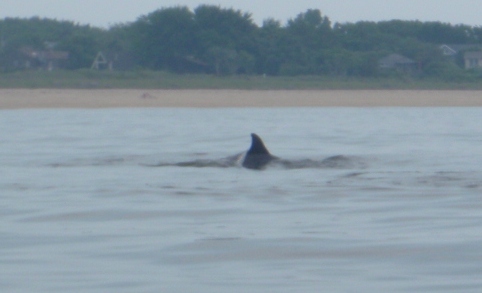
Just a few hours ago a pod of dolphins snorted just a few feet from our kayaks.

Nowhere in the preamble does Achieve.org speak of the wonders of this natural world, of the joys of discovery, of our human need to lift up stones to see what lives underneath.

If I do my job well, that is, if I teach a child science, she will scoff at the premises Achieve.org holds as sacrosanct. If I do it really well, she will scoff at any premises I hold sacrosanct.


Is there no joy in Mudville?
Photo by Leslie--looks like a shot of Nessie, true, but we were both too excited to take a straight shot.

Wednesday, April 13, 2011

On spreading myths

"The lenses o' his eyes, wi' so much divin' intae the water, get hardened, an' he loses his sight" said John Turner MacCrindle.
from The Gannet (Bryan Nelson), via Bookworm on the Net


I spent yesterday's gray afternoon with an old and a new friend, both Real Life Scientists®, wandering around Sandy Hook, climbing bunkers, skipping stones, and sharing stories. A couple of ospreys eyed us from their new nest. Once you get past the debris that floats over from the Staten Island landfills, the Hook is stunningly beautiful.

Offshore dozens of gannets were diving, their white wings reflecting light, seemingly fluorescent against the gray skies. Gannets crash into water headfirst when feeding, sending up plumes of spray.

I shared some local shore lore--gannets eventually go blind from diving, which, of course, kills them.

It makes for a great story. Turns out it's plain wrong.
***

Myths define us, more than most realize. Not so long ago, we survived by our senses, and by our wits. Oral language swirls as our perception of truth swirls. Stories got passed down through our clans, back when stars still mattered, when rivers were still filled with fish, forests with trees. We needed each other, but we needed the Earth's grace more.


Just a few thousand years ago, long after we became human, we developed the written word. Language, already powerful,  now had  the power of permanence. Oral language reflects truth, and waivers, imperceptibly, through generations.

We worship the written word, granting it powers far beyond the first vague firing of neurons that generated the thought that preceded (and transcends) the word.

I saw it in a book...I read it somewhere...it's published science...you can look it up.....

The strength of our belief in the written word has fueled beliefs in the the inerrancy of the Bible or of the Qur'an or, no doubt, of other religious texts. These beliefs are not universal, of course, even among followers, and at least one major religion (Judaism) cherishes oral tradition.


I am not a religious scholar, nor do I care to engage in a discussion of inerrancy or infallibility except to mention that huge swaths of modern culture will bend perceptions of the natural world to fit a fixed ideology, with often disastrous results.

Less extreme examples of word fixation may be harming us as much as the obvious religious ones. I let my gannet myth blind me to the more likely truth. I probably do this several times a day, without awareness.

***

Much, maybe most, of what I do is pierce through the misconceptions of our students--only after I kill this worship of "I know it as a fact" can I hope to teach children to think. If you cannot accept the possibility  of error, you cannot make rational choices. 

Public education is in the dogfight of its life, getting peppered with myth after myth, most blatantly (and certifiably) false stories accepted as truth.

So here are some words to ponder:

  • NCLB does not work--we have a decade of evidence showing such.
  • Poverty matters, above and beyond whatever happens in the classroom--we have decades of evidence showing such.
  • "Zip code is not destiny" makes for a catchy slogan, aimed at the mantra that poverty matters, but solves nothing--it's a contrived (and ugly) attempt to deflect the fact that poverty matters.
  • Our current republic faces a huge threat within our borders, and it's not some caricature of a bomb-wielding Bedouin, or Mother Earth LiberAL, or Willie Horton, or Che Guevara, or the Latin Kings, or yet another child snatcher hiding in your bushes--it's the deliberate shifting of monies and power from public spaces to the private, from the "bottom" 90% to the political (and, sadly, cultural) elite.
It hardly matters if anyone says it aloud, so few folks bother to wrestle with the incongruities between reality and words.

Matters to me--it's why I teach. I want to teach kids how to think. Who knows where that might lead?

 ***

Bryan Nelson himself, despite the myth, knows his gannets. In a letter to the The Observer he gently corrects Richard Dawkins: "I have concrete evidence from marked individuals that gannets can survive more than 30 years with perfect eyesight. The blindness myth probably arose because gannets and boobies have an opaque 'third eyelid' which they can draw across the eye to protect it from the impact of diving."

Where does our blindness come from? Who controls your opaque 'third eyelid'?


Hah! Four scientists mentioned in one post about myths.

I am not anti-religion, not by any stretch. I am anti-anti-thinking.

The 3rd picture is of one of yesterday's scientists, Joseph Mastroianni, 
taken by the other, Kristan Hutchinson,while in Antarctica--it's NSF, so I figure it's PD.

Friday, November 5, 2010

On balance


Theology alert--feel free to jump in....
This was inspired by Father Sean and Brother John and Reverend Scott.


Balance.

We need balance in our lives. Overwhelmed? Seek balance.

An innocuous philosophy--who could possibly be against balance?

A madman in the back wildy waves hand--and (again) I get sent out of the classroom.


***

The light is failing. Local carbon dioxide levels will rise until late May now, when resurrected plants start reconstructing the molecules back into something we can use again next winter. CO2 and H2O, carefully bonded back together into strawberries in June, peaches in July, corn in August, wheat in the September...little left now but the kale and the Brussels sprouts.


Breathe on your hand--you can feel the moisture, the breeze of molecules brushing your hand.

If God can be found, She will be found in the chloroplast, Her heart made of rubisco, the enzyme that puts us together, the most common protein in our known universe. She carefully holds a tiny molecule of carbon dioxide, three atoms of nothing, and glues them to life.
Heart of God?


She takes her life, her energy from the sun. Three times a second, another molecule of CO2 pressed together to a molecule of life, over and over and over again.


Rubisco is everywhere, in every green leaf, and as the leaves of summer fade into fall's glory, She leaves us. We start to drown in our own CO2, waiting for Her return, as She has, as She will. (That's called faith.)
***

You cannot balance a lifetime. You can dance, jump for joy, cringe in fear, curl up, scream, love or hate. There is no balance for love, for fear.

A well lived life is not one where you've balanced your fears with your joys, your love with your hate.

A "well lived" life makes no sense. You cannot "lived"--you can only live, now, this moment. Either the amygdala or the cortex rules a moment. We pretend we can string together moments, we hold on to memories, to words, to pictures, to myths of eternity, and we miss the obvious.

The here and now.

And we wonder why it's hard to teach children in a classroom....

***

A couple of soldier flies erupted from our class terrarium last week. Unexpected. Large critters crawled out of the thin litter layering the glass bottom. The yellow bar splashed on their legs with their waspish wings and fluttering antennae screamed danger. My cortex knows they're harmless, my amygdala makes my fingers stutter when I pick one up.

The last few days a half dozen more came from the same dirt.

When I opened the top to feed my sowbugs yesterday, two flew out and headed for the window. They only live a day or two as adults, and they had been trapped for hours in the terrarium. They flew fiercely, full of desire, and crashed right into the glass.

Instinct, true. Fixed action patterns with proximate and ultimate causes. Memorize this, children, pay $87, and earn your AP Biology credit.

We never speak of desire in other creatures. Of wants. Of needs.

The soldier fly carcasses will sit on the sill until my students return on Monday. I will ask them how they got there. Then I will ask why.

We all need what rubisco gets us--we all feel desire. It's why we burn our energy even though we know December's coming.
***

וייצר יהוה אלהים את האדם עפר מן האדמה ויפח באפיו נשמת חיים ויהי האדם לנפש חיה׃
And the LORD God formed man of the dust of the ground,
and breathed into his nostrils the breath of life;
and man became a living soul.

We think we're sophisticated and learned and (the worst conceit of the three) immortal. We gorge on the fruit of the Tree of Knowledge and forget that we are closer to the soldier flies than we are to rubisco.

I do not know who wrote the Hebrew Bible, and I do not know which of the 47 men chosen by King James translated Genesis 2:7, but there's been a huge misinterpretation of "soul" in the last few hundred years.


The soul, at least according to the Words allegedly governing the actions of the dangerously powerful here in the States, is not separate from the dirt. Our "stuff," the polymers of proteins, our layers of lipids, our DNA, our essence, is our soul.

We are mortal and finite. We are living souls, dependent on rubisco, dependent on unimaginable events in the heart of the sun, hydrogen to fusion, mass to light.

You want your children ready for the world of humans, raise them under artificial light. Keep them planted in front of monitors. Feed them impossibly perfect fruit. Keep them shod. Pump them full of music made by machines. Surround them with images of the "perfect" human, and demand they become one.

Don't talk to me about balance.

We are training our children to avoid the window pane, to stay safe, to gaze at the world outside, to create stronger panes. We don't want to see them hurt. We cannot imagine their last agonal breaths.

Me? I want my children to crash into the glass, and if they're bloodied lying on the sill, to get up and crash into it again. Again and again and again.

3 billion years of desire got us to here; a few hundred years of playing God has reduced us chasing photons on screens, practicing religion disconnected from the wiser elders who wrote texts we refuse to read, to believing we are in control.

I may be unhinged, but I am not as unbalanced as anyone who believes in balance.

The sun that sustains me has been dropping lower into the sky day by day, the plants that feed me have lost their leaves, the bees I adore have gone. I am a man of science, I have a good idea why this is so.

I am also a man of faith--faith that the sunlight will return, and that rubisco will return with it come spring.


Photos are mine and Leslie's.
The rubisco model is from Wikipedia, and is in the public domain.

Tuesday, November 2, 2010

DNA idolatry


We practice state religion in my classroom.

Here is the Central Dogma of Biology:

DNA --> RNA --> Protein

We worship a double helix mindlessly, memorizing details that mean nothing to its idolizers. I let an icon spin on the board, in marvelous colors, while I preach of its powers, its centrality to our lives.

We practice our chants: A with T, G with C.
We learn the sacred language of -ases and -ines,

If the children fail their DNA catechism in New Jersey, and cannot pass the state biology course, they must be re-educated.
***

Last week many, perhaps most, of my lambs were surprised to see seeds come out of a dead flower. Oh, I'm sure they've been told that a dozen times or so in their school careers, but .... We have become that disconnected from the world.

I'm bringing more flower heads in tomorrow. I've had enough modern religion in science class--time to teach that Olde Tyme Religion Biologie.


The image is from Annabeth Robinson here, used with permission.
She has some really neat stuff on her
e-portfolio.

Sunday, August 1, 2010

Lammas again

Yep, same as last year--I like the rhythm of the year.


The sunlight diminishes perceptibly now. The plants know.

The past week we've eaten deep purple eggplants and bright pink brandywine tomatoes, yellow summer squash and green-and-red striped beans. Today we will pick basil for pesto, some for tonight, some for February. A bowl full of ripe blueberries waits for us, sunlight incarnate.

But the sunlight is dying, and the plants know.

We do not speak of religion in class, at least not formally, though students will occasionally ask religious questions, and I will deflect them. I explain that some things cannot be known through science, and that what I believe beyond the limits of science falls outside the province of class.

In class we talk of light and hormones, photoperiods and abscisic acids, to explain how plants know. We talk under the hum of fluorescent lights, time marked by defined blocks of time. In class, September light is exactly the same as February light, and class is always 48 minutes long, no matter where the sun sits.

Sunset today marks the start of Lammas, or Loaf Mass Day--joy for the harvests that are coming and regret for waning sunlight. Lammas used to be celebrated--the first wheat berries of the year were ground into flour and baked into bread offered in thanks, some used for Communion, some for the feast that followed.

We thank God (or Tailtiu or Lugh or some other forgotten gods)--harvest time reflects death and grace, whatever the culture. Death and grace feel foreign in the classroom, indeed foreign in our culture. We pretend, at our peril, that life is linear.

Lammas falls halfway between the summer solstice and the autumnal equinox. The days are shortening, winter is coming. Until you feel the seasons in your bones, until you follow a grain of wheat from the ground to plant to bread to you then back to the ground again, the modern myths may be enough.

Science can explain why plants produce fruit when they do, and I can teach the steps. We can test whether a student learns what I present, and the students that do this best have access to all our culture offers.

You can become very powerful, very rich, without knowing grace. You can go far in life if blessed with intelligence and beauty, degrees and citations, without ever knowing what a wheat berry looks like, without ever kneading a lump of flour and water and yeast into glistening dough.

In the end, we don't know much, and may never know much. We can, however, recognize grace. We might not grasp it rationally, but we we can grasp it--a good reason to celebrate Lammas.


The Skeleton of Death dances every hour in Prague--photo of the Prague Astronomical Clock by Sandy Smith found on VirtualTourist.

Thursday, April 22, 2010

Holy water

O chestnut-tree, great-rooted blossomer,
Are you the leaf, the blossom or the bole?
O body swayed to music, O brightening glance,
How can we know the dancer from the dance?


W. B. Yeats
from
"Among School Children"


Earth Day. Again.

For a few generations, a small slice of humans on this planet got to pretend they rose above the wilderness, the wildness. We pretend we are immortal. We hide our dead and dying.

Wheat settled yesterday for $4.993/4 per bushel. A penny will get you 2000 individual wheat berries.

An acre in wheat will yield about 42 bushels, gross about $210 for the farmer. The farmer pays for fertilizer, for grain, and sometimes for water. The carbon dioxide and sunlight are free.

I grew wheat once on a 20 square foot plot. It yielded about a pint of wheat berries. Cost me nothing but a handful of grain.

It's Earth Day--go scatter some wheat.
***

We eat a lot of wheat. We chew bread, break down the complex sugars to smaller parts, tiny pieces of which finally enter our cells. In our cytoplasm, the bread is broken, and even smaller pieces wander over to mitochondria. Oxygen accepts the now spent electrons, electrons initially excited by sunlight on a Kansas plain, and we recreate the holy water that initially gave up the electrons on a sunlit wheat field.

Resurrection in a water drop. The water is broken on a farmer's field, resurrected in a cell deep within my body.

I can never claim to be a reborn Christian--that implies a singular event. I've been reborn enough times to qualify as an Hindu. I'll leave the Mysteries to the theologians, but I do like our Creation stories, even if they are internally inconsistent. Good stories focus on truths, not facts.

And in the Genesis I read, our soul is made of mud. Our soul is made of breath. We are living souls, acts of creation, and temporary acts at that. We are part of something larger.

Every breath in, oxygen. Every breath out, resurrection.

***

How do you teach this, this mystery of the mitochondria, of the wheat, of water that splits and combines, then splits again, using the sun's energy, so that we can go about singing and frowning and dancing and copulating and playing and growing and, yes, dying, one generation to the next?

How do we approach the mystery from the science end? How do we teach that we are just a tiny piece of consciousness in a long dance of life, and a longer dance of energy?

And if we should ever succeed in teaching this, how will we keep the children in the classroom on a lovely, lovely April afternoon?


The drawing was lifted from the Ecology Center in Ann Arbor--
there is an annual fundraiser there in my sister's name--go enjoy yourselves!


Ironically, my sister was killed by an errant self-identified Christian missionary.


Saturday, February 20, 2010

Eating in science class

Religion is about origins, stories about why we're here, great mythologies to explain greater mysteries.

I teach in a public school. While religion is not shunned as much as professional haters would love you to believe (it is perfectly legal for kids to pray in school), I do make a conscious effort not to tip my hand on matters of myth, even myths I happen to believe.

Still, when you dance with energy and life, you rub shoulders with the inexplicable.


If my lambs learn nothing else, they learn that food comes from the air (CO2) and water, molecules joined together by plants, using energy from the sun. We have a riotous collection of assorted (and often misidentified) plants sprouting all over the classroom.

I needed to thin my jungle of basil this week. As I plucked out a small seedling, the roots still holding on to bits of peat moss, I (again) reminded them where plant stuff comes from. The leaves I was about to eat were formed from carbon dioxide that was formed in the deepest recesses of their cells, inside mitochondria deep in their brains, in their muscles, in their bones.

The warm moist breath each student releases every few seconds carries this evidence of this primal act, food back to water and carbon dioxide, so we may live.

As I eat the leaf, I hear a stifled ewww.... My world briefly dissolves into riotous deliciousness that surprises me every time I eat basil. I hope my eyes do not look unfocused. Professionals do not exhibit ecstasy in the classroom.
***

There is nothing to eat,
seek it where you will,
but the body of the Lord.
The blessed plants
and the sea, yield it
to the imagination
intact. And by that force
it becomes real,
bitterly
to the poor animals
who suffer and die
that we may live.

William Carlos Williams, excerpted from The Host

I teach biology. And while I thrust nonsensical sounds and cycles at the children--NADPH and Calvin and ATP and Krebs--the miracle happens around them, as they breathe, as they eat.

They live in biology--they piss and eat and shit and breathe and some even fuck, all acts tied to life, and we reduce it to safe, nonsensical syllables, which will be tested by something as abstract as "the state" in May.

The simple act of eating a leaf in class becomes a memorable moment because it is tied back to life, to who or what we are.

It's a rare thing in class, going back to origins, and it is a dangerous area in a world where folks kill each other over which myth matters most. So I teach the religion of empiricism, of reductionism.

But even in a public high school science class, using a standardized curriculum polished to a safe sheen through decades of catering to political and religious influences, reductionism occasionally fails to hide what's true.

In moments of clarity for those who pay attention, the world can become incomprehensibly (and beautifully) connected even in a boring science class, taken because you have to, because the old folks around you said so.


The photo is from last summer, fruit from our gardens. A gazillion basil plants, and I can't find nary a picture.

Sunday, November 22, 2009

Bloomfield's sidewalk astronomers catch a galaxy

I advise the Bloomfield High School Astronomy Club--we are sidewalk warriors, fighting the glare of streetlights, security beacons, and gaudy church steeples. A few times each night flashing emergency lights roar past us a few feet away.

We live under 3 runway lengths from Newark Liberty International Airport. (To be fair, runway 4L/22R is about two miles long.) One of our games is called "catch the plane"--students attempt to get the plane in the telescope's field of view, not as easy as it sounds when you're just a few miles from the airport.

I get a handful of kids every clear Tuesday night, chasing Jupiter and the few stars we can see naked eye. Even with the light pollution, though, a peek through an 8" scope changes their view of their universe.

We finally caught the Andromeda Galaxy a few days ago, using an 8" telescope on a manual mount. We have a computerized mount somewhere, but I keep pretending I don't know how to use it. The budding astronomers are getting to know the sky the old-fashioned way, which is to say, they are getting to know the sky.
***

I've been covering cell energetics the past few weeks. How does life get its energy, its "stuff"? I have a time-line in the classroom, a meter for ever billion years.

(OK, the time-line stops at 4.5 billion years ago, just short of Earth's birthday, but I've swept along the imaginary portion of the time-line so many times I'd bet you'd get a dozen kids to testify times that we have a time-line that goes back 14 billion years or so. I really need to get another roll of paper.)


I start at the beginning. I call it our creation story, and it is a story. It has a name--Big Bang model. I'm careful not to call it a theory.

How do we know, Dr. D?
Well, we know this much. The visible galaxies around us keep going farther and farther away. Where will they be next week?
Farther.... (It's amazing to hear kids roll their eyes with their voices)
Where were they last week?
Well, doh, closer
Last year?
A thousand years ago?
A billion years ago?

And they get it, at least they get the impetus for the model. It's our creation story.

I speak carefully, but the words are the right ones--it is a creation story. It's a model. It's a good one, but by acknowledging that we cannot know as a fact (apparently the gold standard in sophomore debate) the origins of our universe keeps their own creation myths safe.

For most of my students, Genesis is the myth they believe in, but most of them could tell you as much about Genesis as they could the Big Bang model. I've taught both, but never in the same place. They're both useful stories. They're both human stories.

Neither explains why an apple tastes so good.
***

The Andromeda galaxy is the only object beyond our galaxy we can see naked eye.

First time I saw it without glass was a week before Hallowe'en, many years ago, right after we took our two youngsters on a haunted hay ride in the Jersey skylands. It hung out there even beyond the stars, a puff of fine mist hovering beyond my known universe.

You will not see Andromeda without a scope in Bloomfield.

When we did find it, we saw an oval smudge. I worried that the kids may feel let down, and started to pontificate about how long it took the light to go from that smudge to our eyes.

I should have stayed quiet--they thought it was cool. They kept going back to look at it.

Besides, turns out I couldn't remember exactly how far the galaxy is--I thought it was a bit over 3 million light years away, but the experts changed their minds and calculated it to be "only" 2.5 million light years away.

And that's the point.

My grandfather was in his late 20's before Edwin Hubble convinced other astronomers that these blobs of stars lay outside our own galaxy. That wasn't so long ago.

And it's hubris to think any of us can know the difference between 2.5 and 3.2 million light years.

***

Cosmology rests on light. Cosmologists study light in its various forms, but unlike biologists, have no need for their noses, for their skin. Cosmologists work with the intangible.

Our modern creation story has been written by a very few men with very big brains who trust their eyes more than their tongues. It is thus written.

The Big Bang model, like Genesis, is ultimately incomprehensible. It's important that my kids know this, at least about the cosmological models. I leave Genesis to their parents.

Once science becomes known "as a fact", once it becomes frozen in mythology, it becomes useless.

Even worse, it becomes boring.

Thursday, November 12, 2009

Amygdalin

Five years ago tonight, a self-described Christian missionary ran my sister off the road, and a few hours later she was dead.

A couple of months ago I finally tore up the letter in which he explained that God's will can be incomprehensible.

I get angry when people try to explain the incomprehensible.

So I am going to sit here and eat an apple that came from the same place she now rests, and will rest.

The apple's existence is inexplicable, as is that of the bee that fertilized it. The stuff of apples, an impossible blend of what we breathe out every few seconds, water and carbon dioxide joined by the energy of the sun, cannot be explained.

Don't try. Especially when I am eating one.

She was close enough to the orchard that it is possible still that some of the molecules of her last few breaths were captured by the same tree that bore this apple I am eating. Her last breath might rest in the amygdalin I taste when I chew on the seeds, a bitter sweet dance with traces of cyanide.

No, I don't understand why apples happen, nor do I think anyone else understands, either. So don't bother me when I sit there munching away on the core.

This whole business of living is, like apples, incomprehensible.

I know I like apples, though. And life. And Mary Beth did, too. No sense wasting time pondering what you cannot know.

That time's better spent enjoying the apple for what it is, whatever that "what" is. It won't be here forever. And neither will you.

Saturday, October 17, 2009

Teaching the controversy


Charles Darwin wrote On the Origin of Species by Means of Natural Selection almost 150 years ago. Most people who debate its merits have never read it, and here in the States, his work has been reduced to whether one "believes in" evolution, as though it falls in the same category as astrology, elves, and Santa Claus.


To understand Darwin's work, you need to understand his reluctance to acknowledge his own conclusions. Evolution per se was not the difficult part--heck, Darwin's grandfather Erasmus published that decades before Darwin's work, and it wasn't original then.

If you grasp why Darwin was so torn by his own words, then you get the controversy.

***

We make connections, even (or maybe especially) when we're children. The universe revolves each of us.

Rally caps, inside-out pajamas, horoscopes, and sidewalk cracks--all have power. We spend our time living in supernatural universes that do not yet (nor ever will) exist.


Starfish were designed to eat clams, alas....


We look at creatures, and of course they were designed--the dolphin has flippers to swim, the bee has a stinger to sting, humans have brains to think and thumbs to grasp tools. Every species alive today fits very neatly in its niche, as though designed just to do so.

Any child paying attention can reasonably conclude that organisms as complex as lightning bugs and robins and catfish were designed to be a part of the world, a specific part of the world.

That much is true. No matter what side you fall on, critters are obviously designed for their environments.

You can know this and not believe in the supernatural.

***

The crux of Darwin's theory, the crux of the controversy, is this--natural selection reasonably and completely explains the diversity of life here on Earth.

This upset Darwin. It upsets a lot of people. It's a big deal.

You cannot fully explain Darwin's importance if you do not understand what the fuss is all about. Most of my students enter their sophomore year believing that Darwin formulated the theory or evolution.

He did not.

He developed a reasonable explanation for the diversity of species through natural selection alone. Others had similar ideas, but his work was cogent, concise, and readable.

On the Origin of Species by Means of Natural Selection reads as though it was written by a man trying very hard to convince himself he was mistaken, but failed to break through the chains of rational thought. The man Darwin was trying to convince was himself.

The theory of evolution removes the need for any other explanation for the diversity of life here--supernatural or otherwise. It requires no further layers to explain how species form.

***

On the Origin of Species by Means of Natural Selection does not, however, preclude a Creator. It does not explain how life began, nor makes any attempt to do so.

One of the first people to read the book was the Reverend Charles Kingley, a writer and a Protestant priest, who sent a note to Darwin congratulating him on his treatise. In the letter the Rev. Kinsley noted:

I have gradually learnt to see that it is just as noble a conception of Deity, to believe that He created primal forms capable of self development into all forms needful pro tempore and pro loco, as to believe that He required a fresh act of intervention to supply the lacunas which He Himself had made. I question whether the former be not the loftier thought.

***

As for the "controversy," the attempt by a few folks with a perverse interpretation of the Gospels to create a scientific curriculum that includes Intelligent Design, well, I present the thrust of their argument--that organisms clearly designed for their environment require some sort of intelligence behind the design--without presenting their motives.

It's the way my sophomores think anyway--they're still children. Heck, it's how we all think.

The whole point of Darwin's work is that it demolishes the need for a designer. The Intelligent Design hypothesis is not a scientific alternative to the theory of evolution--it is that very idea that Darwin destroys in his book.

Calling Intelligent Design a scientific alternative to evolution is like recognizing the Flat Earth Society as a reasonable alternative to a round Earth.

I wish Darwin was wrong. I wish Santa Claus still brought me presents. I wish people would start thinking.

And I still wish upon stars....just not in science class.


*Even more important, you can know this, believe in the supernatural, and still accept,
indeed embrace, the theory of evolution, without any appeal to the supernatural.


Oh, my thoughts on a Creator? On cosmological origins? On energy? On mass? All great mysteries.
Let the mystery be--once you try to explain a mystery to me, you're no longer dealing with a mystery but a myth.