Showing posts with label Galway Kinnell. Show all posts

Thursday, September 1, 2011

In Irene's aftermath

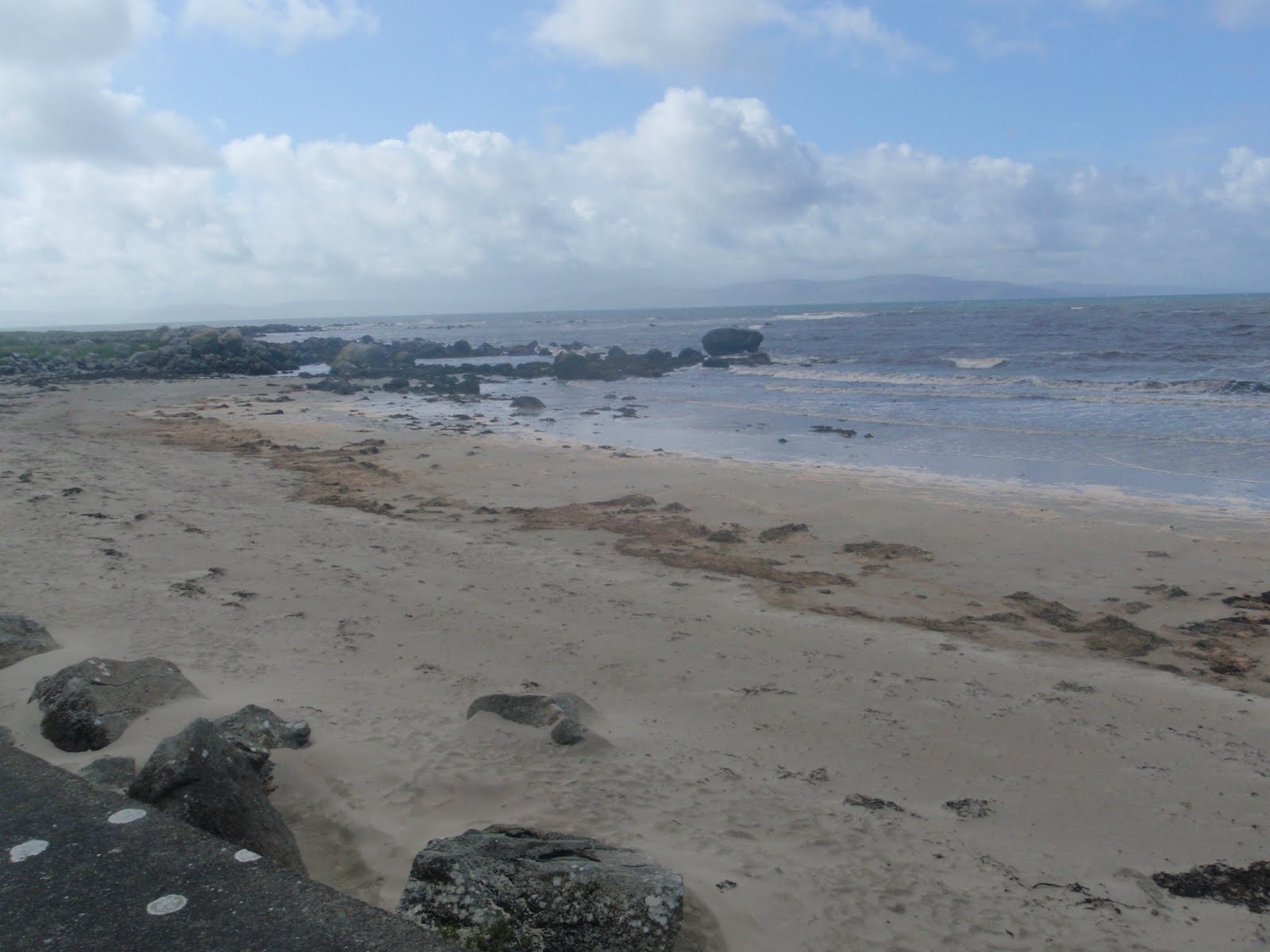
The sandpiper did the unthinkable--it strolled. Then stopped. Then sat at the edge of the ocean. I was sitting a yard or so behind it. It did not matter. This bird is done.

Hurricanes are exhausting.

***

We're more intricately tied to nature than we care to admit. We do a pretty good job denying death and denying age, our little pleasure machines adept at creating the illusion of a perpetually orderly universe.

I write out a word--say "maple"--and the branch I swung from as a child still feels as lithe in my hands, though that branch turned brittle and broke decades ago, its essence long turned back to carbon dioxide and water, gone long before the most recent hurricane, but still vivid in a word.

I do not know how much fear a sandpiper feels sitting exhausted by the edge of the Atlantic, a sandpiper that may only exist now as a word--"sandpiper"--forever etched in my brain, "forever" itself a human conceit. It's carcass now lies just below the tide line, nibbled on by crabs and snails.

When we teach science, we must be wary of our worship of our words, our models, our abstract representations which become more real than the ground under our feet.

The point of science is just that--to look at the ground beneath our feet, for whatever it is, as it is, or as best we can tell what that is is.

If our feet leave the ground, and we chase our conceits instead of the dirt, we lose a chance at something bigger. Scientists know this. So do good poets, of course. Neither get a fair hearing in schools.

We spend so much time deflecting what's true we lose our grip on what matters.

There are a lot of ways to get there--John Steinbeck was a better observer than I'll ever be. The point of biology is not to learn vocabulary any more than the point of reading Steinbeck is to learn sentence structure. The point is to get to what matters.

You might see it in the fading light of a late August sunset a day after a hurricane watching a sand piper rest its weary body on the wet sand. You might hear it in the dying voice of Johnny Cash singing "Hurt." You might smell it in the decay of an early September breeze.


You'll know when you get there.


Your students will, too.


Tuesday, April 5, 2011

Tomato seedlings

That a tiny tomato seed grows at all still amazes me, in a cerebral, Robert Frost kind of way.


The first time I brush against the new leaves, though, the earthy aroma swirling around my limbic system, Frost will no longer do.

William Blake gets close, Galway Kinnell closer still, but the words only get in the way, and what I know, or think I know, float like motes in a ray of sun, perceptible, for the moment, before sliding into the darkness that defines the edge of the light.


Tomato, just recently sprouted, sitting in the basement....

Saturday, December 4, 2010

Dying light


I tossed some metal into the Atlantic surf for about an hour today. The sun has settled low in the south. Gashes of December light broke through the wintry gray clouds. Even the midday shadows are long now.

The chilly brine bathed my feet as I cast. It may be time for boots.


The sun sets at 4:29 PM today, as early as it will for the year. The shortest day arrives in a couple of weeks.

I pulled the last tomato off the vine today, tinged pink on dull green. It froze last night, and had the consistency of pumpkin pulp. I spit most of it out, and tossed the rest back in the garden.

We're down to kale and Brussels sprouts now, then we are done.

***

I pray the sun comes back.

But just in case it doesn't, the prayer is one of thanks, for what was.
I am seeing Galway Kinnell again in just a few days.

Last time I saw him, he was the age I am now. He wrote of love, and loss, and timelessness.
Now he is three decades older, as I am, and he still writes of love, and loss, and timelessness.

He reminds those of us getting through life that there is no "through." Talking to his young daughter Maud, he talks to all of us:

learn,
as you stand
at this end of the bridge which arcs,
from love, you think, into enduring love,
learn to reach deeper
into the sorrows
to come – to touch
the almost imaginary bones
under the face, to hear under the laughter
the wind crying across the black stones. Kiss
the mouth
which tells you, here,
here is the world
. This mouth. This laughter. These temple bones.

The still undanced cadence of vanishing.
If I keep thinking of cycles and orbits and tides and the spin of electrons in invisible particles, if I keep chanting about redox equations and hydrolysis and the Gibbs free energy in the classroom, I miss what is herenow.

I tried to capture a December rose in the fading light with a camera, to share. But I can no more share this than share time itself.

Galway reminds me of this every time I read or hear his words.

He knows, he knows, and yet he writes of what we cannot believe.

We all make the same mistake, we all "commit...the error of thinking, one day all this will only be a memory."

***

Leslie worries that I might someday wander around barefoot too long on the beach, in the snow. She's right to worry, of course. I can get distracted outdoors long enough for incipient ice crystals to tear open my cells with their intricate patterns.

I don't need to worry yet. The water temperature is still in the high 40's--my feet feel warm when washed by the sea when the air is as chilly as it is today.

Back inside, I worry about what might have been. When I am outside, there is no "what might have been." Just sound and light and smell and touch.

I'm not sure ""Little Sleep's-Head Sprouting Hair In The Moonlight" would have made much sense to me the last time I saw Galway Kinnell read, decades ago, shortly before I held my own child in my arms, before the filament of life passed from me and Leslie to two lovely people who, should our prayers be answered, breathe long after we're dead.

It makes sense now.


The lines by Galway Kinnell come from "Little Sleep's-Head Sprouting Hair In The Moonlight," from The Book of Nightmares.

Saturday, July 17, 2010

Death and the web


Promissory Note
If I die before you
which is all but certain
then in the moment
before you will see mebecome someone dead
in a transformation
as quick as a shooting star’s
I will cross over into you
and ask you to carry
not only your own memories
but mine too until you
too lie down and erase usboth together into oblivion.
Galway Kinnell
Strong Is Your Hold

***

Cross-striped cabbageworms have devoured my Brussels sprouts, leaving shredded green skeletons in my garden. (Sister Barbara Mary awakes in the deep recesses of my memory--the stripped plants look like a mad painter's vision of Calvary Hill.)

We all kill unconsciously...all of us. I do not like to kill consciously, but I will when necessary. I pick off the worms and squish them, one by one. I squish the head first--I've no reason to prolong their pain. If the Brussels sprouts get to the point where's there's no longer any point, I will stop killing the worms.

I almost slaughtered a croaker yesterday, a frumpy but delicious fish found off our jetties here. Croakers "croak"--think Lauren Bacall at two octaves lower. (Well, OK, they sound nothing like Lauren Bacall, but no harm thinking about her anyway....)

My frumpy delicious fish kept croaking while I as unhooking it. The soft side of my brain tossed the chatty fish back in the drink.

Throwing away food is not a good survival strategy for any mammal. Throwing it away because a critter "chattered" at me is plain stupid. Still, it speaks to the power of language in humans. Our view of the universe can get trapped in words.

***


Our online lives, for most of us, are words and a few photos we slap up there. We share references and whittle away time, giggling at absurdities while blind to the obvious one:

We do not exist on the web.

It is not a public "space." It is not a town hall or a mall or a park.
It is a linked network of users and databases.

In life, people screw up. Big time. And if Carl happened to barf at a neighborhood block party because maybe he drank too much because his dog just died two days ago, well, it's messy and embarrassing, but it's not permanent. We know Carl. We know his history. It won't be mentioned again.

We forgive Carl's transgressions.

I made up Carl, of course, because once I mention Carl's behavior here, it becomes a permanent stain. There is no forgiving silence on the internet. Forgiveness is impossible because forgiveness is a human trait, part of the same soft-sided brain that released a croaker yesterday, or that pinches worms head-first.

In life, people die. Their daily words die with them. Their misdeeds are forgotten at the wake (unless they were truly dirty rotten scoundrels, and very few of us are).

You cannot be forgiven on the web because:

We do not exist on the web.

Databases cannot forgive. Networks cannot forgive. We are neither.

***

Each of us is mortal.
Each of us will die within a lifetime.
Each of us needs forgiveness.
Each of us exists on grace.

To survive death, to become part of the great life-sustaining detritus I walk on each day, that supports the Brussels sprouts and tomatoes and kale and beans thriving in my garden, I need impermanence.

Only through impermanence can I return to what I was, and am.


Poem by Galway Kinnell used without permission, though I will seek it.

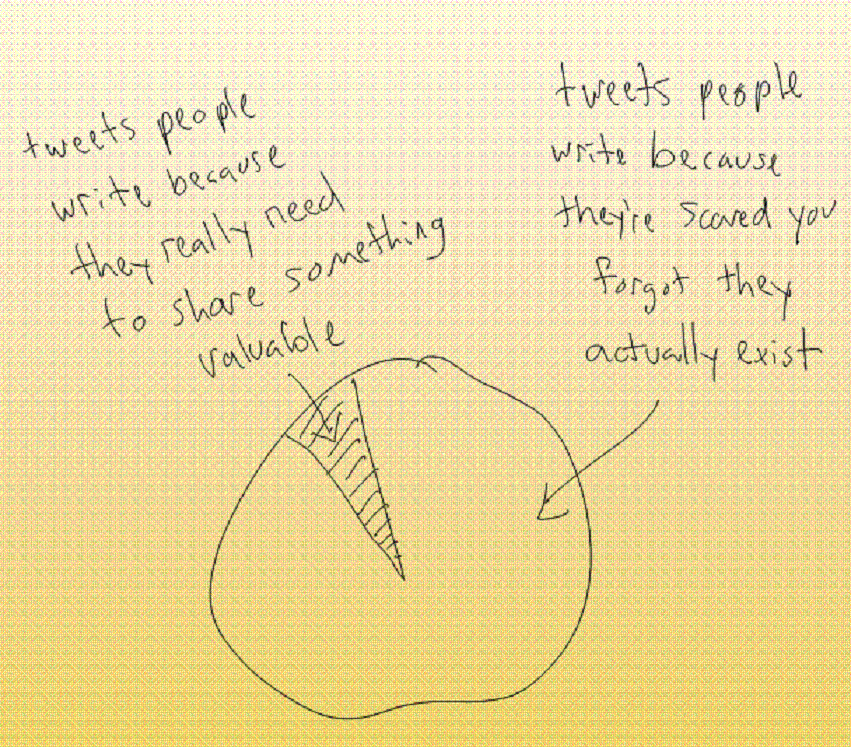
The cartoon is by @tremendousnews on Twitter, no idea who s/he is--found here....
via a tweet by @Larryferlazzo, who also pointed out Herbert's column this morning: "Tweet Less, Kiss More".

Tuesday, June 1, 2010

June


I want to crawl face down in the fields
and graze on the wild strawberries, my clothes
stained pink, even for seven years
if I must, if they exist. I want to lie out
on my back under the thousand stars and think
my way up among them, through them,
and a little distance past them, and attain
a moment of absolute ignorance,
if I can, if human mentality lets us.

Galway Kinnell, from The Seekonk Woods


I have never regretted any moment outside. As in under the sky.
Not one single moment.

I've been cozy, chilled, hot, wet, dry, stung, caressed by the breeze, and almost drowned in the sea. I've feasted on wild berries, feared wild beasts. I've watched ants for hours, and the moon forever.

I've seen life take life, and I've taken lives. I've heard the last yelps. I've eaten critters that squirmed in my hands. I watched a lightning bug flicker in desperation as a spider wrapped her silk around and around and around.

Tonight the honeysuckle blossoms steal words from my cortex, and I welcome the thieves.

June lasts forever when it comes, and is impossible to remember when it's gone. No words are needed in June. None. Life is as abundant as the light. I cannot help myself--I worship the sun now, so tangible on my skin, so obviously the giver, as it settles in the north for a spell.

Tonight somewhere in my town a child is doing homework on an early June dusk. Probably safer that way. Can't have children shirk responsibilities. Keep them indoors. They must stay focused!

Say you're a biology teacher, and, say, you know a lot more biology lies outside the textbook than in it. You're older now, with many more Junes past than any yet to be (graciously) received. What does a 15 year old child need to know? What do any of us need to know?

Ambition is well-rewarded in our culture. Delayed gratification is a virtue. If you want to be rich or powerful, chances are pretty good you won't die in the same town that welcomed your birth.

There's also a good chance you won't know where the local wild mulberries lie ripe for the picking, or where clams can be raked.

In June, my motives are clear--teach the children to see the world under their noses. The world offers riches beyond a wealthy family's dreams, but you need to go outside.

Kids know this until we teach them to forget. Most classes fit well in a classroom--a good biology class tends to ooze outwards.


Saturday, May 22, 2010

Our horseshoe crab trip


What did you imagine lies in wait anyway
at the end of a world whose sub-substance
is glaim, gleet, birdlime, slime, mucus, muck?


from Why regret?
Galway Kinnell

Yesterday we took over 160 high school students to Sandy Hook to see horseshoe crabs.
A few had never seen the ocean before.
A few dared let a fiddler crab tickle their palms.
A few touched a live striped bass, a yard long and just pulled from the ocean.
A few saw an osprey glide of the bay.
A few held comb jellies in a sea water puddle in their cupped hands.
One lost his flip flop to the muck.

I have no idea how much "biology" my lambs learn in the classroom. I suppose they learn as much as anyone else required to sit for the New Jersey EOC Biology Exam, and after 10 years of mandatory schooling, they're pretty good at taking tests about things they do not get (as no one does) to please folks they never met (as we all do).

I have no idea how to test what a child learns as his foot gets caught in the muck, a gray cloud now hiding his footprint, the sweet smell of life and death mingling in mud.

I do know this. The children were as alive as I have ever seen them. I suspect that many of them will carry vivid moments tucked between their amygdalas and their cortical gyri.

We are trained to keep the mulch and the muck hidden from the children, the classroom is safer (and much easier) that way. It was fun to teach real biology life for a day.


I bet even Arne might get it if he spent some time mucking around....

Yep, same photo--I love it. Look at the twists and turns, decisions made
by a chilled tiny horseshoe crab on a late February morning.

Sunday, December 28, 2008

Oysters and knowledge


Go ahead, look it up.

What is the lifespan of Crassostrea viginica, the local oyster?
What is its maximum size?

The experts will tell you it gets to 20 years old, and about 8" long.

I found the shell of one today that just misses 9 inches. Its shell tells a story about 40 years old.

"Awareness of ignorance is as devout
as knowledge of knowledge. Or more so. "
Galway Kinnell via Sean Nash.

We don't know nothing.


Photo from NOAA

Saturday, December 13, 2008

Synesthesia


I started reading a book this morning, a good one.

This particular book was printed in 1903, sat in our high school library for about 30 years before checked out in May, 1934, then sat on the shelves unmolested another 45 years. "L. DeMatteo" checked it out in December, 1979--read under the same dull December light that glows now.

I fetched it out of the library discard pile two years ago, then forgot about it.

It's alive again.
***

Spoken words define humans. We tell stories, create our universes, through evanescent sounds repeated again and again, never quite the same way twice.

To hear our stories, we needed to sit close. I saw your face, you saw mine. I touched pieces of you inside my nose, and you felt pieces of me. Voices rise and fall as did the light from the sun, then the fire. The dynamics of our voices mattered--adagio complemented allegro, pianissimo then forte and back again.

Our limbic system, the seat of emotion and memory, worked hard--a good storyteller reminds us we are more than our cerebral cortex.
***

Written words are dangerous. They are static. They take on power far beyond the fleeting thoughts of the one who writes them down.

They are so powerful that people get paid well to tell the rest of us what a string of written words mean. Lawyers, judges, and professors earn power and prestige debating the meaning of words held fast in stone, on paper, words written yesterday, words written millennia ago.

If you cannot read you cannot participate fully in western culture. This often gets misinterpreted as meaning you are less than fully human. Reading opens doors, true, but it also closes them.

We sometimes forget this in the science classroom.

When you are reading, truly involved in a book, the only sense that's being used is your vision. Reading is a wonderful thing, of course, but we forget its limits. Words represent meaning, meaning ultimately attached to something beyond the photons bouncing of a page.

I can unleash your memories of eating an orange, but only if you've ever eaten an orange.

A lot of kids in school are reading about oranges without ever having tasted one. This is fine if a child really needs to know about them, and if there's no better way to do this.

Best way to teach a child about an orange is to give each child an orange. The only way to know the taste of an orange is to eat one. Too often we confuse "knowing about" something with "knowing." Forgetting the difference contributes to what Clay Burell school calls "schooliness."

The kids use a different phrase for the same thing: school sucks.
***

There is too much sentiment in our passion for nature. We make colored plates and poems to her. All honor to the poets ! especially to those who look carefully and see deeply, like Wordsworth and Emerson and Whitman. But what the common run of us needs, when we go a-wooing nature, is not more poetry, but a scientific course in biology...the fearful and the wonderful have a meaning and a beauty which we ought to realize.

Dallas Lore Sharp, A Watcher in the Woods


We do not need more written words in science class, we do not need more text books, we do not need more photographs. All are too static.

We need more sounds of children gasping as a hydra grabs a tiny piece of fish food while they watch under a microscope, then realizing the universe is far larger than the words in a classroom.

Until the students realize that words merely reflect something much larger than ourselves, science class will remain terminally interminable as students stare at the clock instead of the nifty Powerpoint slide you diligently crafted last night.
***

In December I trust words far more than I do in June, one more reason to hibernate. Dying light scares me, so I hide in the world our culture creates. It is not healthy.

Much of what we do in the classroom is unhealthy.

We know this and do it anyway.
***

I may invite Galway Kinnell's words into my classroom this week. I'd invite him, but I'm guessing he's busy this week.

If he should happen to wander into my class, I would ask him how much he trusts written words.

I'm guessing he'd raise those magnificent eybrows of his and say "not much."

In a brief bio of him on Poets.org
Kinnell felt what he called in one interview "a certain scorn that there could be a course in writing poetry."
Here's a piece from one of his poems, "Under the Williamsburg Bridge," that says more successfully in 33 words what I babbled on above:


Tomorrow,
There on the Bridge,
Up in some riveted cranny in the sky,
It is true, the great and wondrous sun will be shining
On an old spider wrapping a fly in spittle-strings.


It is true.