Showing posts with label clamming. Show all posts

Sunday, April 23, 2017

High tech clamming, or why it's OK to reject the latest edugadgets


I went clamming yesterday, a dreary mid-April day, wearing shorts and sandals, while bundled up above the waist in multiple layers, anchored by an Irish sweater knit on the Aran Islands, made for weather like this.

I used a simple clam rake that has worked well for years, designed to scritch the bay's muck, allowing me to get enough clams to feed a few folks for a day or two.

A bit after I started, soon after the tide had turned, another clammer showed up in a full neoprene wetsuit, sporting a commercial bull rake.
"How many you'd get," amiably asked.
"Enough."

He wasn't satisfied with that, and ambled over to my bucket to see. He let me know he got five in the short time he was there. His bull rake did work faster. It requires a bit more strength, and does a bit more damage. If "enough" is your goal, the bull will get you there faster, but since my goal is clamming, something I love to do, I have no need to save time.
"Aren't you cold?"
"No--a bit warmer than February."
He looked at me askew, looked down at his full neoprene wetsuit, then looked back at me and unzipped the top. "Come to think of it, I'm a bit too warm."

Now there have been days when I would have envied his fancy clamming clothes, but today was not one of them. My old wool sweater was made for days like this.

I wished him luck, put back the smallest and the largest clams I had  back into the mud at the edge of the bay (a practice I started years ago--that way I know there will always be clams), and walked away.

***
"i" in iPad does not stand for "infant."
Image by Steve Paine via Flickr

Before I adopt any new technology (and clam rakes and neoprene both count), I want to know if adopting it will, in any way, reduce increase overall happiness or well-being, for me, and perhaps even more importantly, everybody else.

Not my efficiency.
Not my net worth.
Not my students' test scores.
Not my attractiveness.
Not my credit score.

Not anything beyond a very basic question first:
Will this tool improve joy?

The question is a difficult one for many of us, not so much because our limited imaginations do not foresee the consequences to both us and others down the line, though that is an issue--rather, too many of us no longer allow ourselves to live for joy.

Or even know what joy means anymore.


If you know what you want, you're a lot more likely to find it.

Saturday, November 5, 2016

Clamming in November

Written 8 year ago on a blog long abandoned.


I got a hankering for clams, and paddled over to Richardson Sound to one of my favorite place in the universe.

Slate gray sky above, slate gray water below. The water's still warm enough to wade in, and the tide was creeping in over the clam bed.

I was mostly alone, at least by human standards. A couple of turtles watched me paddle, and a couple of loons called to others, warning of my approach.


I am (finally) getting competent with the clam rake. My hands can now "feel" the texture of the mud as I comb the bottom. I still dredge up a stone now and then, but the ones that fool me now at least are shaped like clams.
***

I scratched up enough clams for dinner, and a few more for my Auntie Beth, then paddled home. It was a gorgeous morning.

Clamming lets you see things you forget you care about. Clams are in no hurry to escape; the only urgency is the rising tide.

You can watch the tides rise and fall. Literally, if you take the time. I take the time.


 I clam at the edge of water. The edge rises perceptibly as I work.

The edge's personality changes over the couple of hours I rake.  It creeps up stealthily, smoothly, for a few minutes, then takes tiny staccato steps for a few more. It pauses. It retreats for an instant, then surges a bit more.

 The edge does not define the tide. Its jerky journey up towards the debris left by the last high tide reminds me what we cannot know.


Tonight we are eating red hake for dinner. My son and I caught a few yesterday on the ferry jetty. Slaughtering fish is not easy for us, nor should it be.

We can try to minimize slaughter by calling fish "lesser" animals.
We can pretend no pain is involved.
I did not raise my son to pretend.

 Before we took the fish home, we made sure we had enough for dinner. If not, we release them.

 Life is messy. We take great care in school where I teach to put things in boxes and categories, to feed into the great mythology we have created, a mythology that now precludes children from knowing where their food originates. We keep biology clean.


 We're part of a huge morass of energetic goo that replicates and plays and consumes and replicates and plays and consumes some more. Life involves fluids and combustion and not just a little bit of mystery.

Saturday, September 13, 2014

Buckets with holes

Buckets come as they are, and they do one thing--they hold things. Everything, actually.

In these parts they're generally made of plastic, the residual order of plants that took in the sunshine unfathomably long ago. (Oh, I could give you a number with a lot of zeroes, but let's be honest, none of us beyond the Feynmans and the Einsteins know how big a few hundred million truly is.)


Most of the buckets in my home were likely made in China, because it's cheaper to make them there than here, even with the cost of shipping. I used to work on the docks. I've been in the hold of very big ships. If the ship is big enough, it can carry enough buckets to make shipping costs almost negligible.

But someone making a bucket in China, a long, long away, cannot possibly know why I need this particular bucket today.

But I do. So I modify it.
***

I bottled a bucket's worth of mead today. Eric, who loves my daughter Kerry, keeps a couple of hives in Montclair. He gave me a gallon of honey from his hive. A gallon of honey weighs about 12 pounds,  a gallon of water about 8 pounds. There's a lot of stuff in honey that's not water.


Each pound of honey took over 50,000 miles of bee flight, so my melomel took the better part of a million miles of flight to make. Millions of yeast critters took the honey and converted it into mead--those surviving now sit in my compost pile in the backyard. I said a prayer for them, or maybe I said it for me, but I prayed anyway, because something good happened to me that I did not deserve.

My mead bucket has a 3/4" hole drilled near the bottom, so I can put in a plastic spigot (also made in China) that lets me drain the fermented mead in a controlled fashion.
***

I clam. Every couple of weeks I get enough meat from the mudflats around here to feed Leslie and me for a few days. I pray for the clams, too, as I drop them into scalding water. I have no idea what they  feel, but I know what I do, and praying helps.

My clam bucket has about a hundred tiny holes drilled in the bottom. I used an electric drill.

Beesleys Point Generating Station and Leslie

The power to drill the holes came from Beesley's Point Generating Station a few miles north of here. It burns coal (made from old plants, but not as old as those that made the plastic for my bucket). It also uses old tires, made from rubber plants likely alive in my lifetime.

And yes, I think of these things as I muddle through my day.
I pray a lot.
***

I teach biology. Our desires change all the time, but our needs are the same as they have been for millenia.

Our needs come down to the stuff of plants, of yeast, of love. Most of what we need I'll never understand, but I teach a very human process that gets us closer to understanding the infinite every day.

But, of course, the infinite can never be understood.


So I pray....


Tuesday, August 5, 2014

Clamming, teaching, and flow

Got a mess of clams from the flats today while feeding a few green head flies. Seems a reasonable trade-off.


I've been borrowing my nephew's clam rake--mine needs a quick fillet weld to tighten a pair of rogue tines--and I've been fighting the new rake. It's blades are both sharper and thinner, but the handle much less sturdy. The rake weighs about half what my rake weighs.

I keep worrying that the handle will snap as I drag the tines through the muck, yet I still pushed down on the handle until near its breaking point.


After paddling out to the flat this morning and getting just a few clams after a lot of work, my back tightened. Not good any time, even less good when you're out alone.I figured I may as well get whatever clams I could anyway, and worry about the trip back once I loaded my bucket, but I had to change the way I worked.

Instead of fighting the rake, I let the rake glide over the flat, not because of some newfound wisdom, but because of  cranky erector spinae muscles. *clink*! A clam.

*clink* another and
*clink* another and
*clink* *clink* *clink*

Teaching is a lot like clamming (or skating or writing or anything that needs flow)--when you try too hard to dig for what matters, you're going to get weary in a hurry with just a few morsels of reward.


I forget this regularly.


Saturday, January 5, 2013

Clams, grace, and industrialism


Low tide came early today. The water temperature is down to 40 degrees--the clams are, well, clammed up now, waiting like the rest of us for this winter nonsense to pass.

Clams eat, they grow. I like to eat them, but I also like the idea of them. I like the way they fit in my palm, I like being on the flats where they live. I like the way my rake resonates against one. I reach into the chill and scoop it up.

Never heard one say "Drat!"
***

Clamming by hand has a cost. I stir up the bottom with my rake, enough that fish will snoop in the area I just disturbed.

I occasionally impale critters not meant for the dinner table--I managed to spear two young horseshoe crabs on a bad afternoon clamming (though a worse day for them).


But I at least knew for a moment the creatures I wounded. Knowing didn't make the agony of the broken horseshoe crabs any less painful, though they at least got a prayer as they sank to their deaths.

We got ourselves tossed out of the Garden a few thousand years ago--clamming is about as close to the Garden as I'm going to get.

I do nothing to deserve the clams, they just are.
I barely need to work to get them, they're abundant at my feet.

I'm just close enough to wilderness to wonder what we lost when we decided to stay home and plant wheat 10,000 years ago.

I work over an area a bit over 500 square yards, and figure about 5000 clams live there. I'll take about 10% of them this year, and next year 5000 clams will still be there, barring any ecological disaster.

Undeserved love, but given anyway. Can't think of a better definition of grace than that.
***

Rare clammers still make a living raking by hand. They know the critters like a child knows the sun.

Most clammers today dredge. Water is shot over the clam bed, creating a cloud of slurry, and the dislodged clams are dredged up to daylight.

The clammers will tell you they are oxygenating the water, feeding the fish, and at any rate, are not doing any permanent harm. Still, in a day when a clammer may take over 10 bushels (an old word), he's not going to know one from the other.


The environmentalists will tell you that the bottom of the seas are being scarred, and maybe they're right.

I compromise--I damage the bottom, true, but I wrestle every clam I eat with my rake, with my fingers. I never wear gloves, which may be more a testament to my stupidity than anything else, and I've spilled a bit of blood back into the bay.

But it seems more right that way, as I nestle my fingers under another snug clam from the bay to my basket.
***

I know every clam I eat. I know where it lived. They don't travel horizontally much, maybe a foot or two in a couple of years.


If ever I get sick from a clam, I can tell the DEP where it came from, withing a few dozen yards. But I won't ever get sick from a clam I know, usually in my gullet before the next low tide.

Beyond the careless destruction of habitat, the sin of the industrial clammer is not knowing the critters he sells. Since most of us are industrial eaters, not knowing where our critters came from, I can hardly blame the clammer. He's just making a living.

I can hardly blame the engineer who designs the hydraulic dredger, nor the driller at Exxon who mines oil for his boat, nor the construction woman who paved the ramp where the clammer launched his boat this morning.

No need to blame anyone or everyone, we are all complicit since we left the Garden. Grace does not dictate the market values, and we all have at least one person to feed, to shelter, to clothe.
***

You're not going to find grace at Whole Foods--you'll find fancy foods at high prices, and a few of the slaughtered beings there may have lived a slightly fancier life than their brethren at Perdue. But you still do not know them.

You pay for the privilege of a fancier form of industry, but you had to earn your dollars somehow. For most of us, earning cash requires participating in an industry.

To know grace you need to see the life drain from the creature you are eating.


Make a resolution to eat something you slaughtered, or at least grew. Religion has fallen out of favor, and our industrial cocoons shield us from grace.

Grace is never easy, nor cheap.
But it is possible.


Yes, the annual beginning of the year clams and grace post.
All photos by us, CC and all that.

Thursday, December 27, 2012

Abstract vs. literal vs. real

Reading about 30 knot gusts registered by a weather station just a mile away is abstract. Federal funds maintain my local station, and I read it religiously.

CMAN4, at the Cape May ferry dock (photo by NOAA)

Thinking about the wind and clams and life as I drag my rake through the mud is literal.
The real happens when the words fade away, when  "I" (never real) dissolve in the salty mist of the strong breeze coming off the flats.

What is real is as unknowable as the shiver of life felt when a rake's tine carves a line in a quahog. I find the line later, as I wash the mud off the clams under running water, like blood from a deep cut, reminded (again) of the violence even in clamming.

 
The strike of tine against clam is real.
The clam knows something at that moment, as I know something, but words serve neither of us as I curl three fingers under its perfect shape, a tinge (literal) that my imperfect state (abstract) requires eating (literal, again).

We take mammals made for running under the sun and the stars, made for climbing and dancing and singing and playing, and (literally) make them human (abstract) at the cost of the real. Show me a child who loves schooling, and I'll show you another lamb who has lost her way.

1921 classroom, by Lewis Wickes Hine, via Shorpy
 
Clamming reconnects me to what is real. So does gardening. And stargazing.
You have your ways, too. We all do, or did, anyway, before we let the abstract get in the way.


All the words and pictures I seek, the ones I share, are useless if just reading and looking are the goals. The goals remain wordless but not unknowable.

But sometimes all we can do is point and hope.


And try to assess that on a standardized test, Mr. Coleman.

Friday, April 6, 2012

Clamming on Good Friday

It's Good Friday, which matters for a few of us, some for good reasons, some for less. I usually spend a few hours in the garden, but today I elected to spend them on a mudflat.

This is what's left after we're done.

At about the same time the Christ would have uttered "My God, my God, why have you forsaken me?" I raked up a clam that had obviously been broken 2 or 3 years ago, possibly by my rake, likely by someone else's. It does not matter.
The shell had healed along its breakpoint, which extended from the lip all the way back. 

Two things popped up in my mind.
Miracle. Mind you, it's Good Friday.

What does this tell me about the immune system of a quahog that it can survive a rupture of its shell? Mind you, I'm a science teacher.
The two are not incompatible.

I did not have a camera. I put it back into the mudflat. It survived some traumatic event a few years ago, and it survived my rake today. That won't always be true.

But it's true today, on a spectacular spring day whose abundance of light reminds me of what I will lose someday, but not today.


We are here now, and that's enough, for now.


OK, I'll resume the regularly scheduled programming in a day or two. Not every day I stumble on a miracle.
And yes, I am aware that I am hyperacutely looking for miracles today. That's the point, no? 
Our reference changes moment to moment, at least mine does....


Sunday, February 12, 2012

Quahogs, Darwin, and grace

Today is Darwin Day, honoring a complex man with a stunningly simple idea that replaced the need for magical thinking.

Folks may hold on to their magic, I know I do, but they can no longer use rational thinking to hold on to the idea that the Hand of God was necessary to craft our appearance here.

The theory of evolution cannot disprove God—no science can. That was never Darwin’s intent.

See, if you grasp science, you grasp that it is not designed to disprove anything outside the realm of the natural world.

It’s not science using theology that causes all the trouble. It’s theology insisting that its stories are scientifically sound. 

I like hot sauce and I like  fruit, but I don't splash Tabasco on my blueberries.
I like fables, and I like science. I try not to confound the two.
 ***


Yesterday the soft gray wintry sky spit on the flint gray water. The air was chilly, but the water was still mid-40's, balmy for February.

Clamming in February, somewhere in Cape May County

I pulled just over a dozen quahogs out of the mix of muck and sand that gives them life. My hands were numb, too numb to feel the slice of flesh, but not so numb that I could not feel the sure shape of a cherrystone nestled in my hand. Perfect.

The more you look at these critters, the more beautiful and sophisticated they appear.

I gently tucked the oldest one back into the muck, one much older than the students I teach. I also tossed back the smallest, not out of sentiment--the small ones are tasty--but out of respect for the law.

Within a few hours, what was left of them sat in our bellies.
***


Here's the thing about science, something Darwin knew, something too many today do not--something does not have to be empirically demonstrated and peer-reviewed to be true, even matters of the natural world.

The natural world exceeds our collective imagination. The science world is limited to the parts of the natural world we have bothered to see. Since what we bother to see is influenced heavily by the wages we get to see it, what we look at represents a tiny, biased view of our universe.

This is true of scientists, this s true of the clergy, this is true of butchers, bakers, and candlestick makers. It's also true of me, and (if I may be so presumptuous) you.

Pulling up a quahog from the muck on a wet wintry day interests me. Quahogs interest me enough to know, from personal study, that many of the chowder clams I toss back are older than me, no matter what science says.
If I had pursued science research as a career, I would not be playing with quahogs, I'd be playing with telomeres--not because telomeres are more interesting, but because telomeres may unlock the fountain of youth, and (subsequently and more importantly)  have some heavy finanacial interests invested in them.

My sophomores feel this. What we call science in high school biology narrows their world view. Their wages (in this case grades) depend on reducing life to a series of incomprehensible and unpronounceable words attached to illustrations of things no human or mammal or any living thing at all has ever seen.
***


You can tell how old a clam is by checking its rings. I have seen several quahogs well into their 60's and 70's, and I mostly toss them back, again not (mostly) out of sentiment, but because they tend to be chewy.

If you Google northern quahog age you'll learn that until recently, "researchers" stated that the oldest northern  quahogs were around 40. I knew otherwise, as does anyone else who bothers to gather clams in places too shallow for dredgers, but I lack the sophisticated "sclerochronological analysis" employed by scientists. I do have eyes, though, and a large sample size

An hour ago, they were still in the mud.


Less than a year ago, researchers discovered that my quahogs can live over a hundred years:
Annually resolved growth lines in the hinge region and margin of the shell were identified and counted; the age of the oldest clam shell was determined to be at least 106 y. This age represents a considerable increase in the known maximum life span for M. mercenaria, more than doubling the maximum recorded life span of the species (46 y).


I could roll my eyes, but this is how science works. And now the "known" recorded life span has more than doubled.
***

But this has always been true. Natural selection has always been true. Gravity has always been true. Our understanding is more recent.

What separates science from the rest of what we know is that it depends on faith in the natural world, and faith in the idea that certain patterns have always been true, and will remain true.

God may (or may not) be a human construct--there's no way to test this empirically, and because it's untestable, it's not only uninteresting to science, it can never be science.

When I feel the perfect heft of an ancient quahog in my hand on a mid-winter day, 
when I become part of the gray light, part of the muddy smell, 
when my edge of self blends in with the detritus of life in the chilly mud between my toes, 
I am unconscious of the rational.

Mercenaria mercenaria, Homo sapiens

I am also ridiculously happy, happy to be part of this thing, whatever this thing is, that connects me and the clams and everything that lives to a world we've done nothing to deserve.

Read Charles Darwin's words. Know that he was happiest when absorbing the  incomprehensible variety of life around us, of us. The first love of his life left him because he preferred collecting bugs to meeting her family during winter break at college.

Happy Birthday, Charles Darwin.


 Darwin did not kill God.
Those who persist in using science to prove God exists, though, just might.


Clam photos by us taken yesterday. 
Yes, I know, I fubared the html--still working on it....

Sunday, January 8, 2012

Clamming: a 21st century skill

19th century version:
Yesterday I headed for one of my favorite places with one of my favorite people to do one of my favorite things--clamming. The moon is waxing and near full, so I knew low tide would fall in the early afternoon.
COST: months of intermittent observing, which I enjoy.


21st century version:
Yesterday I checked the computer for the tides, clicked through a few buttons, and saw that low tide would fall precisely at 1:29 PM. and that the moon was 93% full.
COSTS: computer, internet connection, electricity. 


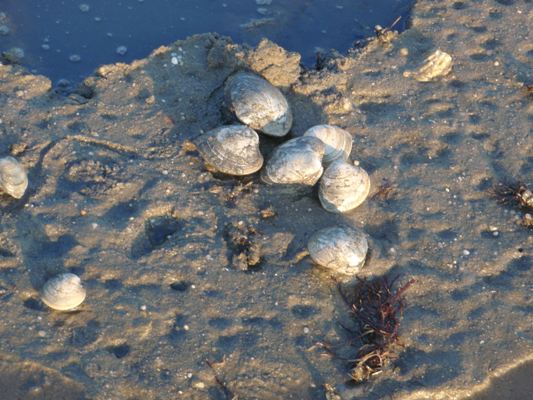
Jersey fresh quahogs, a couple of hours out of the mud.


Which gives me more information? 
Probably the latter. It's clearly more precise, and it's also more efficient than watching the moon and tides in a particular area for a few seasons.

Which gives me more knowledge?
Depends on what you mean by knowledge, but becoming part of the local natural rhythms requires a deeper understanding than needed to read a computerized tide chart, and maybe even something called wisdom.

Which gives me more pleasure?
Following the rhythms of the moon, of the bay. We do not talk much of pleasure in education, and I'd bet most "educators" would would put pleasure far down on the list of reasons for schools to exist.

Of all the reasons to push for high technology in the classroom, arguing that it prepares students for the 21st workplace, that students need to be trained on computers, is, well, hogwash.

Our students do not lack for information--many carry phones more powerful than the computers that got astronauts to the moon back in 1969, and can easily look up today's tide should the need arise.

We've come to see schools as little institutes for job preparation. We used to call that vocational school.

Given the economy, kids around here might be better off learning how to read the moon the 19th century way.


A wise child might wonder why it's warm enough to clam comfortably  in January.


Monday, December 26, 2011

Clam up, Arne


 Tomorrow I am going on an adventure!


Despite predictions of a 30 knot breeze with rain tossed in, I plan to grab my rake and wander out to a mudflat to grab a handful of clams for tomorrow's dinner, and when I'm done, I'll be glad I did.

I have yet to regret a single moment outdoors. I have yet to regret an adventure.
***

I won't be adding much to the nation's economy. The license only cost $10, which averages to less than a nickel a day. The money for the rake exchanged hands two generations ago, though I did spend about a buck on hardware to sturdy up the tines. My pail was headed for recycling anyway before I drilled a few holes in the bottom and called it a clam bucket.


Unless I manage to impale myself, have a heart attack, or drown, the only thing I'm contributing to the GDP tomorrow will be the 80 cents worth of gas I'll need to get there and back.

I dream of teaching my students how to clam. It's a local activity that will never be part of the national standards because it's a local activity. That may sound innocuous enough, but it gets to the heart of the sickness in education today, our love of the abstract.

We teach to what few love, the few with the money, the few with the power to dictate what matters.
***


McNuggets are abstractions, fresh-killed pheasant are not.
A dressed whole chicken falls in-between.
Our source of food has become abstract.
 
Electronic calculators are abstract, abacuses are not.
Slide rules fall in-between.
Our sense of quantities has become abstract.

Digital clocks are abstractions, sun dials are not.
Analog clocks fall in-between.
Our notion of time has become abstract.

There is no in-between on a late December mudflat.
There is no in-between watching a honeybee work her way among dandelions in your neighborhood.
There is no in-between when an elementary teacher takes her students to a local nursing home, to hear the particular and peculiar stories of their aged neighbors, stories that may have a universal theme, true, but stories that matter because of the particulars.

I want my children to grow up in a world they believe matters to them, the one in their neighborhood.I want my students to know the world, the one outside the door. I want my students to be happy, and to contribute to the American experiment, an experiment that starts at Town Hall.
 ***

Arne Duncan wants to use my children to better the economy, to improve our international economic competitiveness--he says so over and over again. He awards hundreds of millions of dollars to states who share his views.

Arne and I have a fundamental difference of opinion in what matters, why children matter, and what it means to live a good life.

Mr. Duncan's vision of the world is fundamentally flawed, as are his attempts to manipulate education away from serving the public good. I suppose he'd think the same about me if he had any idea I exist. Individual lives are an inconvenience to abstract views, and Arne Duncan does not tolerate inconveniences.

Still, if Arne happens to be in North Cape May tomorrow, he's welcome to stop by for the freshest batch of clams he'll ever taste, local ones scratched up and eaten before the next high tide rises. Nothing abstract, just good food and decent home brew.

I promise I won't talk shop, Arne--I'll let the clams do all the talking. Then you can go back to your more important business telling children what matters more than the grace of God right here under our noses. And I'll go back to teaching children about quahogs, democracy, and yes, the real American way.


Yep, I played the America and the God card--the America of local neighborhoods and the God of grace.
Last photo is of Dave Keeney's boots, a slide guitarist extraordinaire--but I have no idea who took the photo.

Dagnabit! Looking like an inch of rain in the newest forecast--which means runoff, which means closed beds. I use 1/2" as my guideline. *sigh*


Saturday, December 24, 2011

Are you Sirious?

Tuesday I'll grab the clam rake for the last time this year. Late Tuesday afternoon I'll wander over to an exposed tidal flat, and pull food out of the muck.


I do not know who crafted the tines of my rake, but I know how it was done.
I do not know where the tree grew that gave me the handle, but I know how it was done.
I do know how the mead I'll drink was brewed--I watched it ferment for months.
***

Tomorrow a lot of people will get an iPhone 4S, and adopt Siri as their personal assistant. We have taken false idols to a higher level.

Our sophistication now dwarfs our humanity.
Talk to Siri as you would to a person. Say something like “Tell my wife I’m running late.”


The machine says she's not capable of love, but we are not capable of discernment. We create our own Sirens, who call us away from the world.

The world either matters, or it does not. We say that it does, but act as though it does not.

Owners of the iPhone 4S talk of how well it snuggles in the hand--perhaps it does, but I doubt it nestles quite as well as a quahog. Probably doesn't taste as good either.


Tell my wife I'm running late.

If I'm running late Tuesday, my wife will hear it directly from me. I may have to wander into the Firehouse Tavern to find a phone, but chances are pretty good she knows exactly where I am anyway. No need to wander too far on a clam bed, they don't move much.

The woman's voice I hear on the other side will be a voice I've known for 35 years. And unlike Siri, she is capable of love. We all are.   

Merry Christmas!


If you're talking to a phone, you're using it wrong.

Friday, December 23, 2011

Cerf the oceanographer

New Jersey got a piece of the Race to the Top action yesterday. Given Arne's track record in reform, this may not bode well, but there's a glimmer of hope:

“This award today will help us to accelerate the tide of reform across New Jersey.”
Chris Cerf, NJ Acting Commissioner of Ed, another portentous sound bite


I'm a clammer, and know a little bit  about tides. They go up, they go down, about twice a day, every day. And every clammer knows, a receding tide can bring joy.

So here's hoping he meant a new moon ebb tide with a stiff northwest breeze, a blowout tide, the kind that blows away the muddy water, exposing the detritus on the tidal flats.


Mr. Cerf introduced me to a former state ed commish as an "ankle biter."
I'm hoping to advance to a shin-kicker.
One more thing--Cerf is the Ed Commish because the prior one made the mistake of pointing out
Christie's gaff wth the last application for these funds.

Monday, November 14, 2011

Clamming and competency

A former student dropped by today to tell me she just got her pilot's license. 
She worked on it for over 4 years, and openly admits to being a little jittery first time she soloed'. 
This post is now 3 years old--but I need a reminder now and again.


By the time you hit your 5th or 6th decade, you're mostly competent at what you do. You've long abandoned the things you're incompetent at, and mortality precludes starting a whole lot of new things.

As a result, most older folk forget what it means to learn new things, forget what it means to be a decade or two old, when everything requires climbing a wall to gain mastery.

"Potential" becomes an albatross around the neck of the young. (Go read The Rime of the Ancient Mariner if you have not. Yes, it's Coleridge; yes, he can be onerous; yes, it's worth your time.)
***

I got a clam rake last spring. It's an old rake, and a good one.

I can only imagine how many clams ended up in a pot after being pried out of their homes before I got it. The tines are rusted brown, the handle oiled by the sweat of others before me.

Still, as good a rake as it is, it was almost useless in my hands last June.
***

Can you remember when you first drove a car? When every twitch of the wheel required thought?

Just about every 17 year old Homo sapiens on the planet has faster reflexes than me. Just about every Homo sapiens in the western hemisphere has more facility with technology than me. Still, All State Insurance charges me a bucketload less for auto insurance than any 17 year old I teach.

Teachers need to remember how hard it is to drive the first time.

Or else go clamming.
***

Back in June, the rake was a weapon--plow through the mud, rip out whatever it hit, say a prayer for another unfortunate creature impaled by its tines. Horseshoe crabs, whelks, worms--but very few clams.

These days the rake is an extension of my arm, its tines tickling the mud beneath the water. I can feel shapes, I can feel density. A tine or two bump against a clam, my sympathetic system reacts. Against a stone, nothing.

The horseshoe crabs are safe again. The clams are not.
***

I like clams.
I really, really like clams.

I practiced and practiced and practiced because I like clams, and slowly my brutal assault against any critter large enough to suffer from misguided tines evolved to a gentle prodding of the mud.

My students like driving.
Really, really like driving.

They practice and practice because they like driving, and slowly their jagged starts and turns evolve to hugging the road unconsciously.
***

Here's my plea to anyone of us arrogant enough to presume we have something to offer to the young. Try something new.

Try to master something you suck at but like to do anyway.

Now imagine trying to master something you suck at and don't really care for.

Welcome to high school.


Photo mine.

Saturday, July 9, 2011

A clammer meets the internets

After yesterday's dust off, where I tangentially blame modern technology for the impending collapse of, well, everything, I thought I might need to re-establish some semblance of credentials for the edutech crowd, and perhaps even more important, potential employers.

I had long planned to go clamming this morning. We got people coming over tonight, and nothing beats fresh clams, except maybe fresh tomatoes, and we got those, too.

My trusty paper tide charts (courtesy of Jim's Bait and Tackle), confirmed online,  predicted that the sweetest clam bed south of Newfoundland will lay open mid-morning today.The kayaks are loaded, my clam bucket sits on the back stoop, and my rake is repaired and ready.


Alas, it rained last night. Rain flushes out the street sewers, which hold pretty much anything and everything the ground holds--cigarette butts, squirrel poop, herbicides, human spittle and other fluids, and all kinds of other matter subject to the law of gravity. A cherry stone will filter about 10 or so gallons of baywater a day, and I figure a chowder might do double that.

I have a general policy similar to a few states (though New Jersey, land of the free-to-ingest-whatever, is not one of them)--if it rains a decent amount the day before clamming, best not clam.

A decent amount for me means 1 inch, from the Latin uncia, 1/12th. Why a twelfth? Why a foot? What science is behind my tolerance? Well, very little. I surveyed the internets again, saw that Maryland closes beds for 1" rainfall, Massachussetts uses 1" in the winter, but only 0.6" in the summer (more squirrel poop around, I guess), and NJ, well, last time any bed got closed for rain was a year ago April so maybe we're not paying real close attention.

We got dumped on last night. How much? Well, I could wander outside and peek into a bucket, all of 15 feet away, but then I'd need to find my measuring tape, last used to measure the fluke I cannot keep, which means finding my fishing bag, which I think I left in the car, and, well, it's easier to look at a screen than get up and walk. Besides, it might be muddy outside. Not to mention the squirrel poo....

According to the internets, our local airport, only a couple of miles away, got 1.89 inches of rain last night. (Imagine that, we're measuring to the hundredths of twelths of some ancient foot standard...a freaking fifth of a millimeter for our more enlightened global neighbors....and which just happens to be the length of your run of the mill Paramecium caudatus.)

So no fresh clams tonight....had it rained 90 paramecium lengths (PLs) less, that is, had my bucket outside only held 99 PLs instead of the 189 PLs it would have held had I left it right side up and moved it two miles away to our nearest airport, I'd be clamming at this very moment, risking skin cancer and contamination with squirrel poop.


Here's a picture of a P. caudatus, just in case we go to that as a standard:


The paramecium photo is by Barfooz, released under Gnu FDL

Tuesday, May 17, 2011

Don't tread on me (or the commons)

I am not inherently opposed to charter schools. 
I am opposed to outsiders narrowing public spaces in my community.
Call me provincial, parochial, or even a local yokel.
We lost much of the commons years ago.I'm fighting hard for what's left.


"If it were up to local municipalities, it would essentially kill charter schools." 

The commons still exist. We still have community spaces, shared by all, that define who we are. We breathe the same air. We drink the same water--at least those of us who avoid the bottled nonsense.

I clam a tidal flat owned by no one, shared by all. Tidal flats are gifts of nature, of god, of grace. I did not earn it. I limit my haul to what I can reasonably share with my clan before the next low tide.

Public education still belongs, tenuously, to local communities. I pay thousands of dollars a year to support our school system, as do my neighbors. Our board of education meets every two weeks, people who live in town, people who I meet on the street. We work together to create a public school district. It's hard work, and it's not cheap.

Democracy has a price.
***

I just got back from the Bloomfield High Spring Choir Concert. The exuberant young voices brought tears to my eyes (shhh....don't tell anyone). The concert was free.

I've taught 1st generation Haitians and Ecuadorans and Chinese and Dominican Republicans and Filipinos and Albanians and Greeks and Costa Ricans and Viet Namese and British and Bosnians in the few years I've been here.

Imagine a small tidal flat separated into fiefdoms--this flag on the north end, this flag on the south, you get whatever (and only whatever) clams under your flag.

It wouldn't work.


There's a move in a nearby town to set up a Mandarin charter school. About a hundred schools in the States cater to Turkish culture. Folks want to set up a school, well, no law against it, and I have no beef with them. Folks want to spend public money to make them run, though, and now we have a problem.

A very big problem.
***

Anyone who believes the point of school is to improve the workforce available for private business fails to grasp the concept of the commons. Anyone who believes the point of school is to make kids ready for college and the global economy fails to grasp the concept of the commons.

Without a commons, there is no real community, and maybe we're there already. If you know more about the American Idol judges than you do the family across the street, you're a bigger threat to our republic than some ragged Taliban fighter protecting some poppy seeds in a land you cannot pronounce.


He's not likely to plant a flag on my mudflats, our mudflats. But you might.
And I'm going to spend what's left of this lifetime making sure you don't.


Saturday, April 16, 2011

Fear, fatigue, and failure

Despite a kick butt east breeze blowing at 20+ knots, pushing the water back into our back bays, I  managed to rake out a few clams today. The near full moon helped. I like raking clams almost as much as I like eating them.

Last week's clamming was a disaster. Two of my rake's tines loosened up, and my crankiness was exacerbated by a neap tide. I don't mind coming home with less than a pailful's worth of dinner, but last week I felt defeated. I was racing against the sunset (Jersey law uses sunset to define the end of a clammer's day), and, for the first time in years, I questioned grace.

When I got home, I dropped two clams, shattering them. I returned the remaining few to the bay. Seemed puny of me to eat them while questioning the universe.

So I "fixed" my rake...

***

...sort of, but enough to make it feel right in my hands again. The sand and mud yielded, gracefully, and I accepted the few clams we will eat in an hour or so.

We will eat the very last of last year's kale and Brussels sprouts, both bolting towards the April sun.

This year's peas have already broken through the ground just a foot or two away from the kale.


Our schools are in a crisis now, but not because of spoiled children or bad parents or awful teachers. We are failing because we are trying to meet standards that are inherently impossible. No state will meet 100% compliance with the NCLB by 2013, because 100% compliance is simply impossible.

Impossible. Look it up....

I worked in pediatrics for years. Not every child is blessed with a brain that works well enough to jump though algebra's hoops. Many children cannot speak at all. Most of you will never see these children.

Trying to do the impossible leads to fatigue, and fatigue leads to fear.

Fear kills education.
***

I was interviewed by Dina Strasser at The Line last summer. She's wonderful--she had no agenda, she really just wanted to talk--and we discussed what it means to be a professional.

Here's where I think teachers fall short. If we really believed that the testing demanded by NCLB harms the education of children, and a lot of us do, then we should not participate.

Docs are an ornery lot. I used to be one. If any President issued a proclamation we believed harmed our charges, we'd have simply ignored it. That's part of being a professional, knowing more about what you do than governors, presidents, and emperors. The other part is acting on what you know.


We (teachers) got the first part down. We won't be true professionals until we get the second part.

***

My failure last week, one borne of fatigue, will help me become a better teacher. My students are tired--I've pushed them hard, and I have no problems with that. I do have problems with judging them while they're tired.

State testing for biology is coming up. They will be judged, I will be judged. Fear is the expected, and the wrong, response.

Historically my lambs have done well. I hope that they do well again. If I fret, though, I stop teaching what matters.

I'm not paid enough to teach bull crap. So I won't.
***

I found a robin's egg in my garden today. It's not just humans that screw up.


There are no trees overhead, and the egg was intact--I think it was laid where it lay.There's a story attached to the egg, but the robin cannot tell me.

Was she scared? Stupid? Just plain indifferent? Does it matter?

I considered taking the egg to school, but if it hatches, then what? So it sits in my garden, a reminder that pretty much everything with mitochondria bumbles its way through this universe as we do. None of us chose this, few of us would willingly give it away.
***


I think, in the end, celebrating failure is fine, as long as it's an exuberant failure. Too often we confuse fear and fatigue with failure, and that's not the same thing.

Not even close.


Photos are mine, all taken today.
A Wizard of Oz kind of wind is blowing today. These things affect me. As they should.

Saturday, April 2, 2011

Clamming. Again.

The water's warmer, but not warm, the days longer, but not long.

After a longish week, pushing young adults in AP Biology to perform cartwheels that will, ultimately, matter no more than the motes seen in the beam of a late afternoon sun, I questioned what I was doing. The College Board has made some necessary changes, but they don't officially kick in until the year after next, which means I am supposed to teach next year's class a flawed syllabus.

Questioning one's daily work can be liberating, but only if you are willing to accept the answers. There's something to be said for mindless obedience. Obedience has never been one of my strong points.
***

I went clamming today, again. And again I wrapped my hands around a creature with a beating heart, pulling several out from the muck. Grace, ecstasy, and dinner.
A stiff chilly breeze blew from the northwest, and Brandt geese, a bit annoyed they had to move, watched me from about 20 yards away. The tide crept up as I worked. Under my feet were thousands of periwinkles, too many to avoid. Next time I may grab a bunch to eat.


My rake, once used by a stranger now long dead, is starting to show signs of wear. I do not want to replace it.


I hope I get another season out of it.
And I hope it gets another season out of me.


Grace.
First honey bee of the year today, too.

Tuesday, March 29, 2011

Clam rake vs. pickle dish

At the end of the day, the hallways are cluttered with abandoned papers. I picked one up.
Quadratic equations, lots of them, scrawled out with the tentativeness of an adolescent's hand.

I'll rake for clams this weekend, fish for striped bass, then bumble in the still chilly garden for a bit.

Which means reading tide charts, currents, and dirt.

I can't tell you how many times I got hit with quadratic equations, electromotive force charts, trig tables, and that freaking pickle jar in Ethan Frome way back in high school.

Then I'd go home and go fishing.

Not saying school wasn't useful--I may still have a decade or two to stumble upon a situation where I might need to decipher broken pickle dishes--but I learned a lot more useful stuff staring at the surf than I ever learned in school.


1:1 computers doesn't change this.

Saturday, March 12, 2011

Take a Senator Clamming Day

A half moon hanging in the sky late Friday afternoon does not bode well for clamming in these parts. Unless my nephew gets here real soon, the clams will rest easy today (which is all clams really do anyway). Some laws cannot be broken. A late day half moon means an early morning low tide.

No matter what.
***
Every time I meet folks with a bit of power or money (the two usually travel together), and in my itinerant careers I've met a few, I come away feeling oily, not because of their behavior, but because of mine.


Senators and CEO's smile, and tend to be bright, decisive, and charming. They like you. They want to help. They share stories about their children, about their towns. They're effective because they believe their own stories, and with reason. Their stories are true.

Because their stories are true, and because I like to be liked, I smile and nod and share stories, too. And then I speak my piece, feeling off-kilter; the message seems foreign when translated into Schmoozese, it loses its strength.

I watched children slowly die, over weeks, over months, over years from our cultural madness, and I literally sputter when trying to speak of the specifics, and sputtering does not translate well in Schmoozese. And at any rate, there is never just one person responsible, never just one organization, and the few times it is, no one responsible gets hurt anyway.
***

I bet I could tell my stories out on a mudflat at low tide, the sweet seething smell of life assaulting the nose of a Congressman as he leans on a borrowed rake, the soft sound of waves lapping at his feet, awakening parts of his brain he last used when he was a child playing outside.


Our stories, true stories, become real outside, as any stories about life do. There's a reason board rooms look sterile. If board meetings were held outside, we'd have a kinder culture (despite lower stock portfolios).


***
A few things are certain.
Something happened a long time ago, a something we will never grasp.
The tides will rise and fall in tune with the moon. 
And each of us will die.

I remember this at particularly bad times, like the day I watched the city burn from across the river, waiting for wounded that never arrived, or the few awful moments telling a mother her child will never hug her again. And remembering these certain things do help.

Most days, however, I forget what's certain, as most of us "living" in this culture, and the consequences are devastating, if not apparent.


My sister never forgot this, and danced every day. She also moved mountains. She could see the person behind the sheen. She could bring the mudflats into the boardroom, and she did.

I don't ever want to make people uncomfortable because of what I said. I just want them to understand the consequences of what they does. With the exception of psychopaths (and a few of them exist), people can, and do, change.


***

I'll leave lobbying to the professionals, those who can speak without sputtering, and not stare (or giggle) at the well manicured hands of the elite. I can't speak rationally in any room that won't support a plant.

Meanwhile, I'll take my nephew clamming. We catch live critters, and we kill live critters. If you do this fully aware of what you're doing, it changes you. At the very least, it will get you fresh food and spoil your appetite for the stuff that passes as fresh in the supermarket.

If any Senator or CEO wants to try a hand at this, let me know. The only condition is that you don't reveal my secret clam bed. We'll rake clams and` eat them before the next tide rises. I'll even break out the homebrew.

I promise not to talk politics. After years of trying, I know my words won't change you. But the mud might.


If you ever get a chance to dine with the elite, goodness, taste their wine. 
While food from our kitchen rivals anything the ultra-rich eat, I have to admit they drink some mighty fine wine.

Sunday, March 6, 2011

The NJ Clamming End of Course Exam

The tines of my clam rake are shiny again, as the rust is polished off by the sand that hides my prey. Spring is here again. I love clamming because, well, just because. I am pretty good at it, too, because I love it and persisted at it. It's not rocket science, true, but there's an art to spotting a keyhole, the mark of a quahog.


What would you teach in class if all your children had decent livelihoods waiting for them that did not require advanced math or public speaking skills? What if you had a child who loved clamming, was good at it, and who wanted to learn more about the world?

I suppose you could argue that he could use geometry to calculate the angles of his rake tines, and biology to find new clam beds, and language arts to create better copy for his business ads, but these are excuses, really, to teach what we want to teach, in 48 minute chunks, 5 days a week.

(When was the last time you used something you learned in high school you could not have learned on your own anyway?)

What would you teach a child interested in knowing more about the world aside from economic aspirations?

Yes, well, um, of course, but such a child is rare, you see, we must focus on the global economy, on future jobs we cannot predict, on beating the scores of China or Korea or Finland--we must prepare them for the "real world."

If you believe that children are not interested in learning about the world, you need to watch them outside of school.

It might just be that they're just not interested in what's happening in your room. Even if it's "on the test."

Imagine if you had to learn about clamming--trivia about the various rakes available, the various shellfish. Where are they found? How do you read a DEP map? How do you get a license? How do you read the tides, the wind, the water temperatures?


You might argue that learning about the particulars of clamming is, well, ridiculous, and I'd agree.

Tell me how "Us[ing] mathematical formulas to justify the concept of an efficient diet" grabs your interest.That's just one of our "cumulative progress indicators"(specifically 5.3.12.B.2) for biology. Now do this for multiple subjects.

And we wonder why the dropout rate is so high....


That's me clamming somewhere in New Jersey, and even saying that much is too much.