Showing posts with label Christopher Danielson. Show all posts

Sunday, September 28, 2014

Our class errorometer

While sharing pints with a few teachers upstairs at McGinty's,
Chris Harbeck took a sip of Guinness, then tossed out a few words that changed my teaching--
"I give out points for anything, a thousand here, a thousand there. They don't mean anything."


Image PD, quote added by Golda Poretsky.


We train kids to fear mistakes.

That's not always a bad thing--I just spent the better part of this glorious fall weekend breaking a pipe that required cutting a hole in the wall because I have more confidence than skills, and may need to call a plumber to fix what I broke.

Still, I learned a lot about plumbing and 1908 pipe threads--things were not quite as standardized then--and I have to admit, I enjoyed solving the many problems that popped up along the way. Even if this project ends up an utter disaster, I had fun along the way, satisfying some evolutionary trait that kept my lineage around for over three billion years.

(I am convinced that "fun" is pretty much always an evolutionary artifact.)

Boy Scouts having fun, 1913, via Shorpy.

School is not fun; making too many mistakes gets you labeled as that kid, and too many teachers say that those kid will end up broke, homeless, and hungry unless we teach them to make fewer mistakes.

We fuck them up even more with the religion of ranking.
Many of my "top-ranked" lambs are my most timid.
So I worked on fixing this.

Here's one of my ideas that seems to have worked:


We have a class Errorometer Board. Each time someone makes a good mistake--and there are all kinds of errors that fall in this category--we add a point. For every 10 points, everybody in class gets bonus points factored into their grades, as real as any other points "earned."

Yes, some wackadoodle well versed in the school game will then say something deliberately wrong to earn points, and I explain why saying something deliberately wrong does not count. We're not about the school game, we're about learning.

Even after the novelty wears off, the kids keep track of the Errorometer--they will spontaneously evaluate whether a mistake has earned a point.  I also toss in points for great, unexpected right answers.


Chris Harbeck is right, the points mean nothing. I finally found a way to make them useful.
Frank Noschese and Christopher Danielson were sharing the same rounds.
Photo of Errorometer coming whenever I remember to take a picture.


Saturday, January 4, 2014

Math, magic, and machines

All practices of magic or sorcery, by which one attempts to tame occult powers, so as to place them at one's service and have a supernatural power over others - even if this were for the sake of restoring their health - are gravely contrary to the virtue of religion.
                                                          Catechism of the Catholic Church, 2117

The Magic Circle, 1886, John William Waterhouse


We once feared magic--it challenged the order of the time.
Kings reigned, Popes pontificated, and we each had a place.
Magic gave those outside the mansions a dangerous tool. There's a reason witches were slaughtered.

Royalty and the church have kept their hold, as they have, and as they will, so long as we remain mortal. Our deepest fears respond to power's siren of promised heavens, so long as we do its bidding.

And we, for all our noise and talk and chatter, do power's bidding.
***

Science has proved far more powerful than magicians. Astrology fell way to astronomy, a man from Galilee to Galileo Galilei. Science levels power, makes democracy possible. Rational thought unleashes its own unfathomable powers.


If the folks used to being in power care to remain in power (with the usual divvying up between various hands of plutocrats, church elders, and royalty), they need to make magic matter again.

It looks like they're succeeding.
***


For a child to have any hope of grasping the universe, she needs a chance to understand how things work.

Some things are easy--clarinets, bicycles, and roller-skates are open-source  machines. You can see the parts, you can directly observe how the parts interact, and you can modify the parts (usually to worse effect) if you want.

Before I learned to drive, my Dad insisted that I learn how a car works, in an era when car engines were still all mechanical, and the parts (mostly) accessible. Cars broke down a lot more then, but we were a lot more capable of fixing them.

All of that is technology, not science, but technology then reinforced the idea that the universe has relationships, and those who mastered those relationships, well, mastered their worlds. When something broke, we had a chance at fixing it, if we  grasped how the parts interacted.

Our world was defined by tangible relationships.
***
Arithmetic is hard, harder than those of us good at it remember.

Grasping it today may be harder, ironically, because of the calculator. In our rush to create little scholars, we toss away memory tricks because memorization is not necessary in a universe that holds our working memory in external devices. Insofar as we're able to slide the work over to machines, I agree.

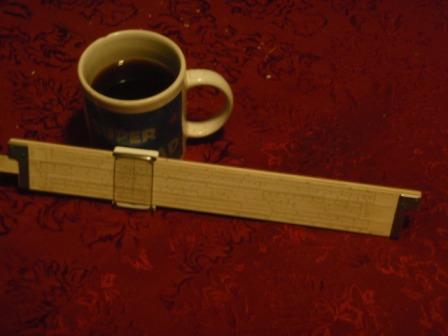
A math machine--once my Dad's, now mine. Still works.

We do not memorize the ways machines do, though. We do not create rigid tables of sculpted data on our brains. We create schema, elaborate networks of gossamer, connecting disconnected ideas with one another in an elaborate fabric where ideas rustle together like the flowing waves in a dancer's dress.

When an idea, a concept, a thought does not fit, it's like a wrinkle on that same flowing dress--we rub at it, press on it, maybe rub some spit on it until it, too, becomes part of out schema, sometimes altering it in ways that the thought no longer has its original meaning.
Or we toss it. We do this all the time. 
When we memorize numbers, when we memorize their relationships, when we struggle with our times tables, we are not simply  chiseling ideas onto stone, we are wrestling with relationships.  It's how we learn.

When we confound the binary code of the efficient calculator--so fast, so accurate, so sleek in design--with the chaotic mess of ideas we struggle to weave into what we already know, we lose a place in our universe, the only one that matters, the one we create in our minds.
***
When we lose our sense of arithmetic--never mind algebra, or trignometry, or calculus--but "simple" arithmetic, we lose our chance at feeling how the natural world works, a world that runs on harmonic rhythms.


The loss of these sensuous rhythms makes high school science a ghost, the class reduced to memorizing incantations of imagined power. E = mc2 becomes a mantra, and passing science becomes a sacred rite of passage.

It also becomes pointless.


Christopher Danielson continues to re-alter my schema on how kids learn math: Talking Math With Your Kids