Sunday, October 27, 2013

Data-driven instruction and the waning light


The "pond"

I spent a chilly few minutes yesterday pulling out some elodea from the pond to take to school--each time I pull up a garland, I let it drip a bit over the pond, wondering about the lives of the critters found in each drop.

(I worry about the few drops that hit the ground.)

When I start to think I am losing my mind thinking about these critters, I peek at a drop or two under my microscope, and see, once again, the dance of foreign life doing familiar things.

That's enough data analysis to remind me why I teach.
***

If we're going to preach data-driven instruction, and use it to take us to the Holy Land, we need to agree on whose Holy Land matters. And my Holy Land includes the critters I kill every time I take a step.
The gargoyle guarding the pond.
If you're alive, it's impossible not to see ourselves in the living around us.
If we see ourselves in the living around us, we care more about the world.
The abstract has no meaning when torn from the earth.

Being alive is a big part of being human, though you'd be hard-pressed to see evidence of this in our data-driven world culture.
***

It's late October, the morning glories in the shadows stay open through the day.  The dead will be dancing in the shadows soon. The world freezes over, and our children are taught not to notice.

The morning glory knows.

Good thing, too--if the children could see what we're stealing from them, they'd never sit still long enough to take the PISA's, the HSPAs, the NJASKs, the PARCCs, the SATs, the AP exams..

I'm still naive enough to believe the point of education is to help young'uns find their paths to thoughtful, productive, and happy lives. There's plenty more data to be found at the edge of a pond than under the flicker of fluorescent lamps.

But this data-driven nonsense isn't about accountability, or data, or education at all.
So I will keep teaching and keep praying, both for children and for the critters found in a drop of pond water the children no longer know exist.

The last of the hops flowers


You cannot dance if you're thinking too hard (or at all) about the rhythm.

Saturday, October 12, 2013

Miles away from the classroom


Don’t play what’s there,
play what’s not there.   

- Miles Davis


I'm a deep kind of tired today, unusual for October, but haven't had a whole lot of Octobers in my mid-fifties. The wispy edge of a tenacious nor'easter keeps spitting some of the bay at us, so we keep planning walks as the sun peeks through, then retreat as another band of rain comes in sideways.

I'm spending too much time playing the game, trying to satisfy the requirements of an epiphenomenal universe of SGOs, CCRALs, NJCCCSs, and RSTs. I do these things in the classroom, as does any decent teacher (and most us are decent), but it is simply impossible to choreograph moment by moment, day by day, the dance of ideas that plays between all of those learning in a functioning class.
***

I remember playing a pick-up hockey game years ago on Duck Pond, behind my junior high school back when ponds froze enough to play on. We were mostly kids in our teens, but a few adults joined us, including the father of a friend, a man who once played semi-pro hockey in Canada.

I was pretty good with the stick, but not so much with the skating, and Mr. Rand made a beautiful pass to a spot I should have been. I was trying to figure out what he was planning to do, and missed a lovely chance at a breakaway.

When he glared at me, I started saying "I thought that..." and he barked back words through his toothless grin words I still hear decades later:

Do not think, it's hockey, just play.
***

I am not arguing that we pursue our craft mindlessly, nor do I believe that teaching is natural--we all must practice, we all must discern, we all must work hard to make our classrooms become the beautiful symphonies of ideas interspersed with unexpected improvisations and, well, bursts of noise.
'

I can teach a child to mimic Miles Davis' tone, but never quite get it, and I can push a child to mechanically recreate small bits of his improvisations, enough to know who she's imitating, but that's not very useful in the long run. That child will never be Miles Davis, and neither will I--and it wouldn't matter anyway, because Davis never played anything the same way twice.
Even if I could faithfully script my classes, each one would be different. It's not the delivery of content that makes a teacher--it's the dance of ideas, the interplay of minds, the opening of worlds we cannot possibly anticipate because every child carries her own version of the universe into our classrooms.
In a couple of days I will be asked to write a script to satisfy the whims of a few powerful men who think they can play like Miles.
It may be time to break up the band....


I'm no Miles Davis.....


My 2013 SGOs


"Student Growth Objectives (SGOs) are academic goals for groups of students that are aligned to state standards and can be tracked using objective measures." AchieveNJ


Student Growth Objectives (SGOs) sound innocuous enough--who does not want a child to grow?

Here in New Jersey, a good chunk of my evaluation depends on how students perform on some set of objective standards I choose, so long as they are approved by my Supervisor and my Principal. I even get to negotiate the percent pass rate that constitutes success with my SGOs, which leads to some interesting game theory if nothing else, so who could possibly object?

I've been thinking long and hard about the SGOs since last spring, and while many of my colleagues are clenching their sphincters over this, I've decided to take the high road and spend another 40 to 60 hours of my time finessing this.

I agree with Chris Cerf, our esteemed Commissioner of Education. He once told over coffee (when he still talked to me) that he is a numbers man. I gleefully responded that, by golly, so am I!

I teach biology just outside Newark, NJ. One of my kids was astounded to learn that we have trees outside the school when I announced we were going outside to study them. Many, perhaps most, of my lambs never grew a plant from seed nor nibbled anything directly off a plant until they came to my class. Seems to me I have all kinds of growth objectives to choose from.


I will need, however, baseline data, because, by golly squared, we need data, and we need it now.  I used to be a pediatrician. I got skills and a few extra syringes around. I got kids who are amazed trees exist in our neighborhood. I got a Commissioner who hopes to take Arne's job away when his pal Christie slides into the White House in 2016. I am going to slay a whole flock of birds with one big chunk of rock.

Why waste time with hours of standardized testing when I can strap a child down and draw a few cc's of blood in less time than Mr. Cerf can say "Hotelling's two-sample T-squared statistics"? Expensive? Yep, but not any more expensive than the tests they replace, and the money stays local.

So here is my proposed SGO:
I will increase the number of students who gain joy by knowing that the natural world (or any world, for that matter) exists. 

Here is how I will obtain my objective data:

At least 80% of all students who failed to see the trees outside our school's doors will have at least a 20% rise (or 15 ng/mL, whichever is greater) in their measured serotonin levels when exposed to trees in May, 2014.


I'm going to walk away from this ed nonsense. And I may never come back....

Wednesday, October 2, 2013

Fuck pink

These words, posted 4 years ago, started as a visceral response to a friend who coined "The One-Boobed Systyrs of the Apocalypse." She's still fighting dead.


I remember the first breast I saw no longer attached to the body it once helped define. I had seen body parts in various forms before, but this one was fresh. A flap of sallow skin with a wizened nipple defining it, a long trail of fibrous fatty tissue trailing off the slab.

The pathologist, smoking as he dictated, handled the breast like a butcher handles meat about to be weighed, though not as kindly.

The breast had been part of a man who probably did not survive his bout with breast cancer. Most people back then did not fare well, and men fared worse than women.

Incidences of breast cancer change in populations as people migrate from one area of the world to another, suggesting that environmental factors contribute to this disease. There is a continuing effort at the NIEHS to identify these environmental factors and the role that exposures to specific chemicals could play in this disease.

National Institute of Environmental Health Sciences, NIH


I shaved my mother's head when the cancer recurred--bony metastases in her skull made the shaving more difficult. She walked like a marionette with tangled strings the weeks before she died. In a radiology reading room, we'd call them "goobers." Goobers on the brain.

Unless it was one of our mothers, our sisters, our daughters--then they were metastases.
***
Since 1985, Zeneca Pharmaceuticals has been the sole funder of October's National Breast Cancer Awareness Month (NBCAM). Zeneca has promoted a blame-the-victim strategy to explain away escalating breast cancer rates, which ignores the role of avoidable carcinogens. Zeneca's parent company, Imperial Chemical Industries (ICI), is one of the world's largest manufacturers of petrochemical and chlorinated [organic] products -- including the plastic ingredient, vinyl chloride -- which has been directly linked to breast cancer, and the pesticide Acetochlor.

In addition, Zeneca is the sole manufacturer of Tamoxifen, the world's top-selling cancer drug used for breast cancer. In return for funding the "awareness" campaign, ICI/Zeneca has control and veto power over every poster, pamphlet and commercial produced by NBCAM.

" A decade-old multi-million dollar deal between National Breast Cancer Awareness Month sponsors and Imperial Chemical Industries (ICI) has produced reckless misinformation on breast cancer," said Dr. Epstein.

The media focuses on the strength of cancer survivors, and I have seen tremendously strong women live and die graciously through months and years of chemotherapy and radiation and surgery. The magazines will show glossy pictures of proud women, and these things matter, of course. Avon will sell "Kiss Goodbye to Breast Cancer Lipsticks," Mars, Inc., will sell you pink and white M&M's, and General Electric will sell you a Senographe 2000D mammographer.

They do not show a mother cowering in her bathroom, her bald head bare, blood all over the toilet from a nosebleed that will not stop, her teen-age son standing awkwardly, bravely holding her head.

They do not show the vomiting, the pain, the fear. They do not show a mother with her arm in a machine trying to squish out the fluid building up from lymphedema.

They do not show the bony protuberances on a skull, the smell of dying cells.

They do not show a child wiping her mother clean because she is too proud to use a bedpan and too weak to use a toilet.
***
dichlorodiphenyl-dichloroethene
polychlorinated biphenyls
dieldrin
chlordane
heptachlor
polychlorinated dibenzodioxins


In 1991, these were the 6 most common carcinogens found in breast milk. The news has gotten worse since then. We are at the top of the food chain--toxins accumulate.

It has been known that breastfeeding reduces your chance of getting breast cancer. The longer you breastfeed your babies, the lower the risk. This has been attributed to hormonal changes related to breastfeeding--breastfeeding women cycle less, and had less exposure to estrogen.

There has been speculation (and it is only speculation), that breastfeeding may help reduce the chemical pollutant load on the mother. Guess who gets the chemicals.
***
The lifetime risk of a woman developing breast cancer was just less than 10% in the 1970's, or 1 in 10; it is now 13.4%, or almost 1 in 7 (NCI, 2005). In the 1940's, the risk was 1 in 22. Breast cancer is the leading cause of death in women 34 to 54 years of age.

Until recently, the incidence of breast cancer had gone up about a percentage point every year since 1940.
***
Janet Jackson flashes a breast, and our Federal Government now rushes to redefine obscene. Certain words and phrases will cost lots of money; Howard Stern has opted to put his voice into orbit.

Here's an obscene phrase that won't cost anything--in fact, in past Octobers you have might hear it dozens of times:

Early Detection is the Best Protection.

This makes no sense--once detected, you already have it. The best protection is prevention which, admittedly, would require massive, radical changes in the way we live. The NBCAM folks got wise--they now say "Early Detection Saves Lives"--if you go to their website, they pretend that this is what they have always said.

So it must be true.

I wrote this several years8 or 9 ago for a friend,who was still fighting at the time, and my mother, who lost.

Sunday, September 29, 2013

Infinite time, finite lives

Some for the table, some for next year's garden

Time is short again, a little shorter than it need be as I piece together various education acronyms and jargon that, when analyzed critically, show internal inconsistencies as wide as the smile on Marzano's portrait pic.

So long as I get to teach, to share the world with my students, I'll continue to play the game. (If you teach without sharing the world, it's called indoctrination.)

Yesterday I watched a few swallowtail caterpillars munch on dill--they'd pull one edge of a wispy strand of dill leaf, start at the tip, then gnaw down to the stem, holding onto the dill like a corn cob.  I'm not giving this up.

Where do they pupate?

I collected a few flowers for the kitchen, then stripped off a few hundred coriander seeds from the brown sunbursts of once vibrant green cilantro plants, some to eat, some to plant after yet another winter. I'm not giving this up.

We walked along the edge of the bay, stumbling upon shed horseshoe crab shells, a live sand flea, and a small marmorated stone that now sits with other stray talismans sitting on our windowsill. I'm not giving this up.

The edge of a horseshoe crab shell, found at the edge of the bay.


We sat at the edge of the canal and watched the sun set, then ate at a table surrounded by family, with food that took my Auntie Beth some time to prepare. We shared stories, some from yesterday, some from half a century ago. I'm not giving this up.

But a few things have tailed off--my assorted stringed boxes rarely vibrate these days, and I have little time to just sit and write. Some things I am giving up, if just for a little while....


What are your students giving up to finish up that work we define as important? 
Is that worksheet written by a stranger worth giving up a sunset in a life limited by death?


Saturday, September 14, 2013

September thoughts, as the sun fades away...

While collecting sow bugs for school and ripping up weeds from the garden today, I stumbled upon a praying mantis.  I watched her as she watched me. She scrabbled away from me, then cocked her head to make sure I would leave her alone. If you watch one for awhile, you start to doubt the human supremacy thing.

A young horseshoe crab, not a praying mantis, but still...


There's more to this thing we call life than language can allow.  Watch a mantis awhile, and the next thing you know, you'll be questioning everything.


Which may be the point of education, at least education that matters.
***

You will die someday. That is something worth remembering every morning, but not worth worrying about (too much), because there is not a whole lot of things you can do about it.

But you can do this much. You can live.

A blue crab's hand held by my own.

If you're like most of us, you won't even be kind enough to leave your carcass for others to feast upon. You'll either have your cold shell pumped full of formaldehyde, or you'll revert your complex organic compounds to water and carbon dioxide in a furnace hotter than you now alive brain can imagine.

So you may as well contribute something to the common good now.
***

What do you want?

If you do not know, why are you teaching?
If you do know, why aren't you fighting for it as though your life depended on it?

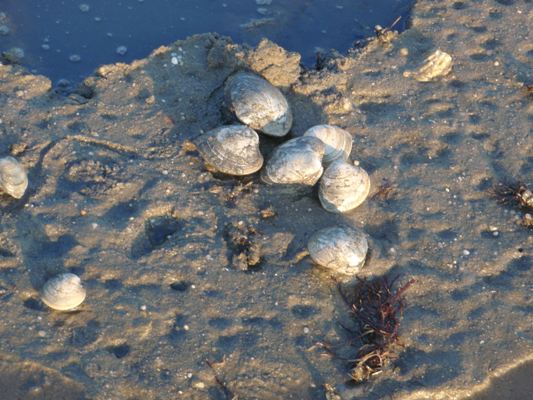
A handful of quahogs raked up by me--they bring me joy.


I just started teaching again, as I have for a few Septembers now. I used to practice medicine. In a few years, I may be doing something else, so long as my health holds.


Whatever I am doing, though, I'm doing it because I want to, because I know what I want. So long as the tide rises and washes over the quahogs I enjoy so much, in a dance so ancient and mysterious I cannot hope to understand, and know I cannot understand, I am happy.


Sometimes I think the most valuable thing I offer my lambs is an adult human who is happy.


Saturday, September 7, 2013

Drafted into Arne's army

I understand now why some of the good ones are leaving....


While kids saunter back into school, back, surrounded by cinder block walls and windows that open just enough to slip through a few fingers, the sun's dance arcs visibly lower day by day.

The dichotomy between the dull education that passes for science and the fantastic changes happening outside our building as we plummet towards winter's darkness disturbs me more with each passing year, as I stumble towards my own winter months.

Truth is I am a public high school teacher, and as such, an agent of the government, bound by the curriculum of a local board that fears, as it should, the governing bodies above it. Arne Duncan may be an evil puppet of corporate thinking, a misguided fool, or just another human trapped in his own mythology fed by money, but his actions directly affect my classroom, no matter his motivations.

I accept money to do what I do, money extracted (mostly) from local families who often struggle to pay it, to deliver "education" to the town's children. So long as I am delivering an education defined by folks who have never set foot in my town, and who, even more damning, would not care to, I am part of a process that does harm to a lot of children.

So long as I tend to the needs of the children in front of me, help them see and understand the natural world through the wonderful human story we call science, and show them that happiness and living a good life are both possible, I am part of a process that helps children grow to be joyful adults.


Every time "college and career ready" dictates are trumpeted from on high, I have a contractual obligation to impose them on our children. Every time "college and career ready" dictates are trumpeted from on high, I have a moral obligation to sift through them to shield our children from harm.

It is not enough to say close the classroom door and teach. It is not enough to say kids are better for having a particular teacher along the way who helped them. It is not enough to pretend that subversion solves anything beyond the niggling thoughts that dare to interrupt your sleep.

The schism between what I ought to do and what I am required to do widens with each wedge of bundled cash the Gates and the Broads of the world shove into whatever crevices they need to crack. Good people at all levels need to act in the best interests of the children under their care, and too few of us are.


I am fortunate to work with a principal who focuses on what he believes is right for our children in a challenging district that happens to be my hometown, but that's not enough anymore. The thunder of foreign hooves rumbles through our town now, and I don't want to join that army.

What do you plan to do when you get drafted to serve their needs instead those of your children?


What would Dr. Diane Ravitch do?