Showing posts with label madness. Show all posts

Friday, August 5, 2011

Stars and storytelling

I've been immersed in the new esocial culture the past week, even carried around an iPod for a couple of days. I wandered down to D.C. for the march, then back up to NYC for #edu140.

I saw incredible visionaries seduce their audiences with words, with music, with movement, with touch. I mainlined social media for several days, dizzy with various boxes of multiple colors, floating on a collective stream of human consciousness, and last night I crashed.

It took two words from my son as we got out of the car at 2 AM this morning: Look up!

The milky way streamed over our head, parting around the Northern Cross. Ancient patterns of stars raced through my brain--not just the neocortex, the part we worship, but arcing through the limbus, the edge, the old mammalian brain, the home of desire. The hippocampus, our ancient compass, screamed for recognition, finally allowed to guide me under something I deeply recognized, something beyond human.

The amygdala, our kernel of fear embedded with wonder, ripped my attention away from my neocortex--words dissolved, language did not. The stars spoke to me, as they do to any mammal wending through night's shadows.

We forget, or maybe the human part of us, the folds upon folds of new cortex that allow us to navigate in our human world, forces us to look away. But the neo-cortex is only part of the story, and not the one that will save us.
***

Astronomy, until very recently, was a story told only of light, but what a story we created. We learned of suns and stars, galaxies upon galaxies, of an expanding universe by creating layers of inferences, stories upon stories, based only on light.

Helium, named for the sun, was discovered on the sun before we found it on Earth, betrayed by its spectral lines.

How many of our children know this? How many adults?

Science is not "knowing" that the sun holds helium--to say this is not to say much, though trivia often passes for science in our culture. Science is grasping the stories of light, of spectral lines, of inferences, and then sharing the stories with others.

If children knew how tenuous our grasp of the universe is, as we try to hold hands with the shadows dancing on the walls of Plato's cave, they'd be a lot less frightened of science teachers, and maybe more frightened by our stars at night.

Fear is underrated.
***

While the stories of science are based on tenuous grounds, the stories are solid. They work, much as the stories we shared before we had written language, as we gathered under the stars on moonless nights, worked for us then.

The children of my ancestors 50,000 years ago had the evidence above them, they felt the creeping dread of the amygdala tempered by the guidance of the hippocampus. Their stories were based on evidence, the evidence of the stars, not the words of a textbook, the words of an expert.

We have become a nation of magical thinkers. I wish I could say this was despite our science education, but too often it is because of it.

For decades now, we have dropped observation of what's real for immersion of what's not--words and photographs and monitors and videos are not real. No media today can hope to capture the sky that wrapped its way around my nonverbal brain just a few hours ago.

If a child uses a computer before she uses a magnifying glass, her science has been stunted.
***

I proctor the BHS Sidewalk Astronomers, a school club that lets kids see a tiny piece of the universe, catching photons in light buckets we set up on the pavement outside our school.

I used to apologize for the poor viewing conditions, but most have never seen truly dark skies, and are thankful for every photon they catch with our telescopes.

The telescopes are easy enough to grasp--you can see the big mirror bouncing light to the smaller one, you can see the eyepiece glass focus light as you slide the tube up and down with a simple knob gear.

No magic involved.

 ***

Cell phones are magic, iPods are magic, wifi is magic, even televisions are magic to most who use them.

I can at least show children how speakers work, using nothing more than a paper cup, a coil of wire, and a magnet, but do not show them how the amplifier that drives the speaker works. (The last time our class made a speaker, it literally went up in smoke, a great lesson in vibrations, sound, and heat.)

I'm done with magic. I'm done pretending we can survive as a culture pushing magic.
  • Magical thinking is what leads rational adults to believe that plugging an electric car into a socket makes the energy "cleaner." 
  • Magical thinking is what leads a culture to putting more calories into the ground than can be extracted from its harvest.
  • Magical thinking is what leads us to believe that we are beyond the laws of physics, that human western wisdom is beyond our collective wisdom, that our minds can solve any problem our brains manage to create.
I'm going to teach my students the first week of school the difference between the magical and the true. I am going to encourage them to catch me every time I slip into magical thinking. We're going to spend a lot of time delving into why their science teacher, despite himself, keeps slipping into the world of magic.

We will learn what's true together, and if a child should escape our haze of urban light and stumble under a sky burning with stars, she will have enough trust in what's true to trust the stories they tell, and have told, since before we uttered our first word.

I'm done with magic. Magic is limiting. Magic kills thinking, kills hope, kills people.


Perseids woodcut via NASA but from 18th c., so I figure it's OK to use.
Book of Wound Surgery of Jerome of Brunswick (also called Brunschwig) published 1497, via Science Photo Library, but also ancient enough to skip the legal nonsense.

Thursday, November 25, 2010

Un-teaching "science"

I am a high school un-teacher. I spend more time un-teaching than I do teaching.

I cannot hope to get kids to think if they walk around life believing much of the nonsense they learned during their impressionable years.

The idea of teaching a room full of children who still have reason (at least economic) to trust the tooth fairy makes my eyeballs quiver. Good Lord, somebody has to do it, and I respect anyone possessing the gadolinium gonads needed to teach larval humans. If you're going to dabble in science, though, please put away the textbooks. and get it right.

Children are sent to school earlier and earlier ("please wipe your feet, hang up your coat, and dry your umbilical stump") and expected to perform more and more. A child reciting a list of organelles before he's sprouted an axillary hair is about as learned as an Irish dancing monkey but not nearly as entertaining. My lambs come to high school spewing content without understanding, and have been rewarded for this. How can this be?*

I've complained about this long enough to get myself attached to a committee, and we're looking at science into the early grades, which means perusing the state standards. Uh-oh.

***


Language matters. I am trying to parse the state standards. The first one below applies to children before they finish second grade. We're talking about 7 years olds. A lot of them will be bored hanging around the old folks weekend. Go chat with one.

The Sun is a star that can only be seen during the day.
True, I suppose, but tautological. It says nothing. A young child never asks why we can see the sun during the day. The interesting question is why can't we see the other stars.

Worry not--we'll jam some science in the young'uns:

Determine a set of general rules describing when the Sun and Moon are visible based on actual sky observations.

Asking second graders to do "actual" sun observations can lead to "actual" blindness.

Part of me loves this idea. Let the kids find patterns. Let them observe periodicity in nature. Don't expect them, however, to come up with a set of general rules. Really. Go talk to one. Even one who does the Irish monkey thing well. (She's the one with the report card on the refrigerator.)

Here's one for the Pre-K crowd:

Experiments and explorations provide opportunities for young learners to use science vocabulary and scientific terms.


No, no, no, no, no, no, no!!!

Children are magical thinkers--words have tremendous power. Telling a child that things "fall" because of gravity is catechism, not science. We have enough of that already.

Instead, focus on the word "fall"--what does it mean to fall? If a child asks why things always fall "down", work on the word down. If you have an ambitiously curious child, tell them that stuff is attracted to other stuff and no one knows why. Do not use a science vocabulary term until the child has a chance to discover what it means.

I'd rather ban the word gravity in elementary school than "provide opportunities for young learners to use science vocabulary." They got plenty of other things to grasp before throwing talismans at them.

I look forward to the committee meetings.


*Turns out our state standards are designed by "educators and experts
recognized for their content area expertise.
[italics mine]" Gulp.

The Einstein acceptance speech wordle was found at Ptak Science Books here.


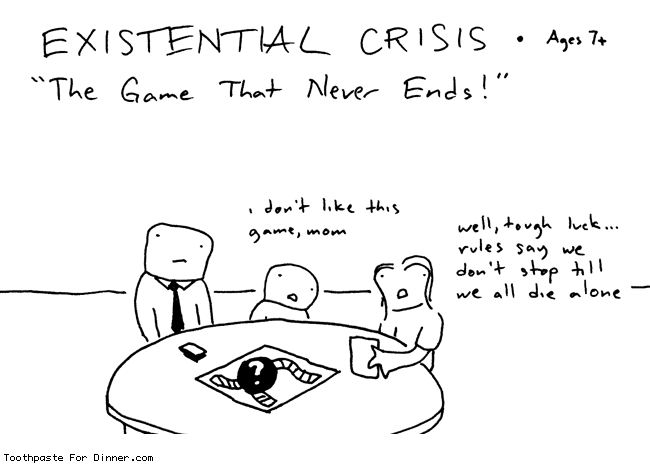
The cartoon is from, of course, Toothpaste For Dinner....

Friday, November 5, 2010

On balance


Theology alert--feel free to jump in....
This was inspired by Father Sean and Brother John and Reverend Scott.


Balance.

We need balance in our lives. Overwhelmed? Seek balance.

An innocuous philosophy--who could possibly be against balance?

A madman in the back wildy waves hand--and (again) I get sent out of the classroom.


***

The light is failing. Local carbon dioxide levels will rise until late May now, when resurrected plants start reconstructing the molecules back into something we can use again next winter. CO2 and H2O, carefully bonded back together into strawberries in June, peaches in July, corn in August, wheat in the September...little left now but the kale and the Brussels sprouts.


Breathe on your hand--you can feel the moisture, the breeze of molecules brushing your hand.

If God can be found, She will be found in the chloroplast, Her heart made of rubisco, the enzyme that puts us together, the most common protein in our known universe. She carefully holds a tiny molecule of carbon dioxide, three atoms of nothing, and glues them to life.
Heart of God?


She takes her life, her energy from the sun. Three times a second, another molecule of CO2 pressed together to a molecule of life, over and over and over again.


Rubisco is everywhere, in every green leaf, and as the leaves of summer fade into fall's glory, She leaves us. We start to drown in our own CO2, waiting for Her return, as She has, as She will. (That's called faith.)
***

You cannot balance a lifetime. You can dance, jump for joy, cringe in fear, curl up, scream, love or hate. There is no balance for love, for fear.

A well lived life is not one where you've balanced your fears with your joys, your love with your hate.

A "well lived" life makes no sense. You cannot "lived"--you can only live, now, this moment. Either the amygdala or the cortex rules a moment. We pretend we can string together moments, we hold on to memories, to words, to pictures, to myths of eternity, and we miss the obvious.

The here and now.

And we wonder why it's hard to teach children in a classroom....

***

A couple of soldier flies erupted from our class terrarium last week. Unexpected. Large critters crawled out of the thin litter layering the glass bottom. The yellow bar splashed on their legs with their waspish wings and fluttering antennae screamed danger. My cortex knows they're harmless, my amygdala makes my fingers stutter when I pick one up.

The last few days a half dozen more came from the same dirt.

When I opened the top to feed my sowbugs yesterday, two flew out and headed for the window. They only live a day or two as adults, and they had been trapped for hours in the terrarium. They flew fiercely, full of desire, and crashed right into the glass.

Instinct, true. Fixed action patterns with proximate and ultimate causes. Memorize this, children, pay $87, and earn your AP Biology credit.

We never speak of desire in other creatures. Of wants. Of needs.

The soldier fly carcasses will sit on the sill until my students return on Monday. I will ask them how they got there. Then I will ask why.

We all need what rubisco gets us--we all feel desire. It's why we burn our energy even though we know December's coming.
***

וייצר יהוה אלהים את האדם עפר מן האדמה ויפח באפיו נשמת חיים ויהי האדם לנפש חיה׃
And the LORD God formed man of the dust of the ground,
and breathed into his nostrils the breath of life;
and man became a living soul.

We think we're sophisticated and learned and (the worst conceit of the three) immortal. We gorge on the fruit of the Tree of Knowledge and forget that we are closer to the soldier flies than we are to rubisco.

I do not know who wrote the Hebrew Bible, and I do not know which of the 47 men chosen by King James translated Genesis 2:7, but there's been a huge misinterpretation of "soul" in the last few hundred years.


The soul, at least according to the Words allegedly governing the actions of the dangerously powerful here in the States, is not separate from the dirt. Our "stuff," the polymers of proteins, our layers of lipids, our DNA, our essence, is our soul.

We are mortal and finite. We are living souls, dependent on rubisco, dependent on unimaginable events in the heart of the sun, hydrogen to fusion, mass to light.

You want your children ready for the world of humans, raise them under artificial light. Keep them planted in front of monitors. Feed them impossibly perfect fruit. Keep them shod. Pump them full of music made by machines. Surround them with images of the "perfect" human, and demand they become one.

Don't talk to me about balance.

We are training our children to avoid the window pane, to stay safe, to gaze at the world outside, to create stronger panes. We don't want to see them hurt. We cannot imagine their last agonal breaths.

Me? I want my children to crash into the glass, and if they're bloodied lying on the sill, to get up and crash into it again. Again and again and again.

3 billion years of desire got us to here; a few hundred years of playing God has reduced us chasing photons on screens, practicing religion disconnected from the wiser elders who wrote texts we refuse to read, to believing we are in control.

I may be unhinged, but I am not as unbalanced as anyone who believes in balance.

The sun that sustains me has been dropping lower into the sky day by day, the plants that feed me have lost their leaves, the bees I adore have gone. I am a man of science, I have a good idea why this is so.

I am also a man of faith--faith that the sunlight will return, and that rubisco will return with it come spring.


Photos are mine and Leslie's.
The rubisco model is from Wikipedia, and is in the public domain.

Monday, August 23, 2010

Death in a classroom


Is part of a public education reminding a child of her mortality?
And if so, would the task fall upon the biology teacher?

It's not a trivial matter. For all the posturing by folks at the national level about our record college enrollment rates, almost a third of graduating high school senior do not go. Many of those that do go are going to juice up their resumes more than their minds.

Would teaching mortality produce a more thoughtful citizenry?

***

All of this, whatever this this is, cannot last for any individual. The oldest known bacteria survived 250 million years, the oldest plant a mere 43,000 years. We tend to think of ourselves as special, a gift (or curse) of our consciousness.

The oldest animal? Maybe the clam--a quahog made it for 405 years. Alas, it was killed by the same scientists who marked its age.

Oldest conscious animal?

A 211 year old bowhead whale leads the list, roaming this Earth since John Adams was President, finally felled by an Inuit.

And good westerners that we are, we oooh and awwww at the record, imagining a life triple life span we have, again forgetting that we truly only live in moments.

How many Saturdays do you have left in a lifetime?


Would folks behave differently if they accepted mortality, accepted limits? Would we be braver? Would we spend hours inside manipulating artificial universes? Would we accept the culture we have?
***

We are all, in a sense, immortal, or at least as immortal as life on Earth. We all share ancestors. We all come from single celled organisms that continues the spark of life for billions of years, long enough for consciousness to develop.

Or maybe consciousness has been around much longer than we know. Bacteria talk to each other.


Dying, I suspect, is a big deal. It doesn't require a whole lot of practice, and just about every one of us will manage to accomplish it whether or not we have graduate degrees, but still, for each of us, it's the end of a universe (at least among the empiricists).

To be fair, I'm a bit warped. I grew up Oirish Catholic, I practiced medicine in the inner city when poor kids were doing their best to die from AIDS before the middle class even heard of it, and I've lost enough people to accept that maybe, just maybe, this death thing is permanent.

***

We relegate death to religion, and otherwise make it taboo. But we all face it.

Biology is literally the study of life--and life is defined by death, the ultimate limit for those of us who pretend to be conscious. A culture that recognizes limits has a chance to be sustainable.

A chance.

Just a chance. Which is more than we have now.....


The skull is from wikipedia, credited to Bernard Bill5
I've watched a lot of people die, most of them young--you will, too.

Ain't Bonnie Bassler wonderful?

Tuesday, August 3, 2010

"An infinite number of biological factoids"


Because biology is a dynamic field with an ever-expanding knowledge base, focusing students more on how to interpret and understand new data as they become available will be much more important than having students memorize an infinite number of biological factoids.

That's what it says. Yes, it's a draft, yes, it's meant to be revised--but that's what it says. If my grasp of English is correct, the "infinite number of biological factoids" refers to the current system.

The College Board is a multimillion dollar operation. It spent over $300,000 last year for lobbyists. The CEO makes well over half a million dollars a year.

So what are my kids supposed to do in the meantime? Pay their $86 to show how well they memorized an infinite number of factoids?
***


I went bat hunting tonight--it sounds a lot more strenuous than it is. Get a lounge chair, wait for dusk, lie down with your eyes looking up, and wait.

I eventually found a bat, and watched it sweep the sky, munching on a variety of other flying critters. There aren't so many bats now as there were a few years ago.

We won't be talking much about that in AP biology class--too little time. Nor will we talk much about the decreasing phytoplankton in our seas. Nor the great mass extinction going on right now as we delude ourselves with these light machines.

***

I participate in the madness.
I am part of the madness.
I am the madness.

***


The AP Biology curriculum will not be revised before the 2012 school year, possibly later. In the meantime, I teach to the curriculum, as I am required to do.

Which is, of course, madness.


I am open to suggestions....

Yes, of course, it's Edvard Munch's painting The Scream