Showing posts with label grace. Show all posts

Thursday, March 8, 2018

On mending a fence

Near Higbee Beach
The earth breaks.
The rains come. The mud heals. The sun returns.
Then the earth breaks again.

For a few dozen cycles of the billions life has been around, you get to share the dance with others, ignorant of where the music comes from, but audible if you listen.
The fence post a few years ago.
The nor'easter blew over a stockade fence post I dug into the earth a quarter century ago. I got out my tool bucket,

A couple of my tools are from my grandfather. He was born in the 19th century, an ocean away. He ran away from home, ended up on the front for two weeks out of three for a several years "fighting" for the same folks who starved his people not so long ago. He lost all his teeth (a toothache bought you an extraction and a day off the front) and got shot in the back of the neck ("I'll be damned if I got shot in the front, I was always running.")

I do not use his tools because of his stories--I use them because they still work. But the stories make the tools feel warmer in my hands.

As I was digging out the dirt from around the post, an earthworm wiggled halfway out of its hole, looking a bit concerned that the earth had disappeared. (I do not communicate well with worms, but it was wiggling a bit, and seemed stressed). After a few minutes it scooted back into its hole.

Cabbagehead jelly seen on an evening paddle

Many have danced before you, mostly not human. We've only been dancing on this earth a short while--but it's no more earned than the air you just breathed in.

I forget this most days.
Today is as good a day as any to remind myself.


And maybe a better day than most--thinking of a few of my lambs today,


Sunday, January 21, 2018

January beach walk


The air warmed up, the beach did not--ice and snow lay just beneath the sand. I went barefoot anyway.

Not much to say, except to say words cannot say what I would want to say. Four scoters waddling by, occasionally dipping under for food. A gull slamming a dying crab on the sandbar. A tiny flock of five sand pipers sharing nine legs.


Oysters scattered on the beach, torn off the rocks by last week's ice, still alive. The sand will swallow them up if the birds don't get them first.

Death all around, but death is always all around--it's easier to see when the living retreat for the season.


The deep January colors and long shadows reminded me not who I am as much as what we are part of--but that's a conceit. There was no me for long moments. Or maybe everything was me, which is impossible, of course. Words fail.


When I came back, my tracks had filled with water, which then sought the bay, as water will.


This one is for me.


Sunday, December 10, 2017

Sunsets and the solstice

Sunset on the Delaware Bay
The earliest sunset of the year (in these parts anyway) happened a couple of sunsets ago ago. The sun is setting later today than it did yesterday.

Folks will argue the point, but I am not so interested in their arguments as their need to have the discussion at all.

We are truly trapped in an abstract of our own making. Noon once meant the time the sun is as high as its going to get on a particular day, and solar noon still means just that, but the sun peaking at noon only happens four times a year now.

And despite what my teachers told me, the sun is never directly overhead in this part of the world.

So I can point folks to the United States Naval Observatory to support my claim, and I often do.

North Cape May winter beach
Here's a better idea, though. Go outside (or at least to a window) and look. Tomorrow do the same. Do it for a week or two. Do the same for sunrise.

I guess it really doesn't matter if someone knows the sunsets are getting later. It may be trivial to most of us. But that's not the point.

If we can so easily fool ourselves about the rise and fall of the sun, imagine the nonsense we do not know that we do not know....


What we believe becomes who we are.


Sunday, December 27, 2015

St. Stephen's Day, a day late....

A reminder from last year's adventures
It is one thing to write of mortality, quite another to kiss its cheek.
I am in the land of the fine again, but we all are dancing in the same shadow.


Flatiron Building, 1902, Library of Congress

A St. Stephen's Day Story


My great grandfather was a bricklayer at a time when New York City, just a sail away, was laying a lot of bricks. He'd come to the States, ply his trade, then return to the island.

In New York City there are many magnificent buildings erected on the backs of those who traveled from home, because they had to, and I am sure many families in the area claim a particular building (or two) as their own.

To whom does a garden belong? The gardener who digs into the rich bed of life, or the rich man who pays for his gardener's services? And so it is with the Flatiron Building in New York City. It is as much ours as anyone with a legal claim to the deed.

I can only imagine the thoughts running through a man far younger than myself as he tumbled several stories to the street below in a city far from his home. I can only imagine the pain and fear as he was carted off to a hospital, at a time when no one expected a man to survive a fall like that.

I do not have to imagine, though, that he prayed.
I have little doubt that in his prayers, after, of course Jesus and Mary, he prayed to St. Stephen.
Stoning of St. Stephen, Paolo Uccello, 1435

St. Stephen was stoned to death for a few reasons, but clearly he agitated those in power with his belief that  "the most High dwells not in temples made with hands." He is the patron saint of bricklayers, which would be ironic in most cultures.

So today is a good reminder to me to remember a few things that matter:
  • We are here by the tenuous thread we call the Grace of God.
  • Though our individual threads will break, we are all part of a larger, living tapestry.
  • Spills, even bad ones, can end well.
  • We revere the temples of learning at our peril.


I am the same man;
I will not be the same teacher.

Sunday, March 22, 2015

Spring, another year older

 Yes, it's a couple of years old, but I liked it then, and I still do.
Seemed like the right day for this.


I met the Bishop on the road
And much said he and I.
'Those breasts are flat and fallen now,
Those veins must soon be dry;
Live in a heavenly mansion,
Not in some foul sty.'

'Fair and foul are near of kin,
And fair needs foul,' I cried.
'My friends are gone, but that's a truth
Nor grave nor bed denied,
Learned in bodily lowliness
And in the heart's pride.


Yeats' Crazy Jane makes sense  in March. This is a hard time of year for mainstream churches. Words fall flat when the earth erupts again.

Today is the kind of day you count the old men in the neighborhood after a long winter. Still missing one, but he may be recovering from St. Patrick's Day. I will wander by his stoop again in a bit.

The cherry blossom buds are tumescent, ready to spew their sperm on our streets, our cars, our heads. Life is, again, for the living.

The big old moon reared up on its hind legs this evening. The clams are in trouble. I could feel the moon pull me along with the sea water. It seems unfair, raking clams when the moon sneaks up so close. The moonlight will dance on their siphons just past midnight tonight, and maybe a clam or two will share in the dance. They need not fear my rake tomorrow.

The crocuses have tossed off any sense of decorum, popping up pretty much anywhere they please.

The sun has returned, and with it, life. The old men left shuffle past and mutter hello, in shoes impossibly thick and black. They know, they know, what we all pretend to ignore.

Grace comes, again, unearned. None of us leave this life intact. Drink the wine, the sun, the pollen, the life.


I have spent too many of last week's hours indoors--I'm tossing this out there and taking a walk....

Saturday, January 5, 2013

Clams, grace, and industrialism


Low tide came early today. The water temperature is down to 40 degrees--the clams are, well, clammed up now, waiting like the rest of us for this winter nonsense to pass.

Clams eat, they grow. I like to eat them, but I also like the idea of them. I like the way they fit in my palm, I like being on the flats where they live. I like the way my rake resonates against one. I reach into the chill and scoop it up.

Never heard one say "Drat!"
***

Clamming by hand has a cost. I stir up the bottom with my rake, enough that fish will snoop in the area I just disturbed.

I occasionally impale critters not meant for the dinner table--I managed to spear two young horseshoe crabs on a bad afternoon clamming (though a worse day for them).


But I at least knew for a moment the creatures I wounded. Knowing didn't make the agony of the broken horseshoe crabs any less painful, though they at least got a prayer as they sank to their deaths.

We got ourselves tossed out of the Garden a few thousand years ago--clamming is about as close to the Garden as I'm going to get.

I do nothing to deserve the clams, they just are.
I barely need to work to get them, they're abundant at my feet.

I'm just close enough to wilderness to wonder what we lost when we decided to stay home and plant wheat 10,000 years ago.

I work over an area a bit over 500 square yards, and figure about 5000 clams live there. I'll take about 10% of them this year, and next year 5000 clams will still be there, barring any ecological disaster.

Undeserved love, but given anyway. Can't think of a better definition of grace than that.
***

Rare clammers still make a living raking by hand. They know the critters like a child knows the sun.

Most clammers today dredge. Water is shot over the clam bed, creating a cloud of slurry, and the dislodged clams are dredged up to daylight.

The clammers will tell you they are oxygenating the water, feeding the fish, and at any rate, are not doing any permanent harm. Still, in a day when a clammer may take over 10 bushels (an old word), he's not going to know one from the other.


The environmentalists will tell you that the bottom of the seas are being scarred, and maybe they're right.

I compromise--I damage the bottom, true, but I wrestle every clam I eat with my rake, with my fingers. I never wear gloves, which may be more a testament to my stupidity than anything else, and I've spilled a bit of blood back into the bay.

But it seems more right that way, as I nestle my fingers under another snug clam from the bay to my basket.
***

I know every clam I eat. I know where it lived. They don't travel horizontally much, maybe a foot or two in a couple of years.


If ever I get sick from a clam, I can tell the DEP where it came from, withing a few dozen yards. But I won't ever get sick from a clam I know, usually in my gullet before the next low tide.

Beyond the careless destruction of habitat, the sin of the industrial clammer is not knowing the critters he sells. Since most of us are industrial eaters, not knowing where our critters came from, I can hardly blame the clammer. He's just making a living.

I can hardly blame the engineer who designs the hydraulic dredger, nor the driller at Exxon who mines oil for his boat, nor the construction woman who paved the ramp where the clammer launched his boat this morning.

No need to blame anyone or everyone, we are all complicit since we left the Garden. Grace does not dictate the market values, and we all have at least one person to feed, to shelter, to clothe.
***

You're not going to find grace at Whole Foods--you'll find fancy foods at high prices, and a few of the slaughtered beings there may have lived a slightly fancier life than their brethren at Perdue. But you still do not know them.

You pay for the privilege of a fancier form of industry, but you had to earn your dollars somehow. For most of us, earning cash requires participating in an industry.

To know grace you need to see the life drain from the creature you are eating.


Make a resolution to eat something you slaughtered, or at least grew. Religion has fallen out of favor, and our industrial cocoons shield us from grace.

Grace is never easy, nor cheap.
But it is possible.


Yes, the annual beginning of the year clams and grace post.
All photos by us, CC and all that.

Sunday, May 20, 2012

What we risk losing

Turning and turning in the widening gyre
The falcon cannot hear the falconer;
Things fall apart; the centre cannot hold;
Mere anarchy is loosed upon the world,
The blood-dimmed tide is loosed, and everywhere
The ceremony of innocence is drowned;
The best lack all conviction, while the worst
Are full of passionate intensity.


I watched a grackle along the edge of our ocean yesterday.

It gallumphed down the surf's edge like a drunken sandpiper, got smacked with a wave, then fluttered back to the top of the now receding wave.

Over and over again.

I sat on the sand with Leslie, and we chatted about our grackle as it battled the wash. I love grackles, hands down my favorite bird, and this one was being particularly grackly. What would possess a bird to challenge the edge of the sea?

After a few minutes, the grackle answered my question--it nabbed a writhing sand crab, then picked it apart a few feet away. The grackle got its reward, and we got our story.
The sand crab did not fare as well.
***

There is a risk challenging those who hope to transform public education into data farms feeding the intricate morass we still call economics. 


Look at the humorless smiles of those running the show, the lupine grins of Arne Duncan, of Bill Gates, of Eli Broad. They may even believe what they are spewing--it takes a certain lack of humor to get to reign over the destruction of things that matter.

They can hurt you, and will if you pose a threat to their goals.

But that's not the risk I am talking about. As much fun as it is to pretend otherwise, a few words shared among a very small community of teachers poses no threat at all to the ed "reformers" who value power over democracy.
  • The risk is falling into their language, into their world, into their ethos. 
  • The risk is spending too many hours poring over their dull documents (Next Generation Science Standards, anyone?), trying to parse out meaning of individual phrases when we should be calling out the process that created such a document.
  • The risk is weighing an offer to make real money sitting at the table breaking bread with them under the hum of fluorescent lights.
  • The risk is not losing the battle--I am not so blind not to see that any remnants of "public" and "democracy" are likely to be crushed for the foreseeable future--the risk is losing ourselves.

I am a happy person, blessed with the grace of a grackle wrestling with the ocean for its food.
I am a mortal person, as doomed as the sand crab picked apart by the grackle.

A grackle will still be wrestling with the ocean long after I am gone. So long as grackles continue to be grackles, our children will have larger stories to learn than the ones foisted on them in the name of the global economy.


It takes little courage to tweet in an echo chamber. 
Live well, be part of your community, grow some food, use your hands, love.


Bill Gates from Seattle Weekly. 
Grackle from Wikipedia via CC 3.0 by mdq


Sunday, February 12, 2012

Quahogs, Darwin, and grace

Today is Darwin Day, honoring a complex man with a stunningly simple idea that replaced the need for magical thinking.

Folks may hold on to their magic, I know I do, but they can no longer use rational thinking to hold on to the idea that the Hand of God was necessary to craft our appearance here.

The theory of evolution cannot disprove God—no science can. That was never Darwin’s intent.

See, if you grasp science, you grasp that it is not designed to disprove anything outside the realm of the natural world.

It’s not science using theology that causes all the trouble. It’s theology insisting that its stories are scientifically sound. 

I like hot sauce and I like  fruit, but I don't splash Tabasco on my blueberries.
I like fables, and I like science. I try not to confound the two.
 ***


Yesterday the soft gray wintry sky spit on the flint gray water. The air was chilly, but the water was still mid-40's, balmy for February.

Clamming in February, somewhere in Cape May County

I pulled just over a dozen quahogs out of the mix of muck and sand that gives them life. My hands were numb, too numb to feel the slice of flesh, but not so numb that I could not feel the sure shape of a cherrystone nestled in my hand. Perfect.

The more you look at these critters, the more beautiful and sophisticated they appear.

I gently tucked the oldest one back into the muck, one much older than the students I teach. I also tossed back the smallest, not out of sentiment--the small ones are tasty--but out of respect for the law.

Within a few hours, what was left of them sat in our bellies.
***


Here's the thing about science, something Darwin knew, something too many today do not--something does not have to be empirically demonstrated and peer-reviewed to be true, even matters of the natural world.

The natural world exceeds our collective imagination. The science world is limited to the parts of the natural world we have bothered to see. Since what we bother to see is influenced heavily by the wages we get to see it, what we look at represents a tiny, biased view of our universe.

This is true of scientists, this s true of the clergy, this is true of butchers, bakers, and candlestick makers. It's also true of me, and (if I may be so presumptuous) you.

Pulling up a quahog from the muck on a wet wintry day interests me. Quahogs interest me enough to know, from personal study, that many of the chowder clams I toss back are older than me, no matter what science says.
If I had pursued science research as a career, I would not be playing with quahogs, I'd be playing with telomeres--not because telomeres are more interesting, but because telomeres may unlock the fountain of youth, and (subsequently and more importantly)  have some heavy finanacial interests invested in them.

My sophomores feel this. What we call science in high school biology narrows their world view. Their wages (in this case grades) depend on reducing life to a series of incomprehensible and unpronounceable words attached to illustrations of things no human or mammal or any living thing at all has ever seen.
***


You can tell how old a clam is by checking its rings. I have seen several quahogs well into their 60's and 70's, and I mostly toss them back, again not (mostly) out of sentiment, but because they tend to be chewy.

If you Google northern quahog age you'll learn that until recently, "researchers" stated that the oldest northern  quahogs were around 40. I knew otherwise, as does anyone else who bothers to gather clams in places too shallow for dredgers, but I lack the sophisticated "sclerochronological analysis" employed by scientists. I do have eyes, though, and a large sample size

An hour ago, they were still in the mud.


Less than a year ago, researchers discovered that my quahogs can live over a hundred years:
Annually resolved growth lines in the hinge region and margin of the shell were identified and counted; the age of the oldest clam shell was determined to be at least 106 y. This age represents a considerable increase in the known maximum life span for M. mercenaria, more than doubling the maximum recorded life span of the species (46 y).


I could roll my eyes, but this is how science works. And now the "known" recorded life span has more than doubled.
***

But this has always been true. Natural selection has always been true. Gravity has always been true. Our understanding is more recent.

What separates science from the rest of what we know is that it depends on faith in the natural world, and faith in the idea that certain patterns have always been true, and will remain true.

God may (or may not) be a human construct--there's no way to test this empirically, and because it's untestable, it's not only uninteresting to science, it can never be science.

When I feel the perfect heft of an ancient quahog in my hand on a mid-winter day, 
when I become part of the gray light, part of the muddy smell, 
when my edge of self blends in with the detritus of life in the chilly mud between my toes, 
I am unconscious of the rational.

Mercenaria mercenaria, Homo sapiens

I am also ridiculously happy, happy to be part of this thing, whatever this thing is, that connects me and the clams and everything that lives to a world we've done nothing to deserve.

Read Charles Darwin's words. Know that he was happiest when absorbing the  incomprehensible variety of life around us, of us. The first love of his life left him because he preferred collecting bugs to meeting her family during winter break at college.

Happy Birthday, Charles Darwin.


 Darwin did not kill God.
Those who persist in using science to prove God exists, though, just might.


Clam photos by us taken yesterday. 
Yes, I know, I fubared the html--still working on it....

Saturday, January 28, 2012

Truth

A drum found on the edge of the Delaware Bay.
 Grace

God, I know nothing, my sense is all nonsense,
And fear of You begins intelligence;
Does it end there? For sexual love, for food,
For books and birch trees I claim gratitude,
But when I grieve over the unripe dead
My grief festers, corrupted into dread,
And I know nothing. Give us our daily bread.

Donald Hall, Old and New Poems, used without permission


Late January, and though warm enough to get the bees about, we still need light, more light, to keep us all alive. And not all of us will get through the winter.

I stumble upon death along the bay's edge--the detritus of uncountable lives lost accented by the stray wing of a gull licked by the edge of high tide today.

Still, a honey bee found it worth her while to spend some energy sipping nectar from our rosemary bush. A blue bottle fly joined her,shoving its head into the sky blue rosemary flower, seeking what it wanted at that moment.

We're not so good at knowing what we want. How do I know this? Just look around.
***

On Thursday, my students were subjected to propaganda, their amygdalas tugged by a series of images and videos tying together Columbine, Hitler, smiling toddlers, Anne Frank, and (for the love of Zeus) Chuck Norris himself.

We all sat in an auditorium with no windows, entertained by "Colleen," a young woman with lovely teeth and healthy skin, telling stories meant to instill fear. The presentation was well choreographed, and it had its intended effects.

Create the bogey man, then tell kids that kindness will kill it.
***

I fell into Bloomfield by accident almost 30 years ago, and stayed because I love it. We're a mixed town, in mixed's myriad senses. We're scrappy. We're a bit to the left on the intellectual (but not intelligence) curve. Most important, we're kind.

That's a huge statement.

When my wife got smashed by a car, meals showed up on our stoop for weeks, meals made by friends, and meals made by friends of friends.

We used to have factories--we made flags, we made metal tubing, we made candy, we made rubber products. We had saw mills, cotton mills,copper mills, paper mills, and woolen mills. We had Schering and General Electric and Westinghouse. We still have an abandoned field where the Manhattan Project first enriched uranium, our town tainted by our patriotism.

We don't make much anymore because other towns across the oceans make it for less. We're a little bit desperate these days.

But we're still kind.
***

Walks along the edge of the bay remind me what is true, what matters. We are all mortal, every one of us, and every day I remember this, and every day it surprises me.

Walks along the bay remind me that there's a lot more going on than language and electronic images can capture.

Earlier today I saw a Canada goose at the ocean's edge, an unusual place for this bird. As we approached, it waddled into the surf, getting smacked one wave after the next.

It will not likely make it to February. No guarantees any of us will. My student's do not need to hear the multiple shots of two very troubled young men in Columbine to know this.

A walk in the beach will suffice.
***
Bread made by Jessica Pierce.

So here's my late resolution for 2012.

I will speak truthfully, always, to my students.

They know that I am happy, they know I find love using a clam rake, but find my joy, and maybe any joy, confusing. They have been trained by parents, by teachers, by culture, not to know what they want.

They seek immortal life with no idea why.
They fear death with no idea why.
They chase what others tell them they want with no idea why.

My primary task as a science teacher is to show them that the natural world dwarfs our imagination, and that the more we seek, the less we know, and that with this comes a paradoxical comfort.

Few of my students have seen the stars as their grandparents did, few of them know where food comes from as their grandparents did, few of them grasp how tenuous all this is as their grandparents did.

Death is certain, fear of death is not.

Joy is possible (even) in a classroom. I know nothing, but I know joy.
By June I pray my students know a little bit more about what is possible and about what is not.

Grace.


You are mortal. Why not act as though you believe it?


Monday, January 23, 2012

Breathing biology

We got beans growing in our classroom. Three gorgeous rattlesnake pods hanging from a vine, the soft purple puff of a flower between the second and third bean.

Most of the stuff that makes up these beans is carbon dioxide, much of it from the breath of all those who share ideas here in our room.

Carbon dioxide from yesterday's Pop Tarts,
Snapples, and bologna sandwiches.
Carbon dioxide that traveled through the hearts 
of every child in our class.
Carbon dioxide expelled as a sigh, 
broken down by a few brain cells that would
rather do anything but this school thing.
Carbon dioxide that is invisible and soft as a baby's breath
as real as the ancient massive maple tree 
just outside our classroom window.
Carbon dioxide children are taught to fear as "bad,"
the harbinger of catastrophic climate change.


We ruin it, this carbon dioxide communion, reducing it to hieroglyphics on a page, to be regurgitated by spilling bubbles on a sheet, a religiously messy communion of sorts sterilized to a formula:

C6H12O6 +6 O2  =>  6H2O + 6CO2


And yet, for a moment, the moment before eating the bean, a few students allow themselves the beauty and the power of the story to let them believe what they've always known to be true, that this whole life business, as messy and complicated and incomprehensible as it seems, gets down to this:

Each living thing, every living thing, shares an intimate bond that goes beyond the language of science, beyond the language of art, beyond human boundaries.

The universe belongs to all of us, as we belong to it.

No matter how we do in school, no matter what we know, now matter what we do.


I would trade all the biochemical pathways we "teach" for a child's grasping, for more than a moment, 
that we are indeed the stuff of the universe around us, and that this stuff cycles through us, is us.

Monday, January 16, 2012

The Bambification of Dr. King

When I die, I hope nobody mistakes my kindness for niceness. I am not a nice man. 
This is a repost. Dr. King was, and still is, my hero. 


I have almost reached the regrettable conclusion that the Negro's great stumbling block in his stride toward freedom is not the White Citizen's Counciler or the Ku Klux Klanner, but the white moderate, who is more devoted to "order" than to justice; who prefers a negative peace which is the absence of tension to a positive peace which is the presence of justice....Shallow understanding from people of good will is more frustrating than absolute misunderstanding from people of ill will.

Martin Luther King, Jr., from "Letter from a Birmingham Jail"
***

Death's shadow stretches long on a mid-day January beach.


Energy's no longer cheap. Last year's abundance has become scarce, and  the sun is too oblique to fulfill last summer's promises.

Purple sandpipers picked at the remnants of horseshoe crabs that failed to return with the last tide; several vultures hunkered down at the edge of the bay.Glistening glass orbs marked the end of comb jellies just out of reach of the receding waters.

We stumbled upon a hole dug by a gull, its presence betrayed by its footprints. Next to the whole lay a small, live clam. I tossed it back into the bay, figuring the gull had given up.

A few steps later, I found another displaced clam, again sitting next to a hole dug out by a gull, and again I tossed the critter back in the sea.

Then a third.

Winter beaches kill the ignorant. I looked around. Several similar holes, each with a clam next to it.

Gulls know how to open clams--I've watched them do it. They pick them up, hover over the jetty, then drop them, following them as they fall, ready to eat the freshly exposed flesh as the shell shatters on the rocks.

I suspect the clams had been left to die--their gaping shells would have saved a gull a few trips over the jetty.

I left the remaining clams on the beach.

One creature's death is another creature's grace. Powerful stories emerge daily from the beach--stories of grace and power and even love. None of them, however, are "nice."

Bambi never lived in the real world.


***

Dr. Martin Luther King, Jr., was loving, and kind, and powerful. His words still resonate, should you choose to hear them.

Do not confuse non-violence with passivity.
Do not confuse kindness with niceness.

During school announcements yesterday, our students were told that Dr. King pushed "cooperation." Rania Jones, a 3rd grade winner of the Milwaukee Public Schools' "People Must Work Together" King contest wrote "That's what we must do today - demonstrate cooperation." This is the Dr. King lite version of a complex story. This is the version that gives so many of us the day off on Monday.

"Love" is a complex word, and one not easily used in public settings. "Cooperation" is much safer, more sanitary.

And it's the wrong message.
***

My Dad joined  the 1963 March on Washington, dressed in full uniform, a proud US Marine officer. He flew A4 Phantom Skyhawks off carriers, in love with a country that let poor first generation children fly.

My dad was pulled to the front of the parade, or so the story goes. If you see a full-dressed USMC officer in photos from the parade, it may well be Bill Doyle. Dr. King later went on to oppose the Viet Nam War as unjust, and my father, a die-hard leatherneck, resigned his commission for the same reason.

I grew up in an Irish Catholic home, but Dr. King held as much influence as the Pope, maybe more, years before he was assassinated. My Dad loved the man, not the cartoon he has become.

Read "Letter From a Birmingham Jail."
Take a walk outside and watch the grace and agony of life around us.

Yes, it's complicated. Life is complex,

Bambi's just the celluloid illusion of a corporation that owns a good chunk of the airwaves today, including ABC. I'm betting you won't hear much about King's letter from jail Monday.

You want to learn about Dr. King? Go read his words, listen to his speeches, learn everything you can about him. But don't "cooperate" with those who would steal his image without his words, the Glenn Becks, the Arne Duncans, the innumerable talking heads that will piously bow on Monday.

Take a walk on Monday, a walk outside, away from noise. Carry a copy of King's letter and read it under the January sunlight.

Share it. Live it.
Don't let the dream die.


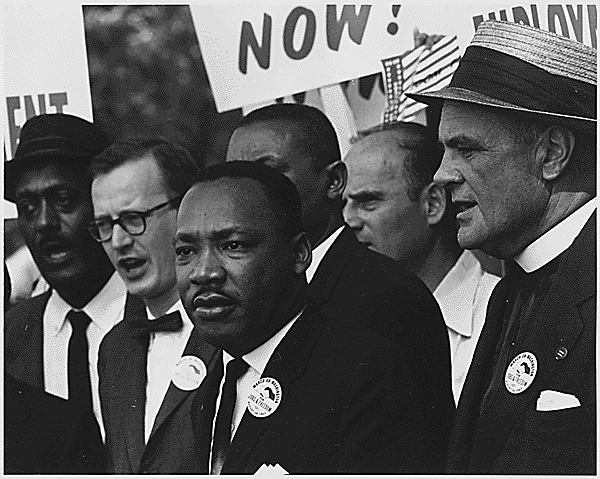
The photo of Dr. King (D.C., August, 1963)  is from the National Archives and is the public domain.
The crab claw was taken by Leslie.

Sunday, December 11, 2011

Teaching photosynthesis

I work hard to make my classroom "unscientifical." I discovered not so long ago that some students learn just enough scientifical vocabulary to throw me off their scent.


We are raising a generation of liturgists. I ask specific questions no one truly understands, I get back scientifical nonsense no one understands, and everyone pretends something was learned.
Teacher Priest: What is ATP?
Student Congregation: ATP is the main energy currency of cells.
I bet I can teach a parrot the Krebs cycle.
 ***

Light is light, and stuff is stuff, and never shall the twain meet. (Well, not in the Newtonian universe, anyway.)


Photosynthesis does not turn light into food. Yet almost all my lambs believe this. I suspect they believe this because that's what they've been told. It explains, logically, how trees can get so big without creating a crater around them.

Photosynthesis, of course, bangs together the atoms of CO2 and H2O to form a bigger, far less stable organic molecule. (We pretend that it's glucose, but it's really not... we simply cannot tell even simple truths to children.)

I am an educational professional--I can train most children to "know" the photosynthesis equation:

CO2 + H2O → C6H12O6 + O2

I can train the same students the respiration equation:
 
C6H12O6 + O2  → CO2 + H2O

And yet when I combust an organic compound, they are dumbstruck that water--the kind that comes out of faucets--"comes out" of the reaction, not internalizing that H2O is indeed the same thing as, well, water.

I don't want to be an educational professional. I want to be a teacher.


So tomorrow I light up the propane torch once again, and show them water from "fire." We'll discuss fire and energy and stuff.

I'll shine a bright light through my homemade chloroplast solution--just let some spinach leaves sit in alcohol for an hour or two--and let the children see the transparent green solution fluoresce an opaque deep red, as though transformed into blood, and we'll talk about excited electrons bouncing up, then back down. What is light? What is energy?

And they'll leave the class confused, because they'll think what they saw is magic.

It's not magic; I will not allow magic in my classroom. Magical thinking destroys our connections to the earth. We owe it to children to tell the truth.

I don't want to be an educational professional. I just want to teach.


The skeleton photo was right before my first back to school night ever!

Saturday, November 26, 2011

Last Saturday of November

Raked some leaves, then some clams, then some charcoals to cook the clams. New moon tide in late November on a spectacular day makes for good living, at least for me. Can't say the same for the clams now in my belly.

In between the leaves and the clams, Leslie and I kayaked up a local  creek. The cormorants are still here, soon to be replaced by the loons. The osprey are gone. We say a flock of surf scoters--a sure sign winter is coming.

The zinnias now put up tiny flowers, so little energy now available from the sun, but they're still trying.

I saw a few lazy bees hang onto the cosmos flowers--they were pretending to scoop up what little nectar remains, but they were mostly slumming in the sun. The only animals in these parts that cannot see the obvious are the H. sapiens sort.


The sun is dying. Long live the sun.

We can pretend to thrive under the fluorescent hum of madness, or we can settle into the patterns of the seasons. Biology is all about available sunlight.

If my lambs get that much, it will be enough.


Grace.

Friday, November 25, 2011

Ditching digital time

We're in the last few weeks of the dying sun, our days defined by our shadows. I know the sun will return, but I don't believe it.

The digital clock on my classroom wall leaves no shadows.  It defines little. It just assigns a number to now. 9:27, 9:27, 9:27, stuck in a moment. Suddenly the clock announces 9:28.

The sun barely moves, but it moves perceptibly, a fluid sliver of time  marking an infinite number of instants, and the long shadows move with it.


My analog clock moves with the sun, its second hand kissing the minute hand every 61 seconds, the minute hand kissing the hour hand every 65 minutes, the three hands uniting every 12 hours, then resuming the dance.
***

We spent a lot of money for fancy electronic whiteboards to replace the melamine boards that replaced the blackboards that replaced the slate. As fancy as the new board is, it has not fundamentally changed anything.

The images are fancier, they move, they tweet, they change colors, they can be saved to amuse another classroom full of children, but they do not alter the way children look at the world in any meaningful way. (They do, however, allow us to continue to cultivate the magical thinking that pervades our culture--another topic for another day.)

A digital clock alters obliterates our sense of time. It tells us of now only, a discrete now at that. An exact now. 9:29.
***

"I'm not late, it's still 9:30."
The bell rang a half minute ago.

I used to think the kids were just playing with me, confounding the instant after 9:30 started with the instant before 9:30 ends. But it really is all the same to many of my students. And to much of our staff.
***

My analog clock moves inexorably. It divvies up time into visible chunks of pie--this is where you are, this is how long you've been there, this is how long you will be there. The hands sweep over marked swaths of clock face.

The large hourglass that marked Dorothy's  inevitable destruction in Oz terrified me--the tangible flow of sand ebbing through its glass womb made even young viewers feel mortal.


Time flows both ways from the ever-present moment. The digital clock hides this from us, and we're glad not to know.
***

A bored child stares at the clock, eyelids hovering just over the pupils. When will this class ever ennnddddd...? 9:34...9:34...9:34....

Our class clock is covered with a large file card with the words "Tempus fugit" scribbled over it. (Sophomores love to say fuggit.) Time flees.

In front o the class I have a large analog clock, rescued from among the Great Clock Massacre of 2004, when we opened a new science wing at our high school.

Yes, children still get bored. Yes, eyelids still droop, But the droopy-eyed now stare at an analog clock, watching the seconds drip by, and, eventually, they see the barely perceptible movement of the minute hand as well. They learn the exact moment the bell will ring as the second hand sweeps past the 43rd tick on the clock's face. They see that 9:45 is a quarter of an hour from 10 (not 10:00), and three quarters away from 9.
***

I am not aware of any studies that looked at this, but I'd be willing to bet a carboy's worth of home-brewed mead that children learn more about time from an analog clock than from a block of blinking digital numerals masquerading as a time piece.

I pretend to teach high school biology, but what I focus on is teaching children how to see patterns, how to recognize the patterns as patterns, then how to describe the patterns in order to predict future patterns. Some folks call that science.

Everything that I can control in my classroom should be working toward those goals.

The digital clock does not, so it's covered up. If you want to know what time it is in Room B362, you're going to have to know how to read an analog clock.


Yes, we have a sundial, too--but it's only good for a few hours in the afternoon.
We have west windows.

The hourglass is obviously from The Wizard of Oz--
I got it from Julie Hedlund's website Write Up My Life

Thursday, November 24, 2011

Thanksgiving redux

I liked this 3 years ago.
I still like it....Happy Thanksgiving!


This week's The New Yorker magazine cover highlights a turkey sitting on a ledge with a few pigeons. It's the classic turkey any schoolkid would draw--blue head, red wattle, and a lovely banded tail.

Most turkeys destined for tables tomorrow, broad-breasted whites, never looked like this. Commercial growers prefer a bird whose feathers do not betray a less than perfect plucking job, a bird with a chest so broad it cannot reproduce without a few humans involved, a bird which does not taste like the one your grandmother ate.

Today I asked the kids to describe the turkey they planned to eat. Many refused to believe it has white feathers.

At least kids still have some connection between the critter and the cooked carcass.
***

Sean Nash has started a wonderful conversation on his blog, a chat initiated by a question asked by one of his students--where are the seeds in an orange?


Detachment.

Oranges without seeds. Flour without bran. Imitation crab.

None of this need be a big deal, and they may never know what they're missing. At my age, I cannot remember what I am missing. All I can do is taste the difference between a Brandywine tomato picked an hour ago, and whatever F1 hybrid tomato A&P is carrying. That is enough.

And what if a child today prefers the illusion of safety cocooned in a womb of technology? So what if she prefers WoW to the edge of a pond? What is lost?

And here is where old folk sputter and spew, because we know something's missing, right? By the time we're done sputtering, the earbuds are back in, thumbs waving like antennae, and the child's back in her universe.

What is lost?
Complexity beyond imagination.

If a child is not exposed to the incomprehensible, she will start to believe she understands the world, that the world is truly safe, that humans are truly superior creatures, that humans can fix any problem nature has to offer, not realizing that she and nature cannot be separated.

Enough of the rich and powerful adults among us grew up in cocoons, and seem genuinely puzzled by what has happened here in the States.

Those of us with toes in the mud know better, because we know we know almost nothing.

We know this much, though. The sun, a gift, only shines so much in a year. Plants, all gifts, only bear so much fruit in a year. There are only so many animals available to eat in a year. All economics, or at least all economics of value, ultimately comes down to how much the soil and the sun can yield--not in a year, not even in lifetime, but indefinitely. There are limits to what we know, to what we can know.

There are also limits to what we ought to know; I'm a heretic among science teachers. Wes Jackson, a farmer and founder of the Land Institute, is also a heretic:


For a half century now I have had the opportunity to witness the mind of religious fundamentalists at work.... We usually think of it as associated with certain religious denominations but it is now more rampant in the scientific community than religion. Fundamentalism is worrisome, wherever it is found, because it takes over where thought ends. It is so rampant in science now, that we plunge ahead with biotechnology faster than we can develop the intellectual framework and imagination for evaluating the possible risks.


The curriculum demands I teach my students about transgenic bacteria just a few years after they traced their hands and drew the spectacularly colored turkeys they thought they were eating.

I bet most of them still don't believe that turkeys are white.
***

I was going to show a brief video today of how turkeys are inseminated, but thankfully the school filters worked better than my frontal lobe. I still may have done just enough to make Thanksgiving a little more interesting tomorrow for some of our families.
Your science teacher did what?

He gobbled like a turkey, picked up a desk, pretended it was his chest, then tried to, er, you know, do it with a pretend girl turkey, and he couldn't, so now humans do turkeys. I found a video on YouTube...want to see it?

I'm calling the school first thing Monday!

Food, from the ground to our gut, has become taboo.

How many of us dare to show how animals are raised? Butchered? Processed? Even when done humanely, we hide it from the kids.
***

I gave every one of my freshmen a wheat berry today. I told them it was part of something they would stuff inside their turkey. Only one child guessed what it was.

Just about every town around here has a "Mill Street" dating back to when flour was only fresh for a few days, back when flour had enough oil to turn rancid. Refined flour, however, has a much longer shelf life. We don't need local mills anymore.

Crushed wheat berries are brown, not white.
Crushed wheat berries have a complex, wonderful flavor that makes bread come alive.
Crushed wheat berries can keep you alive without being fortified with folic acid, niacin, and riboflavin--they're already in there.

I have fallen out of the habit of making bread--I need to start again. My time would be better spend grinding wheat berries and baking bread than sitting in front of this monitor.

On the other hand, if I keep talking turkey in class, it might not be too long before I have a whole lot more time on my hands.


I lifted the orange from Sean Nash's site, who borrowed it from
Weil, Gyorgy. “wguri’s photostream.” oranges. 17 MAY 2007. Flickr. 24 Nov 2008 


The wheat berry came from the University of Arkansas.

The New Yorker cover came, natch, from the New Yorker site.

The bread comes courtesy of Jessica Pierce, the bunny lady.
She creates wonderful things regularly. If you're ever in Atlanta, stop by and try her cake!

Tuesday, June 21, 2011

Solstice graduation

"The eye of man hath not heard, the ear of man hath not seen, man’s hand is not able to taste, his tongue to conceive, nor his heart to report, what my dream was."


Except in June.

Just about every day this week I grabbed a few small, dark cherries from the small trees lining Liberty Street--just the right bitterness to counter the almost too rich fruitiness. The sun seems to have frozen in the north, teetering a week or two before starting our slow plunge back to darkness.

Life brims mid-June, feeding on the energy that bathes the Earth this time of year. The energy starts to dwindle tomorrow. Tonight I put my shoes away for the summer,unless, of course, there'a a wake. I took them off as I left our graduation ceremony. The ice returns in just a few months, as inevitable as the wakes that keep my shoes busy.

If you pay attention to these things, the dwindling light, the mad dancing of organisms in the June dusk, the aroma of honeysuckle drifting through your skull, the incessant buzzing of hundreds, thousands of critters aware of you, you'd go mad, of course, a Mid-Summer's Night Dream kind of insanity,

And many of us do--pay attention and go mad--mid-June, midsummer, when living requires little, as fine a time as any to toss a class of young adults out into the world.

And how many are "college and career-ready"? Not sure what that even means.

But I am sure of this--several hundred children from many different cultures, from many different lands, from many different circumstance, left our building tonight having an idea of what is possible, of what democracy can look like. A lot of them left our building "college ready" for schools they cannot afford, and "career ready" for jobs that left north Jersey a generation ago.

They are kind, they are brave, they are bright, and they are now adults entering a world Arne does not (or will not) recognize. As we turn inexorably to November, to darkness, to fear, I hope that a child's new-found knowledge of how the natural world gives her pause before she plunges into cynicism, or to self-loathing.

It's a beautiful world out there, but a world defined by limits imposed by our sun, our soil, or water. Our children are of this world, so long as they live. This matters more than any games imposed by wealthy gentlemen governing from hundreds of miles away.

Congratulations to our Class of 2011. This is your world, get to know it beyond the boundaries imposed by human words and limited ideas. Embrace it like you own it.

Because you do.


Teaching matters.
The print is Titania, by Joseph Noel Patton, 1850.

Tuesday, June 7, 2011

Another year ends

We're winding down.

Tomorrow I will wander over to the windowsill, pluck a few snowpeas who know only our classroom, and eat them. I will remind the students that their breath was combined with water, using the energy of the sun.


Communion without fanfare, a miracle unrecognized.

And if a few students leave class this week, our last few days of class, pondering the mystery of biology, the flow of energy, the flow of life, well, I've done my job.
***

I spent countless hours as a child trying to figure out transubstantiation. The wafer tasted like, well, a wafer, but the priest assured me it was the body of Christ.

In my head I imagine molecule after molecule substituting another. I did not know the concept did not originate until a thousand years after Christ's death.

This is my body.

And it is, complex organic molecules fused together by plants, abetted by the nitrogen fixing abilities of bacteria. In physical terms, at the molecular level, we are, truly, what we eat.

And everything we eat ultimately gets back to plants. OK, sunlight. Well, yeah, to something over 10 billion years ago.
***

We had some births in class, we had some deaths. Most of our tanks are unfiltered, unprocessed--light in, air in, and the occasional flakes of crushed shrimp. We have 2nd generation peas and wheat and fish and third generation snails and umpteenth generation of transformed bacteria that fluoresce.

We have the shells of horseshoe crabs and land snails, starfish and whelk.

Our class witnessed a starfish consume a snail, a shrimp snack on a hermit crab. None of this planned, all of it inevitable.

I am not a particularly religious man. My faith rests in the sun, in the plants, in life. I do not pretend to grasp the why of anything in science, and I do not ask my students to grasp anything I cannot see myself.

We do a lot of observation in B362. We see more than we can understand. We form hypotheses, we see hypotheses smashed, and we form new hypotheses.

I'm not sure how my lambs did on the state test, though historically they do well enough.

They leave my classroom more confused now than when they entered back in September.
And that's OK. That was the goal.


The world is, well, awesome. A fresh snowpea of a windowsill plant tells me so.