Showing posts with label truth. Show all posts

Wednesday, October 8, 2014

Fuck pink

These words, posted 5 years ago, started as a visceral response to a friend who coined
 "The One-Boobed Systyrs of the Apocalypse."
She's still fighting dead.


I remember the first breast I saw no longer attached to the body it once helped define. I had seen body parts in various forms before, but this one was fresh. A flap of sallow skin with a wizened nipple defining it, a long trail of fibrous fatty tissue trailing off the slab.

The pathologist, smoking as he dictated, handled the breast like a butcher handles meat about to be weighed, though not as kindly.

The breast had been part of a man who probably did not survive his bout with breast cancer. Most people back then did not fare well, and men fared worse than women.

Incidences of breast cancer change in populations as people migrate from one area of the world to another, suggesting that environmental factors contribute to this disease. There is a continuing effort at the NIEHS to identify these environmental factors and the role that exposures to specific chemicals could play in this disease.

National Institute of Environmental Health Sciences, NIH


I shaved my mother's head when the cancer recurred--bony metastases in her skull made the shaving more difficult. She walked like a marionette with tangled strings the weeks before she died. In a radiology reading room, we'd call them "goobers." Goobers on the brain.

Unless it was one of our mothers, our sisters, our daughters--then they were metastases.
***
Since 1985, Zeneca Pharmaceuticals has been the sole funder of October's National Breast Cancer Awareness Month (NBCAM). Zeneca has promoted a blame-the-victim strategy to explain away escalating breast cancer rates, which ignores the role of avoidable carcinogens. Zeneca's parent company, Imperial Chemical Industries (ICI), is one of the world's largest manufacturers of petrochemical and chlorinated [organic] products -- including the plastic ingredient, vinyl chloride -- which has been directly linked to breast cancer, and the pesticide Acetochlor.

In addition, Zeneca is the sole manufacturer of Tamoxifen, the world's top-selling cancer drug used for breast cancer. In return for funding the "awareness" campaign, ICI/Zeneca has control and veto power over every poster, pamphlet and commercial produced by NBCAM.

" A decade-old multi-million dollar deal between National Breast Cancer Awareness Month sponsors and Imperial Chemical Industries (ICI) has produced reckless misinformation on breast cancer," said Dr. Epstein.

The media focuses on the strength of cancer survivors, and I have seen tremendously strong women live and die graciously through months and years of chemotherapy and radiation and surgery. The magazines will show glossy pictures of proud women, and these things matter, of course. Avon will sell "Kiss Goodbye to Breast Cancer Lipsticks," Mars, Inc., will sell you pink and white M&M's, and General Electric will sell you a Senographe 2000D mammographer.

They do not show a mother cowering in her bathroom, her bald head bare, blood all over the toilet from a nosebleed that will not stop, her teen-age son standing awkwardly, bravely holding her head.

They do not show the vomiting, the pain, the fear. They do not show a mother with her arm in a machine trying to squish out the fluid building up from lymphedema.

They do not show the bony protuberances on a skull, the smell of dying cells.

They do not show a child wiping her mother clean because she is too proud to use a bedpan and too weak to use a toilet.
***
dichlorodiphenyl-dichloroethene
polychlorinated biphenyls
dieldrin
chlordane
heptachlor
polychlorinated dibenzodioxins


In 1991, these were the 6 most common carcinogens found in breast milk. The news has gotten worse since then. We are at the top of the food chain--toxins accumulate.

It has been known that breastfeeding reduces your chance of getting breast cancer. The longer you breastfeed your babies, the lower the risk. This has been attributed to hormonal changes related to breastfeeding--breastfeeding women cycle less, and had less exposure to estrogen.

There has been speculation (and it is only speculation), that breastfeeding may help reduce the chemical pollutant load on the mother. Guess who gets the chemicals.
***
The lifetime risk of a woman developing breast cancer was just less than 10% in the 1970's, or 1 in 10; it is now 13.4%, or almost 1 in 7 (NCI, 2005). In the 1940's, the risk was 1 in 22. Breast cancer is the leading cause of death in women 34 to 54 years of age.

Until recently, the incidence of breast cancer had gone up about a percentage point every year since 1940.
***
Janet Jackson flashes a breast, and our Federal Government now rushes to redefine obscene. Certain words and phrases will cost lots of money; Howard Stern has opted to put his voice into orbit.

Here's an obscene phrase that won't cost anything--in fact, in past Octobers you have might hear it dozens of times:

Early Detection is the Best Protection.

This makes no sense--once detected, you already have it. The best protection is prevention which, admittedly, would require massive, radical changes in the way we live. The NBCAM folks got wise--they now say "Early Detection Saves Lives"--if you go to their website, they pretend that this is what they have always said.

So it must be true.


I wrote this several years 8 or 9 ago for a friend,who was still fighting at the time, and my mother, who "lost."

Sunday, January 19, 2014

The Bambification of Dr. King

When I die, I hope nobody mistakes my kindness for niceness. I am not a nice man.
Dr. King's life profoundly affected mine.


I have almost reached the regrettable conclusion that the Negro's great stumbling block in his stride toward freedom is not the White Citizen's Counciler or the Ku Klux Klanner, but the white moderate, who is more devoted to "order" than to justice; who prefers a negative peace which is the absence of tension to a positive peace which is the presence of justice....Shallow understanding from people of good will is more frustrating than absolute misunderstanding from people of ill will.

Martin Luther King, Jr., from "Letter from a Birmingham Jail"
***

Death's shadow stretches long on a mid-day January beach.


Energy's no longer cheap. Last year's abundance has become scarce, and  the sun is too oblique to fulfill last summer's promises.

Purple sandpipers picked at the remnants of horseshoe crabs that failed to return with the last tide; several vultures hunkered down at the edge of the bay. Glistening glass orbs marked the end of comb jellies just out of reach of the receding waters.

We stumbled upon a hole dug by a gull, its presence betrayed by its footprints. Next to the whole lay a small, live clam. I tossed it back into the bay, figuring the gull had given up.

A few steps later, I found another displaced clam, again sitting next to a hole dug out by a gull, and again I tossed the critter back in the sea.

Then a third.

Winter beaches kill the ignorant. I looked around. Several similar holes, each with a clam next to it.

Gulls know how to open clams--I've watched them do it. They pick them up, hover over the jetty, then drop them, following them as they fall, ready to eat the freshly exposed flesh as the shell shatters on the rocks.

I suspect the clams had been left to die--their gaping shells would have saved a gull a few trips over the jetty.

I left the remaining clams on the beach.

One creature's death is another creature's grace. Powerful stories emerge daily from the beach--stories of grace and power and even love. None of them, however, are "nice."

Bambi never lived in the real world.


***

Dr. Martin Luther King, Jr., was loving, and kind, and powerful. His words still resonate, should you choose to hear them.

Do not confuse non-violence with passivity.
Do not confuse kindness with niceness.

During school announcements yesterday, our students were told that Dr. King pushed "cooperation." Rania Jones, a 3rd grade winner of the Milwaukee Public Schools' "People Must Work Together" King contest wrote "That's what we must do today - demonstrate cooperation." This is the Dr. King lite version of a complex story. This is the version that gives so many of us the day off on Monday.

"Love" is a complex word, and one not easily used in public settings. "Cooperation" is much safer, more sanitary.

And it's the wrong message.
***

My Dad joined  the 1963 March on Washington, dressed in full uniform, a proud US Marine officer. He flew A4 Phantom Skyhawks off carriers, in love with a country that let poor first generation children fly.

My dad was pulled to the front of the parade, or so the story goes. If you see a full-dressed USMC officer in photos from the parade, it may well be Bill Doyle. Dr. King later went on to oppose the Viet Nam War as unjust, and my father, a die-hard leatherneck, resigned his commission for the same reason.

I grew up in an Irish Catholic home, but Dr. King held as much influence as the Pope, maybe more, years before he was assassinated. My Dad loved the man, not the cartoon he has become.

Read "Letter From a Birmingham Jail."
Take a walk outside and watch the grace and agony of life around us.

Yes, it's complicated. Life is complex,

Bambi's just the celluloid illusion of a corporation that owns a good chunk of the airwaves today, including ABC. I'm betting you won't hear much about King's letter from jail Monday.

You want to learn about Dr. King? Go read his words, listen to his speeches, learn everything you can about him. But don't "cooperate" with those who would steal his image without his words, the Glenn Becks, the Arne Duncans, the innumerable talking heads that will piously bow on Monday.

Take a walk on Monday, a walk outside, away from noise. Carry a copy of King's letter and read it under the January sunlight.

Share it. Live it.
Don't let the dream die.


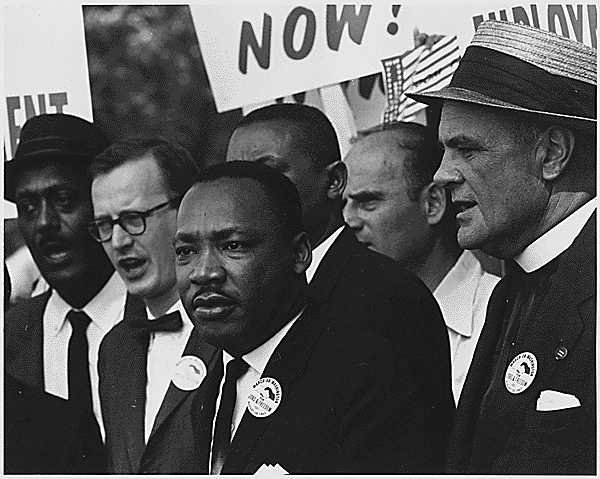
The photo of Dr. King (D.C., August, 1963)  is from the National Archives and is the public domain.
The crab claw was taken by Leslie.
This is a repost.

Saturday, December 29, 2012

On Beyoncé, choices, and hurting children

Yep, on my high horse again.... 


"Pepsi embraces creativity and understands that artists evolve. As a businesswoman, this allows me to work with a lifestyle brand with no compromise and without sacrificing my creativity."

You are wealthy, beautiful, bright, and have hundreds of millions of fans.

And yet you still felt the need to brand yourself with the seal of a corporation that pushes colored, carbonated high fructose corn syrup on the children you pretend you want to save from obesity.

I guess you can call the ad above iconic, in a hipsterish, Warholian way, and we can all wink at our unironic ironic irony, in our own mildly superior artsy way....

But I teach children, and I used to play doctor--I know what happens to a child who develops diabetes, loses her kidneys, her legs.

Hard to dance with these wounds, from Limb Salvage Institute

You can spout all you want to me about personal responsibility, and freedom of choice, and all that--you are leading a multi-million dollar marketing campaign aimed at children.

What we glorify defines who we are, and when kids see one of the most powerful women in the States branded by a company that prides itself on recognizing its "responsibility to help develop solutions to such key global challenges as obesity and malnutrition."

I teach children, because I care about them, and I teach science, because I care about the world.

If I do my job well, children will see through the unconscious hypocrisy of Beyoncé and Pepsi, through the lies so deep that children no longer have a reference point to truth in their virtual worlds that sell Pepsi as love.


Public schools stands as one of the few remaining public spaces left; the natural world surrounds us, and will not bend to money or power or fear--Jupiter will shine over us tonight, and it is there for any child brave enough to abandon her virtual world, her social world, her branded world, her world of forever unmet needs.

All a mammal ever needs sits outside, ultimately untameable, ultimately unknowable, ultimately unmarketable. Beyoncé calls our children like a Siren, promising the unobtainable, while increasing the market share of NxStage System One dialysis machines--you can buy a share (NXTM) for about ten bucks.

Natural acts have natural consequences. If a child can learn that much, she has a shot at real  happiness, and her chances of sharing her blood with a dialysis machine because of her lack of "personal" responsibility.
.
We're killing our children, and we lie to them (and ourselves) as we do it.


Tired of all the lies--a child need to think for herself if she is to think at all....

Saturday, September 8, 2012

Hand of God, hand of Darwin


Too often high school biology teachers take the soft way out when confronting challenges in the classroom.

"Science and religion answer different questions."

This is more convenient than true. How humans came to be is a religious question. It's also a science question. Trying to placate a student by insisting otherwise diminishes science, religion, and your student. If you think guiding a child's grasp of the natural world matters, then teach science.

If you think convenience matters more, get out of the classroom.
***

We have Disneyfied Darwin. (To be fair, we have a habit of sanitizing just about all the great thinkers in history.)

Darwin did not come up with the idea of evolution any more than Newton discovered gravity or Columbus proved the world is round.


Darwin's genius, the reason Darwin's ideas are so powerful and frightening, is this: once life was here (for whatever reason),  natural selection is sufficient to explain how humans (or any other organism alive today) came to be.

If natural selection is sufficient, then the Hand of God becomes superfluous. Not wrong, of course, and certainly not falsifiable--the supernaturalists will always have that edge over science--but folks get understandably peeved when the Almighty becomes a footnote.

If you're a 15 year old child with a firm belief in the omnipotence of a creator, and you get even an inkling of the repercussions of Darwin's concept of natural selection, you're going to feel like someone just ripped your world apart.

Because someone just did.
***

So, yes, science doesn't have much to say about whether God's Hand directed the traffic of evolution--it's no longer an interesting scientific question. Most of my students, like the vast majority of adults, do not get this. Heck, most people who "believe in" evolution don't get this, either.

It's easy to hide in this cloud of ignorance, to pretend science and religion serve different masters. I suspect many biology teachers (who, for the most part, are not biologists), do not themselves have a deep understanding of the repercussions of natural selection.

If Darwin was right, humans were not inevitable. That can be profoundly disturbing to a sophomore high school student.


I know it's disturbing to at least one 53 year old science teacher....
Michelangelo drew those hands, of course....


Tuesday, May 8, 2012

I've been slimed


Every day I am asked what the secret is to ensuring every child in New Jersey graduates from high school ready for college and career, and I always have one simple response – outstanding teachers.

I do not  doubt that you have "one simple response"--I do doubt your sincerity.

At a small meeting last spring among a few other teachers, and the Governor himself, you said that teachers were the most important factor affecting student success.

I said, perhaps a bit too pointedly (politeness is not my strong suit), that teachers are the most important factor in the building, but that poverty weighs more heavily than teachers do.

The Governor jumped in and said that you said "in the building." I did not hear that.

And here you go again.
I began my career as a high school history teacher, and I can honestly say that I never worked harder or felt more rewarded than I did during those four years.

Why did you leave, Mr. Cerf?

We as a state should make sure that we celebrate outstanding educators every day for their work with our children and for developing the next generation of leaders.
Providence knows we need them. Our current leaders need a few lessons in civility, in history, in analysis, and most of all in love.

But I don't just teach "the next generation of leaders," Mr. Cerf, I teach children. I teach the next generation of plumbers, of soldiers, of clerks, of attorneys. I teach the next generation of doctors and line workers, of ball players and police officers. I even teach a few destined for incarceration, for cruel endings despite living in a land blessed with fertile soil and decent water.

But mostly I teach the next generation of Americans, and perhaps the last generation of Americans, who have reasons to dream of a lofty experiment in government that trusted people, because it was once made of the people.

It is ridiculous, of course, to expect leaders to agree with everything I believe. It is not ridiculous, though, to expect a man like Mr. Cerf to serve openly and honestly, to work for the best interests of all children, not just those he cares to mold for his corporatocracy.

I teach in a public school, Mr. Cerf.
Do you even  know what "public" means anymore?


And Mr. Cerf does add the "in-school" clause later. He knows it's true.
Cerf photo from here.

Saturday, May 5, 2012

A world divided

I was forbidden to accept science and still believe in the lyrical poetry, the song that pushes the dance of cosmology or the story of descent with modification -- first by the science teacher and then by the church....

I never chose between the two and, on some level, I've never felt at home in either world.


Science is not about the "real" world but about the natural world--and there lies a world of difference. Your science teacher was mistaken when he divided the world.

The church, too, is mistaken, when it seeks to cleave what we want to be true from what we know to be true. The prophets lyrically warned us, but we do it anyway. (Which is, I guess, the whole point of prophets.)

If science is seen as a process--and it is, a particular process of developing stories to help us grasp the natural world--then "scientific belief" is nonsensical.

Art and science are both better defined by process than by ends--no one asks me if I "believe in" Picasso's Guernica. It's a silly question.


***


Neither science nor art require "belief" and neither invalidate any particular belief systems that tolerate truth. Both art and science are dangerous because both privilege truth.


This is why I believe in taboo. There are some things humans best leave alone, in science and art.

The Picasso piece is obvious; the other drawing is by Charles Darwin--turns out we're all related.


Wednesday, April 4, 2012

Slaughtering science in the classroom

It's planting time--as has been for the past few weeks. I poke a small hole in the earth, drop in a seed, push dirt over the hole, then go on to the next.


It is an act of faith that each seed will erupt into a growing organism, thrusting it roots deep into the dark, its leaves arching towards the sun. It is through acts of science that we "know" how.

I can tell you the science behind germination, a complex and fascinating dance, and if I'm feeling particularly cognitive, grasping this complexity brings joy. That's not what I think about though when sowing, when I think at all.

I pick up each basil seed one by one from my palm, each seed felt as it clings to my moist finger. Live seeds, even tiny ones, have a vital heft. I know this through experience, something I have done for years because I enjoy it, and because I like to eat fresh basil.

It's a good reason to pray, so I do.
***

I do not believe in science. A lot of folks do, but a lot of folks are confused. Science is not so much about the "real" world as it is the natural world--and therein lies a world of difference.

Science is not a belief system, it is a process, a particular process of  story-telling to help us understand the events we're capable of perceiving in the natural world. Science is not based on faith of any sort except that there is some kind of underlying universal order, without which science would not work.

And science works.
***

No one has seen an atom's nucleus, though we all know the story. No one has measured the gravity imposed on us by a random star 12 billion light years away, but we trust that the mathematical expression of gravity applies. We cannot visualize chemical bonds, yet our students draw stick figures of molecules using a line to represent what they call a "bond."


We test these things regularly--and most of our kids mindlessly pass those tests.

We fetishize science, finding huge meaning in facts when what really matters is how we write the stories, how we enhance our senses to see what is part of the natural world, and what is simply part of us. (The two are similar, but not identical.)

Praying for a basil seed's being makes at least as much sense as drawing stick figures of molecules. The stories of science are meant, simply, to understand what we can perceive. My prayers acknowledge that I cannot perceive everything that matters through senses alone.

When we fail to make these distinctions, when science defines reality and everything else dissolves into mere fictions, we not only demean the arts--we kill science.


The basil is from our classroom.
The stick formula drawing from Joachim Schummer, "The Chemical Core of Chemistry I: A Conceptual Approach"

Sunday, April 1, 2012

Why we hate science, 2

Leslie and I walked along the edge of the Atlantic this afternoon, arguing just what that meant. She believes the edge is ephemeral, abstract, and I drew a line at the highest point of the last wave. It was a pointless discussion, and done in play, but it gets back to the words thing. So many words approximate what we think we know.

If we knew what we were talking about, we wouldn't be so chatty.
From Fishing Destin Guide

I saw a sand flea on its side. I picked it up to look at it, and it kicked its legs a bit. I dug a hole at the edge of the ocean to give it a chance to survive, and accidentally uncovered another one. I dug another hole, disturbed yet another one. Thousands upon thousands of sand fleas lay under our feet, betrayed by the dying one lolling upside down in the tiny trench washed by the surf.

I buried it an inch or two, said a prayer, and walked on.

There is far more to this universe than we'll ever know. 
***

To reject expertise, to reject scientists, is not the same as to reject science, but the distinction can be fuzzy. Science research can be (and is) dictated by powerful folks who drive our economic engines. Scientists can be (and are) influenced by money, by rewards, by fame--everybody wants to be a rock star.

Science itself, though, can be practiced by anyone with a reasonably intact brain and a decent command of written language (a scarce commodity), anyone willing to follow where the natural world takes you.

I might say the same for democracy, substituting "rational thought" for "natural world"--and this similarity drives my passion for teaching in a Title 1 public school system. I'm not worried about the children in private schools, nor those in the elite suburban public schools. Our culture has their backs.

Democracy wasn't promoted by our British aristocratic roots--the first man killed in the Boston Massacre was once an American slave, a dockworker of both African and Wampanoag descent. If we ever remember our own history, we might avoid our habit of electing Tories.
***

The problem with science is that it tells the truth, at least as far as the natural world goes. You do this, you get that. We don't always understand the "that," and much of the creative joy in science is creating models of the "that" that can explain all this stuff outside our brains in a way we can understand.
  • Our current dominant economic system requires "growth"--it does not recognize natural limits.
  • Our current dominant political system depends on raw emotions--it does not recognize rational thought.
  • Our current dominant culture requires magical thinking and deference to humans--it does not recognize the mystery around us.
I am part of the bourgeoisie, a Christian when it's convenient, a social liberal who walks by the homeless, and I still get teary-eyed with a good rendition of our national anthem. I thrive in our human community, though many of my students do not.

Then I pick up a "dead" sand flea, and its feeble kicks tickle the palm of my hand, reminding me I know nothing, then dig up several others while trying, foolishly, to save the one.
***

The push for STEM education comes about for all the wrong reasons, and will fail for the same. We need to kick China's ass, we need to fix the economy, we need to kick Russia's ass, we need to provide workers for our multinational corporations, we need to kick India's ass, we need to get more energy, we need to kick Europe's ass....


Science, real science, starts with the first time a child's simple observation of the natural world conflicts with what she knows, the first time she realizes that the world most of us live in, as comforting as it may seem day to day, is made of mirrors. She has a choice to make, a huge choice that will push her into a new world that will separate her from her culture.

I have known a few real scientists in my classrooms, and most of them do not thrive in our building. The life of a scientist requires hard work, and may pay less than the high school science teacher who pushes them into a field he himself could not master.

You can no more make professional scientists by pushing high school science child than you can by eliminate obesity by requiring every child to take physical education.

We do it anyway.

What do you remember from high school science?


Sand flea by Fishing Destin Guide, permission pending
The STEM chart from New Voices for Research


Approximation to adequacy: why we hate science

The individual concepts of children, and the individual concepts of most persons who live and die in this world, are exceedingly vague, crude, and obscure. That is, they are vague, crude, and obscure in comparison with any approximation to adequacy.
Francis W. Parker, "Observation," Talks on Pedagogics, 1894


Leslie and I startled a black duck-like critter as we stepped over to the other side of a jetty. It scrabbled its way back to the water, its legs flailing against the sand. It had a bright orange-red beak, and it swam a lot better than it ran.

What was it? Not sure. We'll find out eventually by putting together its shape, color, location, season--all things recorded by others, things I can look up. Right now I suspect it was a black scoter. A few minutes on the internet, and I'll figure it out.
***

Science requires observation, of course, but it also requires a way to record those observations. Humans (and other mammals) when left on their own will see what they need to see. Context matters.

Writing things down matters more than we realize--we give life to words, because words make moments permanent. We can compare a moment we had two years ago with the one we have now. It turns out our words are less fallible malleable than our memories. Before the written word, our stories were certain and true.

Words make our stories more certain, and over time, less true. We trust the book (in whatever form) over our elders now, no small reason we have formalized our warehousing of the old. We no longer need the old folks for their collective memory, and books don't soil their beds.
***

Science works because the natural world follows consistent rules, and because those who practice science trust their written words over their intuitions. It still upsets me that an American dime (2.3 grams) falls as fast as the  CRC Handbook of Chemistry and Physics (almost 3500 grams) when I drop both from about 8 feet on the first day of class.

They both hit the floor at the same time, every time.

I know that they will, but I still don't believe it.  Cognitive dissonance.

Cognitive dissonance hurts, a lot, and for good reason. A mammal who hesitates, who is confused by competing interpretations of its environment, may soon end up in pieces, torn by the talons and teeth of a critter a bit more focused.

If my students aren't grabbing their brains complaining that all this science stuff hurts, then I'm not teaching science, I'm teaching trivia. I teach a lot of trivia.

Ripping away the comfort of cultural reality creeps people out. On a rare day, I'll see a glimpse of fear in a child's eye as she feels the floor drop under her feet. I won't push this, but I will acknowledge it--"the world is bigger than any of us can know" or maybe "welcome to science."

What I won't do is pretend it's not terrifying, this cognitive dissonance, bucking hundreds of millions of years of evolution that taught us to fear the shadows, fear the dissonance.

I'm sure a English Language Arts teacher sees the same when a child grasps that Gilgamesh shares his fears of death in a poem written almost 3,000 years ago. An art teacher sees the joy on a child's face as she recognizes the power of her hands and her imagination, so rarely expressed in a classroom.

None of us see it during review for the state tests.


Yes, I am working my way to this...
Thanks, Kate Tabor, for the book!

Tuesday, February 28, 2012

Transformations

Yesterday we fooled a few bacteria into taking in some jellyfish DNA, and now they fluoresce green. Tomorrow I will take a few colonies of these and give them what we all need--food, shelter, and a little security, and I'll get a few million more by Thursday.

This has become old hat in high school biology classes, but it still blows my mind, as it should.

We are all God  now. You may laugh, and I can temper this with some off-hand remark, but we're not the same critters we were before we started transforming lifeforms. That we do this with indifference makes it seem surreal.


(I wanted to jump up and down and scream in delight and fear--"Look what we've done!!!!" And, OK, maybe I did, just a little bit....)
***

A few planets are lining up this week, and a few folks are excited. So excited that you can go online and see them.

That planets are visible naked eye is pretty cool, and that they wander against the background of stars even neater. Indeed, that's where the word "planet" comes from--planasthai, "to wander."

To stare at one naked eye, though, is not particularly exciting. They flicker less than stars, and are quite bright, but, well, um--they look like stars.

We have made looking at planets a check list event, a commodity, an "event" simply because it's an event.

A lot of folks cannot fathom anymore why that bothers me, so I guess that puts me in the crank category. A lot of folks cannot fathom what they even want.

Maybe the point of education is to learn what you want, to figure out what's worth seeking. I'm pretty sure it's not to pass a standardized test.
***

Most of my students have never stumbled upon a flickering comb jelly, flashing electric blue as it lies dying on the beach. I have, and I wondered--who was meant to see the light?

I can change the way light is reflected off bacteria, light meant only for a few other humans to see, to reflect our glory of ourselves as we play God.

Some comb jellies flash an electric blue when disturbed, presumably to distract predators. This makes sense, a logical reason to expend energy, fit for our mechanistic view of the world.

Yet when I squat by a dying critter, the rhythm of the wash of waves running through my ears, the salty smell of the dying in my nostrils, the soft forgiving warm and wet sand caressing my feet, this single jelly flashing its last three, brief pulses of light on the edge of the bay matters to me, and I do not know why.

I only saw it because I happened to be there--and it would have mattered even if I had not seen it.

I have no opinion on the existence of God--my people said He is unknowable, and I, to their chagrin, took them at their word. I do not truck with what I cannot know.

But I do know this--we cannot know (and can never know) what we pretend to know today. Hubris does not require the existence of gods.

Tomorrow I will be the destroyer of earths as I kill the same bacterial cultures we worked hard to create. I will pretend this does not bother me.
***

As for the planets, if you think it's worth staring at them online, I have a few other parlor tricks that may interest you.

Cristoforo Colombo used a similar parlor trick to fool the locals of what is now known as Jamaica. The locals had supported Colombo and his crew, but were (understandably) a little annoyed at the murderous actions of some of his crew. Colombo knew of an impending lunar eclipse predicted by Regiomontanus many years before. He attributed the eclipse to the Christian God, the same God Europe used to justify slaughtering those who knew my bay before me.

Stories matter.

Still, a lunar eclipse is about as exciting as the planets lined up in late winter--a parlor show. That they exist (and that we figured out what those points of light mean) are the stories worth knowing.

So tomorrow, an hour or so after my bacteria break down their last molecules of sugar, I will wander outside Bloomfield High, take a look west, and see the string of planetary pearls that got so much attention this week.


Then I'll walk home, knowing I am among the luckiest men alive, feeling the earth below with every step that takes me home.


Hokey smokes! Fluorescent bacteria!!!!

Sunday, February 26, 2012

Evidence-based hypocrisy

This one meanders and is meant for heavy fire--I want to know why "evidenced-based research" is an oxymoron in education. I want to know why Gardner and Marzano are revered for their research. I want to understand why the cult of personality supersedes rationality in my craft.


I love playing with numbers, and I love trying to understand the world beyond the human noise. So do a few other folks. It's what scientists do.

If you want to know if a particular action (independent variable) has a particular effect, you set up an experiment. You minimize extraneous actions as much as you can (and eliminating them all is impossible even in the simplest experiments), run your experiment, collect your results (dependent variable), then do it again. And again and again and again....

You may see a pattern emerge, you may not. The pattern you see emerge may be consistent with what you thought you knew, it may not. If you see a pattern emerge, it may have caused by the independent variable, but, and this is critical, chances are pretty good it may not be.

If there is less than 5% chance that your results occurred randomly, they can be considered significant--and the word "significant" means nothing more, nothing less than that. You can have  results that look like change has occurred, and still have no significance, and you can have significant results that show change did not happen.

One final point. Correlation does not mean causation unless you have a perfect experiment with only one  variable--and this is impossible. If you want to know why some scientists get a reputation for walking around like they got peri-anal meter sticks under their pants,  try controlling anything for all variables.
***

Social scientists have three huge problems:

First, the myriad variables inherent in humans and their interactions  makes reducing any experiment to just one variable impossible. There are ways to minimize the noise--using huge sample sizes, for instance--but the results will always be a tad wiggly.

Second, imposing an independent variable on a select population of humans to see what happens compared to a separate, similar population creates chilling ethical considerations. Autonomous mammals tend to reject such nonsense.*

One way around this is to use retrospective studies--look for a pattern among culled data instead of trying to run a true experiment. For example, I can look at the demographic data of kids taking the HSPA, and see if there is any correlation between their Zodiac sign and their math scores. If I find a significant (again, less than 5% chance these results are random) data, I might have something worth sharing.

The last problem may be the biggest, one that infects American education today--because social science research is so wiggly, and because it tends to use retrospective data, I can make a career latching on to a piece of data suggesting correlation, scream about it, then become the go-to guru.

This happens in the natural sciences, too--people is people--but in the natural sciences, published claims are easily tested. Scientists make a living climbing on the backs of others, destroying their colleagues hypotheses with better ideas and better data--a lovely mud bath of human foibles exposed for all the world to see.

For reasons I still do not grasp, this doesn't happen much in education. We have "theories" without evidence, and handsome men gracing websites, paid to give sermons sharing their "research."
***

I have my suspicions. Careers are made selling snake oil, and there's a lot of money floating around public education.

I have no fear of research-based initiatives influencing what I do in the classroom. If decent, replicable studies shows that my lambs will learn more science if I wear an eggplant on my head, then I will do that. In the meantime, I will continue to do what has worked reasonably well for several generations influenced by Francis Parker, John Dewey, Jerome Bruner, Margaret  Donaldson, Lev Vygotsky, among many others.

I will continue to use advanced tools so long as they serve our purpose. My $2 whiteboards are superior, for what we do in science class, to our $2000 SmartBoard, but I also use 1:1 netbooks to (sometimes) good effect. My Mobi, alas, never quite took off.

I will use decent recent research, but my criteria for "decent" goes beyond a pretty face and a slick repackaging of what we already know works. Daniel Willingham (who definitely does not have a slick hairdo) is a cognitive psychologist who initially studied "brain basis of memory and learning" and now focuses on the "the application of cognitive psychology to K-12 education."

I was a pediatrician before I threw my hat into professional wrestling education. I know a lot about child development, and expected those in education would, too. (I also expected my kids to fall in love with photosynthesis at first sight--I was a bit naive going in.)

I'm all for evidence-based best practices--any superintendents out there want to try it?


*Medical research has the same issue--people are people--the Tuskegee syphilis experiment belongs in a huge Hall of Shame, as does the Fernald School which allowed Harvard and MIT to used radioactive cereal on retarded children. Theses kinds of experiments tend to be performed on the less powerful among us--the poor, the incarcerated, the children.


Young woman scientist via Shorpy/Library of Congress
Snake oil ad via Wikimedia

Sunday, February 19, 2012

Teachers are not (yet) professionals

A scorpion, being a very poor swimmer, asked a turtle to carry him on his back across a river. "Are you mad?" exclaimed the turtle. "You'll sting me while I'm swimming and I'll drown." 

"My dear turtle," laughed the scorpion, "if I were to sting you, you would drown and I would go down with you. Now where is the logic in that?" 

"You're right!" cried the turtle. "Hop on!" The scorpion climbed aboard and halfway across the river gave the turtle a mighty sting. As they both sank to the bottom, the turtle resignedly said: 

"Do you mind if I ask you something? You said there'd be no logic in your stinging me. Why did you do it?"

"It has nothing to do with logic," the drowning scorpion sadly replied. "It's just my character." 
Joe Hill

I belong to the Bloomfield Education Association, the NJEA, and the NEA--none have behaved admirably the past couple of years, but they have done what unions are supposed to do. I pay them a lot of money to do this, and I'll just smile here and pretend everything's hunky-dory. That's how the rank and file are supposed to roll.

A lot of teachers are frustrated, but that's part of being in any profession that deals with embryos that pretty much do what they do, no matter what the President, the Pope, or the PTA say.  We can handle frustration.

What we cannot tolerate is our erosion of autonomy.

The union fights for dollars, benefits, hours (ha!), and reasonable working conditions. It does not fight for the kids. Not saying it should (though if the NEA could grab $15/year/kid I bet it would), but let's be clear on what the union does. It serves a clear and necessary function, as do septic tanks and sergeants.

If a colleague of yours is accused of doing something unseemly with a student, the union lawyers will defend him, no matter what the circumstances. We pay the scorpions to be scorpions, and I'm OK with that.

Just don't expect them to be anything they're not.

***

In medicine, I almost got to fisticuffs twice--and I still regret not punching a particular colleague in the nose (/me waves to Barry).

Cooler heads prevailed, and instead we tossed journals at each other. P values, corroborated studies, prospective vs. retrospective, controlled vs. anecdotal, meta-analysis vs. multiple studies. A lot of medicine is as mucky and murky as Chicago politics, but we worked with what we had, and we had a common goal: fix the kids.

If a child died, we all lost.

I don't get the sense that my current profession fears damage to children more than damage to ourselves. We say the right things, but our behavior is what matters.

If a hospital administrator ever tried to pawn the stuff masquerading as "research" in the ed world, we would have simply laughed. Despite organizational charts on paper, we knew as the ones directly giving care that we held the power. Laughter has a way of democratizing a workplace.

Instead I get a union that put this on the cover of NJEA Review last September:

Mikey don't play that way.....


A profession can survive a crisis in faith, as long as our faith is shared. It cannot survive a lack of vision.

A profession can survive bad research, as long as the research can be assessed honestly. It cannot survive bad research used dishonestly.

We're either professionals. or we're not. It's our behavior, not our words, that matter.
***

The union is designed to protect our jobs, not our profession. That's up to us.

I have an idea. Why not develop guilds to complement our unions?
  • We have a common cause, educating our children.
  • We have common methods, subject to peer-reviewed research.
  • We have common goals. Within a building we know who's got game.

No more fear. No more fear. No more fear. No more fear.
***

In two weeks, licensed NJ professional high school teachers will proctor the HSPA, our alms to NCLB. We will grumble, we will bark, and we'll still hand out the tests.

Arne has not earned our love.
 

Some of us might even feel dirty, though most of us will just do what we do because we're told to do it.

That's not professionalism. 
***

I'd like a colleague to be passionate enough, mad enough, care enough to punch me in the nose if my actions endanger a child.

Look at your classroom. Look at your students. Look at your actions.

Here in New Jersey we are in real danger of losing our union protections within the next two years. A few of us will lose our paychecks no matter what we do.

I propose that we work together to do what's best for our kids. We can hash out just what that might be privately, and a few noses might get bloodied. The only hard rule is that we act what we believe matters for our kids, not ourselves.

Isn't that why you got into this profession?


If you're happy and you know it, clap your hands....

Jose Vilson and Ken Bernstein got me going today. Tom Hoffman deserves some blame, too. How far are you going to take this?

The turtle and the scorpion story is well-known, lofted verbatim from Snopes.

Saturday, January 28, 2012

Truth

A drum found on the edge of the Delaware Bay.
 Grace

God, I know nothing, my sense is all nonsense,
And fear of You begins intelligence;
Does it end there? For sexual love, for food,
For books and birch trees I claim gratitude,
But when I grieve over the unripe dead
My grief festers, corrupted into dread,
And I know nothing. Give us our daily bread.

Donald Hall, Old and New Poems, used without permission


Late January, and though warm enough to get the bees about, we still need light, more light, to keep us all alive. And not all of us will get through the winter.

I stumble upon death along the bay's edge--the detritus of uncountable lives lost accented by the stray wing of a gull licked by the edge of high tide today.

Still, a honey bee found it worth her while to spend some energy sipping nectar from our rosemary bush. A blue bottle fly joined her,shoving its head into the sky blue rosemary flower, seeking what it wanted at that moment.

We're not so good at knowing what we want. How do I know this? Just look around.
***

On Thursday, my students were subjected to propaganda, their amygdalas tugged by a series of images and videos tying together Columbine, Hitler, smiling toddlers, Anne Frank, and (for the love of Zeus) Chuck Norris himself.

We all sat in an auditorium with no windows, entertained by "Colleen," a young woman with lovely teeth and healthy skin, telling stories meant to instill fear. The presentation was well choreographed, and it had its intended effects.

Create the bogey man, then tell kids that kindness will kill it.
***

I fell into Bloomfield by accident almost 30 years ago, and stayed because I love it. We're a mixed town, in mixed's myriad senses. We're scrappy. We're a bit to the left on the intellectual (but not intelligence) curve. Most important, we're kind.

That's a huge statement.

When my wife got smashed by a car, meals showed up on our stoop for weeks, meals made by friends, and meals made by friends of friends.

We used to have factories--we made flags, we made metal tubing, we made candy, we made rubber products. We had saw mills, cotton mills,copper mills, paper mills, and woolen mills. We had Schering and General Electric and Westinghouse. We still have an abandoned field where the Manhattan Project first enriched uranium, our town tainted by our patriotism.

We don't make much anymore because other towns across the oceans make it for less. We're a little bit desperate these days.

But we're still kind.
***

Walks along the edge of the bay remind me what is true, what matters. We are all mortal, every one of us, and every day I remember this, and every day it surprises me.

Walks along the bay remind me that there's a lot more going on than language and electronic images can capture.

Earlier today I saw a Canada goose at the ocean's edge, an unusual place for this bird. As we approached, it waddled into the surf, getting smacked one wave after the next.

It will not likely make it to February. No guarantees any of us will. My student's do not need to hear the multiple shots of two very troubled young men in Columbine to know this.

A walk in the beach will suffice.
***
Bread made by Jessica Pierce.

So here's my late resolution for 2012.

I will speak truthfully, always, to my students.

They know that I am happy, they know I find love using a clam rake, but find my joy, and maybe any joy, confusing. They have been trained by parents, by teachers, by culture, not to know what they want.

They seek immortal life with no idea why.
They fear death with no idea why.
They chase what others tell them they want with no idea why.

My primary task as a science teacher is to show them that the natural world dwarfs our imagination, and that the more we seek, the less we know, and that with this comes a paradoxical comfort.

Few of my students have seen the stars as their grandparents did, few of them know where food comes from as their grandparents did, few of them grasp how tenuous all this is as their grandparents did.

Death is certain, fear of death is not.

Joy is possible (even) in a classroom. I know nothing, but I know joy.
By June I pray my students know a little bit more about what is possible and about what is not.

Grace.


You are mortal. Why not act as though you believe it?


Thursday, January 26, 2012

A science teacher's challenge

 "The road to Hell is paved with good intentions."
Thoughts on Rachel's Challenge.


Atoms, as most adults know them, do not exist. Never have. Our models are human constructs, useful but little more than organized patterns of neurons firing away, as we try to make sense of the world around us.

Yet most reasonable adults in these parts will tell you that they know what an atom is.

Quahogs, on the other hand, are as real as these hands upon this keyboard. Beautifully curved mollusks that live with as much purpose as most of us, tucked away in mud flats just a few miles away. Good eating, too.

Yet most reasonable adults in these parts could not find one with a GPS mounted on a bull rake.


Which matters more?


The abstract matters, of course. Without it, language dissolves and bridges fall. Still, the point of language is to share our collective grasp of the world around us.

 We worship our words, our images, more than the ground we literally walk on, the dirt that keeps us fed.

***
Today our lambs got exposed to a cacophony of sound and images--Chuck Norris and bullets and Sean Hannity and smiling babies and Hitler and  white coffins and Anne Frank and moving anthems and stories of coincidences that defy logic all to send a simple message: be kind.

The show was designed to rip at the amygdala, an organ already pretty charged up in the adolescent crowd. I don't like seeing truth and children manipulated, even if (or maybe especially if) the message is kindness.

The models of science ultimately rest on our understanding of the ground beneath our feet. As abstract as science can get, it's ruled by what can perceive of the physical world. Science requires evidence, and it requires open discussion of how that evidence can be fairly interpreted.

Maybe I just don't like Chuck Norris.

I'm a science teacher. I worried a bit about my students accepting the stories told today at face value simply because their emotions were twanging like Duane Eddy's guitar.

I needn't have worried. My students have been mostly kind this year. I kept quiet as I listened to their conversations.They're adding a healthy skepticism to their kindness.

The kids are all right.


Oh, and a suggestion--if you spend an hour telling the kids how everyone matters as much as everyone else, don't end it by announcing a "select" few will get together later to start a club.

Chuck Norris photo from Amazon.

Thursday, January 12, 2012

Seeing thro' the eye...


We are led to believe a lie
When we see not thro' the eye,
Which was born in a night to perish in a night,
When the soul slept in beams of light.
William Blake 

I found the light above after it passed through the multiple lenses of a horseshoe crab that no longer needed them. The light was there whether or not I saw it, but I saw it, so now I share it.

It's been an interesting year. I sat directly across the Governor Christie in my school building, and next to the NJ Acting Commissioner Cerf in his.

I listened to both of them, and they both deigned to listen to me. I heard their words, then parsed the meaning of those words. I am blessed with moderate intelligence and keen curiosity, so I have little doubt of how they expected me to interpret their words.

And, sadly, there is nothing true from either meeting worth sharing.


It's been an odd year here in New Jersey.
I'm sticking to the classroom--where I can still effect change.


Friday, December 30, 2011

Faith based science


Everywhere I look I see signs of spontaneous generation. Scum blooms in a puddle of water, flies erupt from a wintry beach, and I once found a possum carcass writhing with maggots obviously emanating from its flesh.

We see this, but we all know that spontaneous generation does not happen. We know this with a certainty, a certainty that confounds me given the evidence to the contrary all around me.

Comb jelly spontaneously generating from wet sand.


A colleague reproduced Pasteur's experiment with the gooseneck flask and chicken broth. We both watched the open flask for a full school year. We both knew in our heads that nothing would grow, yet we were surprised anyway.


I have yet to meet a child, however, who believes in spontaneous generation. We've knocked it out of our culture, more through magic than science.

We tell kids every year that every cell comes from a pre-existing cell, and every year the students write this down like ancient Irish scribes, preserving truth without question, to be recited as Gospel, never questioning where the first cell came from.

Here in urban New Jersey, evolution gets presented with hardly a murmur. Most students think it's obvious, this evolution thing, and if surveyed by Gallup would call themselves "believers."

My frustration with those who accept the theory of evolution is not that descent with modification is invalid. It's not--it's a wonderful schema that makes sense of all of biology. No, my frustration is that most adults I know do not grasp the fundamental idea behind Darwin's work, the same fundamental idea he wrestled with for decades:
While natural selection is not random, the genetic variation it acts upon is random.
Humans, it turns out, were not inevitable. Evolution has no goal.And our demise is inevitable.

I am not saying we should teach children that life springs up from spontaneous generation, and that evolution's goal is to produce the perfect human. That would be silly, and grounds for my dismissal.

If a child accepts evolution  and denies that spontaneous generation occurs before dabbling in anything resembling science, then my job is paradoxically much more difficult.

Science starts with your relationship with your senses, not your culture. We're raising priests, not science literacy.


Good Lord, it's gorgeous outside--see you again when winter returns. 
Pasteur's flask came from Microbiology GPC.


Sunday, December 25, 2011

A Christmas Tale

I love the Christmas Story, the lights, the glitter, the love. I love that the day coincides with the first glimmer of the rising sun. I love the madness that reminds us how tenuous our grip is.

Here's a photo from the latest Vatican nativity scene. It's a lovely crèche, just unveiled on Christmas Eve, and as tradition mandates, the Magi are there, bearing their gifts.


Only problem, the wise men didn't show up until a year or two after the birth, at least according to the Holy Bible.

I'm not looking for a fight on Christmas Day. I was raised Irish Catholic, grew up with various crèches as much a part of today as our tree and our Santa, and put faith in The Gospels (while recognizing humans told these stories long after the Crucifixion).

But here's the rub--just asking a practicing Christian when the Wise Men finally got to Bethlehem often brings an  incredulous stare with a hint of hostility.

If the Vatican sanctions the bastardized story that the Magi were present the night of Jesus' birth, a story the Holy See must know to be corrupt, what hope does a science teacher have of sharing stories that do not fit a child's preconceptions of the universe?

None, actually, but my goals are far less grandiose. I just want a child to learn to see, and to question inconsistencies in our stories based on the natural world.


If a child happens to question the inconsistencies in other parts of her life--sustainable economic "growth," Peacekeeper missiles, and a nuclear submarine named the USS Corpus Christi ("the body of Christ")--she has a chance to change a human world that needs a bit of changing, a world that is worth saving.


The Corpus Christi insignia is from Bluejacket.com. 

Yes, I know the official name is USS City of Corpus Christi--heck, I even lived there when I was still a Marine brat--but it's original name was Corpus Christi, changed under pressure by the Church, despite objections by the Navy Secretary John Lehman.

The nativity scene by Max Rossi (Reuters) via Indonesia Katakami.


Monday, October 31, 2011

What is the highest result of education?

With all the dashing about, pretending that we can make leaders of us all, make scientists of us all, pretending that the whole point of education is test score and "college and career readiness," well, it's no small joy to be working under a Principal who puts up in the hallway a large poster quoting Helen Keller:

"The highest result of education is tolerance."

Not bad, and most teachers would appreciate the thoughtfulness (I did) and move on (I didn't).

The word "tolerance" sticks in my craw--it's not a bad word, but just the hint that it requires the tolerant to endure people not of the same ilk bothers me. OK, I can't tolerate the word.

I mentioned this to the Principal, even suggesting that "love" might be a better fit, fully understanding that even the most tolerant Principal can't have a quote like this:

"The highest result of education is love."
 That's too Kumbayesque even for me, and that's saying something.

Leslie, who keeps me sane, suggested "empathy"--which I really liked, and I mentioned it to our Principal.

And today I saw this on our school message board outside:


Amen. And thank you.


Oh, yes, that white stuff is snow. I'm not very tolerant of that, either.