Showing posts with label plants. Show all posts

Sunday, March 2, 2014

Seeds of civilization


We're still up to our butts in snow here, with more coming, but today I plant the first seeds of the summer.

Peppers take their time crafting baby peppers, and given a voice, would not be here in Jersey at all.

The story of planned planting is the story of civilization, a word that evokes complex (and for me mixed) feelings. Music without guitars, foods without farms, travel without cars--for the brief times I am walking along a mud flat hunting quahogs, civilization recedes.

I will clear out a small space for my pepper plant seedlings. and kill many beings I do not see (and a few that I do) in order to create an orderly, human space for my pepper plants. We forget the inherent power of our words, our thumbs, our sheer size, as we tear up the earth for what we need, and more for what we want.


Civilization is dangerous enough when we remember our connection to the earth, when we acknowledge our limits, when we still recognize sin or hubris or whatever word you care to use that defines the moment we forget our connection to something bigger than ourselves.

Lose your land, lose your power--there are not enough mulberry trees or mud flats or dandelions to keep my family alive, so we barter our services for what we can find on the shelves of our local grocery stores. In education we sell this as career readiness, and some of us use the threat of joblessness and starvation as motivation to get a diploma.

And we wonder why so many of us are sick....

So I plant. I share seeds with others, and we plant and plant.
  • I do not want my students to topple civilization--I just want them to know that it starts in the dirt that does not recognize deeds.
  • I do not want my children to covet their neighbor's land--I just want them to realize the costs of living landless, depending on strangers for food.
  • I do not want my lambs to lack career readiness--I just want them to learn how to live once their bellies are full and the rent is paid.
I believe in the land, in the sea, in the air I breathe, and the remnants of  the Constitution of the United States. I trust the patterns of the natural world, while recognizing much of it will remain impenetrable. Most of all, I trust that the seeds I plant later today will reward me with food, and more seeds for whatever March holds for me next year.

That's why I teach.
Education exists To Serve Man?

The clams and the pepper plants will be here long after I am gone, and, if we teach our children well, so will this great land of ours.

We need to take it back.


Yes, it sounds like an idealistic dream. This country was founded on dreams.
Hops photo  from the backyard.


Friday, November 11, 2011

Clamming in November

The shadows are long, now, even at noon. We know why, of course, and pretend otherwise, living under electric lights, listening to electric voices, staring at electric screens.

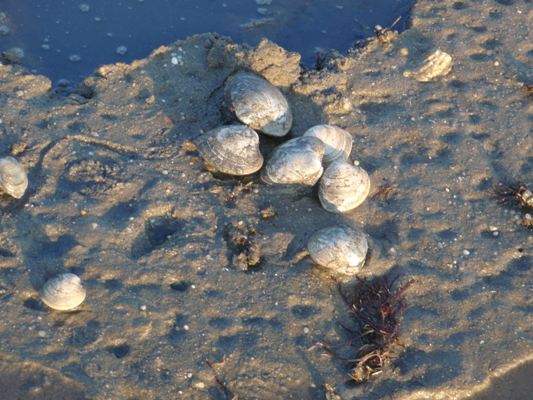
The wind is blowing over 20 knots from the northwest, in November, and the tidal flats call like Sirens. No one out there but me, a gull, a few scoters, and the clams.

I teach in an urban district, where the few guns around tend to be snubby, designed to be used at close range on humans. I spend most of my free moments in Cape May, where guns are more prevalent, tend to be longer, and more often used on game other than H. sapiens.

I hunt with a rake and a hook, not quite bloodless, and unlikely to raise my testosterone cred, but it does connect me with this life business more than the folks who never kill their prey.

I'd rather be a wolf than a vulture, no matter how fancy the store. We have a lot to learn from the hunters.
***

Even vegetarians kill. Plants are every bit as alive as you and me. We place high regard on sentience, and no one has yet shown that plants give a damn about anything, but every living animal must take lives in order to stay living.

Tonight we munched on quahogs and Brussels sprout sprouts. The clams are dead, the Brussels still alive, so a vegetarian could claim some moral superiority.

Even so, the clams tasted pretty good.
***

I put three back, the largest I caught. Each was a couple of decades old, each had done nothing to earn the wrath of my rake.

They are sitting within a few inches of each other, their collective age older than mine, and I hope they spawn.

Their fellow quahogs are in my belly now.

And so it goes.....


Photo taken along Richadson Sound by us.

Thursday, January 6, 2011

Fun with a microscope camera

You can tell kids that plants are alive, and they nod and write it down in their notebooks, then get on with their lives. Their notebooks reflect what the system tells them, not what they believe.

You can show pictures of chloroplasts, and they nod and draw them in their notebooks, then get on with their lives. There's no reason to invest a whole lot of thought in plants.

Or you can project the cytoplasmic streaming of an elodea leaf, sitting on a microscope on your desk.


"That's a video, right...?"
No, that's what's happening under that microscope


"That's the leaf? You mean, like, it's alive?"

To a child (or most adults), if it doesn't move, it's not alive.
And on some days, even this cranky old biology teacher feels the same way.

Their faces lit up as though they were watching fireworks.

We had the added bonus of seeing the chloroplasts change shape as they muddled through the cell. Watching the chloroplasts scrunch up as they hit the corner of a cell wall, bending like the water balloons they are, shows just how squiggly membranes are.

Seeing the chloroplasts live makes it real.

Not sure anybody wrote anything in their notebooks about what they saw--no need to. It's part of their lives.


The video was posted by on YouTube by pphotoex. His (her?) blog is in Japanese.

I am going to set the microscope camera out every day now --
I'm smacking myself on the head.
Such a simple idea, with a huge return.