Showing posts with label mistakes. Show all posts

Sunday, September 28, 2014

Our class errorometer

While sharing pints with a few teachers upstairs at McGinty's,
Chris Harbeck took a sip of Guinness, then tossed out a few words that changed my teaching--
"I give out points for anything, a thousand here, a thousand there. They don't mean anything."


Image PD, quote added by Golda Poretsky.


We train kids to fear mistakes.

That's not always a bad thing--I just spent the better part of this glorious fall weekend breaking a pipe that required cutting a hole in the wall because I have more confidence than skills, and may need to call a plumber to fix what I broke.

Still, I learned a lot about plumbing and 1908 pipe threads--things were not quite as standardized then--and I have to admit, I enjoyed solving the many problems that popped up along the way. Even if this project ends up an utter disaster, I had fun along the way, satisfying some evolutionary trait that kept my lineage around for over three billion years.

(I am convinced that "fun" is pretty much always an evolutionary artifact.)

Boy Scouts having fun, 1913, via Shorpy.

School is not fun; making too many mistakes gets you labeled as that kid, and too many teachers say that those kid will end up broke, homeless, and hungry unless we teach them to make fewer mistakes.

We fuck them up even more with the religion of ranking.
Many of my "top-ranked" lambs are my most timid.
So I worked on fixing this.

Here's one of my ideas that seems to have worked:


We have a class Errorometer Board. Each time someone makes a good mistake--and there are all kinds of errors that fall in this category--we add a point. For every 10 points, everybody in class gets bonus points factored into their grades, as real as any other points "earned."

Yes, some wackadoodle well versed in the school game will then say something deliberately wrong to earn points, and I explain why saying something deliberately wrong does not count. We're not about the school game, we're about learning.

Even after the novelty wears off, the kids keep track of the Errorometer--they will spontaneously evaluate whether a mistake has earned a point.  I also toss in points for great, unexpected right answers.


Chris Harbeck is right, the points mean nothing. I finally found a way to make them useful.
Frank Noschese and Christopher Danielson were sharing the same rounds.
Photo of Errorometer coming whenever I remember to take a picture.



Friday, January 7, 2011

Faith and fear


For I took an Earthen vessel, in which I put 200 pounds of Earth that had been dried in a Furnace, which I moystened with Rainwater, and I implanted therein the Trunk or Stem of a Willow Tree, weighing five pounds; and at length, five years being finished, the Tree sprung from thence, did weigh 169 pounds, and about three ounces... I again dried the Earth of the Vessell, and there were found the same two hundred pounds, wanting about two ounces. Therefore 164 pounds of Wood, Barks, and Roots, arose out of water onely.

Jean Baptista van Helmont
Early 17th century experiment


That's how it works. You observe the natural world, take a stab at explaining it, and get it wrong. Van Helmont could have stayed on sure footing--the "stuff" of the tree did not come from the earth he used.

This week I am asking my lambs to memorize the photosynthesis equation. I have them breathe on their hands to remind them what "stuff" plants need for this (carbon dioxide and water), and the warmth of the breath reminds them that the plant needs energy to put the stuff together.

The warmth is sunlight transformed--to chemical bonds in plants, now to body heat.

The words "carbon dioxide" mean little to most, and many keep calling it "carbon"--I've broken a lot of pencils to show them what carbon looks like.

And yet I insist on teaching them that plants take it in on little more evidence than faith in me or in their fear of failing. Faith and fear may work for that old tyme religion, but it should have little place in a science class.

Which makes me a hypocrite--from the Greek hypokrites or "pretender" [Online Etymology Dictionary].
***

Van Helmont's experiment is wondrously flawed--he wanted to show that water feeds plants, but shoved 200 pounds of dirt between his willow and the water. He should have just planted the willow in plain water. (I learned this from David R. Hershey, who talks about this in a fun article "Digging Deeper into Helmont's Famous Willow Tree Experiment, " The American Biology Teacher, 1991.)

My students fear failure in class, and not irrationally. Failure kills students in public education.

We grow all kinds of things in class. Just this week, a child took home a fully formed carrot that grew in peat moss, fed by our breath and the water she gave it.

If I asked a very smart kindergartener how a plant grows seemingly from nothing, she might raise an eyebrow with an incredulous look--"It ate the water!"--how can a grown-up be so dense.

If I ask a sophomore, many will stumble, trying to give me sciency jargon. At least the kindergartner got it half right.
***

Unlearning is hard. My students have been blowing on their hands for 4 months now, since the first week, when we discussed why a candle (or anything else in the classroom) burns.

Over and over and over again I break things down into two categories--"stuff" or energy.

When you burn something, you end up with exactly the same amount of stuff you started with. Exactly, down to the atom. For all the light and heat and sound that erupt in from my lit propane torch, none of that energy cost an atom.

I sweep the propane torch on a large flask, fogging the glass with water, water that did not exist until that moment. I can talk of electrons and oxygen and energy states, but that's a lot of theory to toss out based on a little bit of fog from flame.

Faith, boys and girls, faith. And there's a test in two days. Fear, girls and boys, fear.

And why do I comply. Fear and selfishness. I love teaching, and pretend that I can slip some science in now and again. Right now the tests are winning.

***

Part of me believes that if I can get my students thinking, really thinking, they will do fine on the state exam. I'm not convinced. So long as the exam asks students to discuss invisible gases, I've got to push faith in the classroom. Ironically, van Helmont, who came up with the idea that carbon dioxide is a special kind of gas, distinct from air.

I am convinced that they will know more about the world in June than they did coming in, but, to be fair, that might just reflect a general maturity on their part.

***

I want my students to be wrong at least 5 times a class. At this point, I'll even except quiet wrongs, mistakes made on our old school whiteboards. I won't accept ludicrous wrongs unless there's a train of thought behind them.

One of the most important things I am just learning, now in my fifth year, that the truly ludicrous wrong answers have some thought or history behind them.

If a child hears over and over that photons are "particles" of light, well, then any rational child will think of light as "stuff." If a child hears over and over that plants make food from sunlight, it only confirms that light is "stuff." It's not, of course, but try unteaching this!

We spend a lot of class time unraveling bad science.

May is coming, the New Jersey Biology Competency Exam looms. Who has time for science? Trust me, lambs! Or else you will fail!

*sigh*


Ironically, van Helmont was a victim of faith and The Inquisition;
much of his work was not published in his lifetime, likely out of fear.


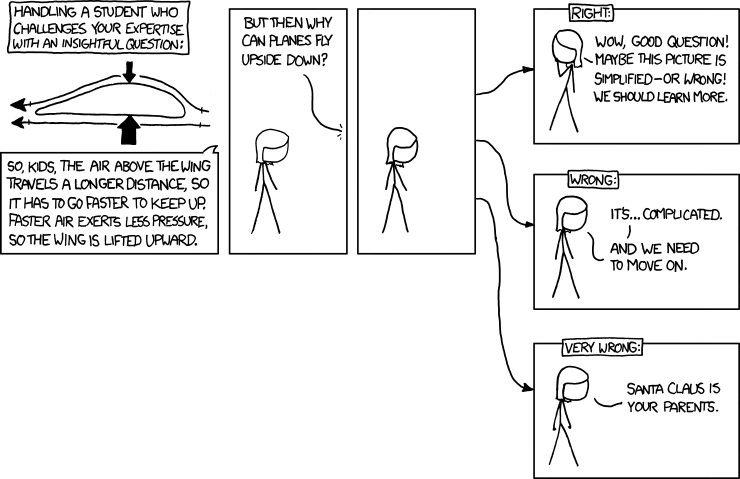
The cartoon is, of course, xkcd.