Showing posts with label evolution. Show all posts

Tuesday, February 24, 2015

What are you living for?

Every living critter under and over you, in and around you, has a lineage just as long as yours, stringing back billions of years, with the same basic daily goals and needs as you.

Except most of us in our culture have forgotten what those goals are. We've also forgotten (or spend our hours trying to forget) our mortality.
When was the last time kids in your classroom discussed "what are you living for" with a reasonably rational adult?

Lazy ass jelly fish lolling in the Delaware Bay at dusk.

Animals (besides humans) never plan for the future beyond taking care of the business that needs to be taken care of in order to live. Beyond that, most animals fiddle away the day socializing, eating, snoozing, or just watching the shadows move as the sun glides by, the antitheses of the good capitalists and consumers humans cherish in these parts.


Time for Achieve to start cracking down on all those lazy ass squirrels!
Common Core Squirrel Standards, anyone?


Monday, December 30, 2013

Our evolving ignorance


evolution2013-1 

It gets worse, at least from a biology teacher's point of view:

Only about a third of Americans accept natural selection, the cornerstone of biology. That's like "believing in"  chemistry without accepting the concept of atoms, or physics without accepting inertia.

Forget NAEP, forget NGSS, PARCC, and CCSS--forget all of that, because whatever we're doing is not working, and will not work, so long as we continue to treat children as standardized units, as long as we treasure obedience over skepticism, as long as we continue to reward the worst of our behaviors at our highest levels of power.

In the meantime, I will continue to plant seeds in our classroom, both figuratively and literally, until the happy (but not inevitable) day when our children bark at the nonsense we feed them every day at home, in school, in malls, in just about any space where kids encounter adults.


Take a child clamming, gardening, fishing, crabbing, kite-flying, hunting, whatever it takes.


Saturday, September 8, 2012

Hand of God, hand of Darwin


Too often high school biology teachers take the soft way out when confronting challenges in the classroom.

"Science and religion answer different questions."

This is more convenient than true. How humans came to be is a religious question. It's also a science question. Trying to placate a student by insisting otherwise diminishes science, religion, and your student. If you think guiding a child's grasp of the natural world matters, then teach science.

If you think convenience matters more, get out of the classroom.
***

We have Disneyfied Darwin. (To be fair, we have a habit of sanitizing just about all the great thinkers in history.)

Darwin did not come up with the idea of evolution any more than Newton discovered gravity or Columbus proved the world is round.


Darwin's genius, the reason Darwin's ideas are so powerful and frightening, is this: once life was here (for whatever reason),  natural selection is sufficient to explain how humans (or any other organism alive today) came to be.

If natural selection is sufficient, then the Hand of God becomes superfluous. Not wrong, of course, and certainly not falsifiable--the supernaturalists will always have that edge over science--but folks get understandably peeved when the Almighty becomes a footnote.

If you're a 15 year old child with a firm belief in the omnipotence of a creator, and you get even an inkling of the repercussions of Darwin's concept of natural selection, you're going to feel like someone just ripped your world apart.

Because someone just did.
***

So, yes, science doesn't have much to say about whether God's Hand directed the traffic of evolution--it's no longer an interesting scientific question. Most of my students, like the vast majority of adults, do not get this. Heck, most people who "believe in" evolution don't get this, either.

It's easy to hide in this cloud of ignorance, to pretend science and religion serve different masters. I suspect many biology teachers (who, for the most part, are not biologists), do not themselves have a deep understanding of the repercussions of natural selection.

If Darwin was right, humans were not inevitable. That can be profoundly disturbing to a sophomore high school student.


I know it's disturbing to at least one 53 year old science teacher....
Michelangelo drew those hands, of course....


Thursday, May 3, 2012

I don't believe in gravity, either


I may have more trouble with those who "believe in" evolution than I do with Creationists. At least the Creationists are upfront about their deliberate ignorance of the empirical.


If you think that the poster is an effective argument for evolution, then you may not quite grasp the profundity of gravity either. That things fall is obvious. That all things made of stuff are attracted to all other things made of stuff, not so much.

That there is a predictable relationship between all matter in our universe is a bigger deal than many who "believe in" gravity grasp.

There may be some confusion about religion, too, a confusion exacerbated by those who would distinguish spiritual from religious.

Natural selection, by itself, is obvious. Living things have heritable differences. Some living things are more likely to reproduce than others, partly because of these difference. Those that reproduce pass their qualities on to the next generation.

You need time for complexity to evolve, and time we have.

But complexity is not the "goal." We are not headed towards a higher being, just a different one, possibly more complex, possibly not.

When a child gets this, do not be surprised if she goes into a trance for a day or a week. A child who gets this will feel her universe shift under her feet, her place redefined, her sophomoric cynicism squashed by awe.

Some folk call that a religious feeling, and it is. 

Grasping evolution changes our relationships with the living world around us.

Darwin's reasoning does not need to supplant God, and for many it does not. The theory of evolution does, however, supplant the need for a superior consciousness (or any other sort of consciousness) to guide the development of the beasts we call human.

It takes more than a class or two for a kid to get this, but there's no mistaking when one does. She's the one who's gone silent, stunned.

Natural selection is deceptively easy to grasp. It's not the concept that most of us resist. It's the implications. Evolution has no goal.

We're no more evolved than the earthworm, the mushroom, or the E. coli in our guts.


The jumping lamb is from Life is Physics Not Mathematics.
It's all good--we're all a part of this universe thing, and that's just awesome!


Sunday, February 12, 2012

Quahogs, Darwin, and grace

Today is Darwin Day, honoring a complex man with a stunningly simple idea that replaced the need for magical thinking.

Folks may hold on to their magic, I know I do, but they can no longer use rational thinking to hold on to the idea that the Hand of God was necessary to craft our appearance here.

The theory of evolution cannot disprove God—no science can. That was never Darwin’s intent.

See, if you grasp science, you grasp that it is not designed to disprove anything outside the realm of the natural world.

It’s not science using theology that causes all the trouble. It’s theology insisting that its stories are scientifically sound. 

I like hot sauce and I like  fruit, but I don't splash Tabasco on my blueberries.
I like fables, and I like science. I try not to confound the two.
 ***


Yesterday the soft gray wintry sky spit on the flint gray water. The air was chilly, but the water was still mid-40's, balmy for February.

Clamming in February, somewhere in Cape May County

I pulled just over a dozen quahogs out of the mix of muck and sand that gives them life. My hands were numb, too numb to feel the slice of flesh, but not so numb that I could not feel the sure shape of a cherrystone nestled in my hand. Perfect.

The more you look at these critters, the more beautiful and sophisticated they appear.

I gently tucked the oldest one back into the muck, one much older than the students I teach. I also tossed back the smallest, not out of sentiment--the small ones are tasty--but out of respect for the law.

Within a few hours, what was left of them sat in our bellies.
***


Here's the thing about science, something Darwin knew, something too many today do not--something does not have to be empirically demonstrated and peer-reviewed to be true, even matters of the natural world.

The natural world exceeds our collective imagination. The science world is limited to the parts of the natural world we have bothered to see. Since what we bother to see is influenced heavily by the wages we get to see it, what we look at represents a tiny, biased view of our universe.

This is true of scientists, this s true of the clergy, this is true of butchers, bakers, and candlestick makers. It's also true of me, and (if I may be so presumptuous) you.

Pulling up a quahog from the muck on a wet wintry day interests me. Quahogs interest me enough to know, from personal study, that many of the chowder clams I toss back are older than me, no matter what science says.
If I had pursued science research as a career, I would not be playing with quahogs, I'd be playing with telomeres--not because telomeres are more interesting, but because telomeres may unlock the fountain of youth, and (subsequently and more importantly)  have some heavy finanacial interests invested in them.

My sophomores feel this. What we call science in high school biology narrows their world view. Their wages (in this case grades) depend on reducing life to a series of incomprehensible and unpronounceable words attached to illustrations of things no human or mammal or any living thing at all has ever seen.
***


You can tell how old a clam is by checking its rings. I have seen several quahogs well into their 60's and 70's, and I mostly toss them back, again not (mostly) out of sentiment, but because they tend to be chewy.

If you Google northern quahog age you'll learn that until recently, "researchers" stated that the oldest northern  quahogs were around 40. I knew otherwise, as does anyone else who bothers to gather clams in places too shallow for dredgers, but I lack the sophisticated "sclerochronological analysis" employed by scientists. I do have eyes, though, and a large sample size

An hour ago, they were still in the mud.


Less than a year ago, researchers discovered that my quahogs can live over a hundred years:
Annually resolved growth lines in the hinge region and margin of the shell were identified and counted; the age of the oldest clam shell was determined to be at least 106 y. This age represents a considerable increase in the known maximum life span for M. mercenaria, more than doubling the maximum recorded life span of the species (46 y).


I could roll my eyes, but this is how science works. And now the "known" recorded life span has more than doubled.
***

But this has always been true. Natural selection has always been true. Gravity has always been true. Our understanding is more recent.

What separates science from the rest of what we know is that it depends on faith in the natural world, and faith in the idea that certain patterns have always been true, and will remain true.

God may (or may not) be a human construct--there's no way to test this empirically, and because it's untestable, it's not only uninteresting to science, it can never be science.

When I feel the perfect heft of an ancient quahog in my hand on a mid-winter day, 
when I become part of the gray light, part of the muddy smell, 
when my edge of self blends in with the detritus of life in the chilly mud between my toes, 
I am unconscious of the rational.

Mercenaria mercenaria, Homo sapiens

I am also ridiculously happy, happy to be part of this thing, whatever this thing is, that connects me and the clams and everything that lives to a world we've done nothing to deserve.

Read Charles Darwin's words. Know that he was happiest when absorbing the  incomprehensible variety of life around us, of us. The first love of his life left him because he preferred collecting bugs to meeting her family during winter break at college.

Happy Birthday, Charles Darwin.


 Darwin did not kill God.
Those who persist in using science to prove God exists, though, just might.


Clam photos by us taken yesterday. 
Yes, I know, I fubared the html--still working on it....

Monday, January 9, 2012

Oh, dear, New Hampshire, too?

"I want the full portrait of evolution and the people who came up with the ideas to be presented. It's a worldview and it's godless....Columbine, remember that? They were believers in evolution. That's evidence right there."

For all the excitement over whether evolution can explain H. sapiens without appealing to the dominant version of God in these parts, I'm working on the small battles.

Leaves come mostly from air, a lit propane torch emits water, a dime falls as fast as the 7th edition of Campbell's Biology, a charged glass rod can bend a stream of water, a tiny pinhole can flip an image upside down, you can light a lamp by spinning a magnet in a coil of wire, and you can balance a gyroscope on a finger.

Sunlight makes a radiometer spin, gingko fruit smells like vomit, red cabbage juice changes color when you add acid, a garbage bag with the air vacuumed out can immobilize a JV high school football player, and you can crush an empty Pepsi can instantly simply by cooling it quickly.

You can launch a rocket a couple of hundred feet up using just a little water and a lot of air, you can float a paper clip on water, you can make that floating paper clip act like a compass by magnetizing it first, you can make green chlorophyll fluoresce red.

You can catch (and listen to) a radio signal with a long wire and the right crystal, you can make a coat hanger sound like bells, you can see Jupiter with your bare eyes, and you can grow a bean in the back of a science classroom.

I got a whole lot of things every bit as interesting and seemingly miraculous as evolution, and none of it is magic.

Maybe we should just ban the teaching of science period--God only knows how much damage thinking might cause to this fine democracy.


You cannot make this stuff up....

Sunday, October 30, 2011

Doritos and daphnia

In the middle of the snowstorm yesterday, I scrambled out to my tiny pond, a mud puddle, really, to fetch as much elodea as I could for school. Elodea is a lovely water plant that plays well with microscopes. I also scooped up about 5 gallons of pond water full of critters about as ill-prepared for the storm as I was.

Two buckets of pond water now sit in the kitchen--some will overwinter in the basement under fluorescent lights, some in the windowsill of our classroom. (One year I had mayflies in January.)


The classroom pond water has been there for years now. I should really start it over--as the years go by, the evaporating water leaves behind traces of salts, and eventually it will be too salty for pond life. For now, though, the water fleas still dance among a few translucent snails and the knolls of blue-green algae covering the bottom. All sorts of microscopic critters flit through the duckweed.

I could start over, dumping my windowsill pond down into the drain, starting fresh. Starting over without consequences, though, is a tricky thing, possibly impossible, in life, human or otherwise. Everything we do has consequences.

So I work with what I have, and what I have includes the great-great-great-great offspring of daphnia from my backyard summers ago.
***

The metaphysical (or at least the anti-reality folks, or ARFs as I shall call them) crowd has me worried. The Daily Show ran a piece with an ARF, Noelle Nikpour, yipping away against science:

The Daily Show With Jon StewartMon - Thurs 11p / 10c
Weathering Fights - Science: What's It Up To?
www.thedailyshow.com
Daily Show Full EpisodesPolitical Humor & Satire BlogThe Daily Show on Facebook


I have several children who know more about the Mayan calendar than they do about evolution. I have more than several children who do not know their connection to the earth. We tell children that our planet is round, and that Doritos are junk food, without offering a shred of evidence for either.

I'll concede that the Earth is round. Took me awhile to believe it, but after years of looking at boats disappear over the edge of the sea, shadows change over the seasons, and photos from satellites, it's easier believing it's round than flat.

Doritos, however, are miracles, a sophisticated blend of complex organic molecules fused together by plants using the energy emanating from the sun, itself a miracle, fusing hydrogen into helium. They're food, and pretty good food at that--and all food is biology at its gory best.

I get one shot to teach children biology--for most of my kids, this is the last time they will study biology in any formal sense, ill prepared to face years of propaganda via the Noelle Nikpours, Rick Perrys, and Rick Warren (what is it with Ricks?) of the world.

Tomorrow I will haul a couple of gallons of water almost a mile, as my ancestors did (though for a different reason), to bring more "real" life to my biology classroom. In the end, I cannot hope to compete with the propaganda fed both inside and out the school by the monied interests who know more about demographics than democracy, more about profit than people.

My hope is to give children a taste of just how large this universe is, how wonderful, how deeply ingrained we are with it, and it with us.

A bucket of pond water holds more life than most of us can imagine.

It starts with a single drop.


Or I could just teach to the state test, and put the microscopes away.

Monday, August 29, 2011

Intelligent curriculum design?

When anyone suggests that we not teach evolution in school, he is suggesting that we not teach biology, and in a broader sense, science.


So let's be more frank about the discussion--do we teach science, or something else pretending to be science (which reduces science to superstition), or skip the whole thing entirely?

(And no, technology doesn't count--I can teach a child how to put together an automobile without her understanding much about combustion or friction or the basic laws of Newtonian physics.)

Wednesday, June 29, 2011

It's all there for those who care to look

 This was posted two years ago. I liked it then, and I still do.

It's  late June.


Light life and more light and more life. Little makes sense, but in June the abundance pushes aside the questions.

I have tooth marks in my thumb from a fluke. A snake no longer than a ruler tried to strike me a few hours later. A lone bat heralded dusk.


School winds down in June.

Next year I plan to start with Darwin's idea of descent with modification. He did not invent evolution. He did, however, figure out that the raw beauty of life's symphony here can be explained without appealing to some central plan that places humans above all else.

It's all there for those who care to look.

If you are going to acknowledge something is unknowable or incomprehensible or too powerful to comprehend, hey, I'm right there with you. Many things will remain unknowable in any scientific sense.

When you try to explain the inexplicable, when you presume to know the "meaning" of existence, though, keep it outside my classroom door. I teach biology, not metaphysics.


I'll be glad to discuss the "unknowable" with you,
ideally by a lake at dusk,
watching bluegill sucking down lightning bugs
enamored by their own reflection.

Just not in class.


Photos taken a few moments ago--grapes, honeysuckle, and sage.

Sunday, February 20, 2011

Moving on up!

In the past, I have had some enlightening literature left on my desk.


If you reject Jesus, your Creator, that will be your worst mistake ever! You'll be in the lake of fire with billions of others who believe we evolved from monkeys. 


If "billions of others" believe we evolved from monkeys, well, something is wrong with science education. We did not evolve from monkeys, we evolved from a common ancestor.

On the other hand, if "billions of others" accept natural selection as the mechanism for descent with modification, but are simply confused about which organism we came from, maybe there's still hope for science education and the billions of souls sitting in the cauldron of fire.

On the other other hand, if I'm 15 years old, and I have a choice between passing an exam about something I don't quite understand, or tanking the exam and avoiding the whole lake of fire thing, well, I'm taking the easy way out. Eternity is a long, long time--longer, even, than when the Cubs last won a World Series.

We must never forget what children are learning outside science class. I'm not saying it justifies willful ignorance, but really, if we just preach instead of teach, we are not going to make a bit of difference in our students' worldviews.


Yes, it's really called Chick Publications.

Monday, January 31, 2011

Science fiction

 13 percent of teachers explicitly endorse creationism or intelligent design, and spend at least on hour of class time presenting it in a positive light. An additional 5 percent reported that they support creationism in passing or when answering students’ questions.
from Wired, citing Science.


What if 13% of science teachers announced in class that they didn't believe that our current economic system is sustainable, that there are limits in biology, that capitalism as practiced today will collapse in the face on natural limits? How long would they last?


What if 13% of science teachers made it a point to discuss the biological basis of homosexuality, to explicitly analyze twin studies suggesting that genetics plays a role in sexual behaviors? How long would they last?

What if 13% of science teachers explicitly discussed the phenomenal rise of breast cancer in our land since the 1940's, the rise of carcinogens found in breast milk, the local CEOs who dumped toxins on our towns, the politics of industrial waste disposal?

Heck, what if 13% of science teachers explicitly discussed the threat of leprous leprechauns roaming the countryside?

Ask your child what your science teacher "believes"--then do something about it.


The photo of the book cover from here.
And no, I do not speak of economic collapse in class. 
We do talk about population growth and carrying capacity. I let your children come to their own conclusions.

Monday, November 29, 2010

What ales us


"Because when you’re set in your ways, you stay true to yourself."

I'll give the wealthy Coors family this much. They've managed to sum up the crisis in education, in our culture, and in our experiment in democracy in a succinct piece of propaganda.

And they managed to do this by selling mediocre beer at a premium price.

We don't need no stinkin' schoolin'--we revel in our ignorance.

(And we wonder why less than half of Americans accept evolution, the cornerstone of biology.)


Photo by Steven Rhodes , used under CC, of Joe Rees' neon sculpture.

Friday, August 13, 2010

A dandelion's life


Here's a question I would love to pose to my sophomores:

Is the spark of life in humans more valuable than the spark of life in a dandelion?

I am not asking which organism is more valuable, more productive, more useful, or more sacred....though you might be surprised at how I answer those.

Is the flame of life, whatever that happens to be, identical for humans and dandelions?

***

Life, once gone, is gone for good. A chain that extends back more than 3 billion years, millions upon millions of millions of generations, has broken. The flame of life within you, that is you, has been lit since before the dinosaurs, before life came onto land, before oxygen filled the air.

Like fire, you can pass your life onto new creatures, who can spread the flame further and further again and again long after you have gone.

If you go back far enough, you and the dandelion sitting in your yard come from a common ancestral species. Everything alive comes from prior organisms that were alive. You and the dandelion are related. Literally.

Like fire, so long as even a small flame exists, it can spread, and remain the same fire, even as the original source of the flames is snuffed out. We deify the Olympic flame for a reason.

***

Witnessing the death of a human under your hands is rarely clean. Death happens in errant steps, but the final break is startling. I have seen more than my share fair of human deaths, and every one of them startled me. I have lost a few close people. Each death changes me. One nearly destroyed me.

Still, I think nothing of digging up a dandelion and tossing it in the compost bin.

Is there anything substantially different between the flame of the dandelion and the flame within me?

***
What's the point of the exercise, why should I use it for class?

We are studying biology, we are studying life, we are studying something that gets to the core of our existence. My lambs are at a wonderful age--young adolescents start to question pretty much everything as their bodies betray childhood.

Just about all of my students (and the rest of us as well) see life as discrete units--organisms. We grieve when we grieve because we lose organisms we love, not because the universe suddenly has a smidgeon less living mass.

The spark of life of my parents, dead as both are, still exists in me and my siblings. In me and my cousins. In me and all the descendants of those lives that first arose from the soup that existed when tides were violent and the Earth still quite warm.

The spark of life that was in my parents came from the same source that spark the dandelion.

We are all cousins.
***


Eye rolls:
OK, enough philosophy crap, Dr. D, what does this have to do with anything?
And will it be on the test?

We teach children that the DNA of the bacteria in their poop codes exactly the same way ours does. Indeed, human insulin today come from engineered E. coli. Yes, that E. coli.

We share many proteins with plants, coded with similar sequences of DNA, because we come from the same ancestors.

This is a big deal if you take time to think about it. We rarely take the time, because, well, the state test is coming, we still have to cover a few dozen more standards.

Still, if I can get the kids to see, really see, life as a messy web with all kinds of tentacles emerging from some common events a long time ago, then maybe, just maybe, I can get them to see plants as alive us we are.

If they get that, then evolution becomes interesting.

If a student passes the state exam without knowing that, then the state exam isn't worth the student's time.


OK, a few things:

Yes, I am aware that the Hadean period may have been a
lot cooler than earlier believed, the sun's output lower, etc.--
here's a nice summary of recent thinking on that from the New York Times.


No, we do not share 50% of our DNA with bananas--another topic for another day.

The dandelion is from Wikimedia, by Loyna

Vats of human insulin lifted from Scott's Web Log: January 2008. Credit attached.


Saturday, August 7, 2010

Biology essential question: Were humans inevitable?

The essential question of the year is already up on the board:

Were humans inevitable?


But now I'm thinking (and thinking) that it's not personal enough, so I may change it to this:

Were you inevitable?

(Sophomores love chatting about themselves, and they love big questions. Not necessarily because they're budding philosophers, but rather because the Big Question discussions spool away a lot of class time that would otherwise be used doing boring school stuff.)

At first blush, textbook science says no, you were not inevitable, you're a happenstance--a particular sperm got to a particular egg because of some random thunderstorm occurred 20 years ago and your parents accidentally met up in a phone booth seeking shelter from the rain.

And the discussion ends.

That's why I like asking whether humans were inevitable--it avoids a class full of sophomores imagining their parents having sex, which usually destroys any thinking about anything else....

Still, it's an interesting question, and the answer is not a dismissive "No, humans were not inevitable."

***

If you have not advanced beyond Newtonian physics and a mechanistic view of the universe, well, then, everything indeed may have acted in predetermined fashion since the Big Bang's inception.

(I hate the term "Big Bang"--the model does not allow for a bang and it was hardly big--a point is a point, really no space at all. The model proposes something extraordinarily powerful happened, but "big" is a misnomer"....and the model has so many holes in it to be nearly useless, but it does help hold things together, and science is all about making models.)

Quantum physics came along--the universe did not change, merely our view of it, a hugely important concept for students to grasp, and with it, predetermination. Well, this subatomic event may have gone this way, maybe that way--independent of other events around it.

Ha, now we have chance! Maybe God does play with dice!

*Whew* Pretty lucky thing we're here, eh?
***

Well, maybe the universe will ultimately stop expanding and start collapsing on itself again then expand when it reaches a certain concentration--the Big Bounce.

And maybe this happens over and over again.

And if it happens over and over again and has for infinity, then any combination of matter/energy that is possible will at some point happen (and happens an infinite number of times....)

If you get this far in the discussion, and it must be a discussion, you cannot force kids through this kind of nonsense, a few of them will be so dazed they may walk into walls.

But you have them.

Because you know as little as they do, and you just showed them that science is alive.

And the answer to our essential question is unanswerable.


Skulls are from the BBC Radio 4 website, "In Our Time,"
which, by the way, proclaims
"there was nothing inevitable about the course of human evolution."

Saturday, July 24, 2010

Darwin in the classroom


Humans evolved from monkeys.
Ask you students if the above is true. Poll the kids vote anonymously. Heck, ask other teachers in your building.

Human blood in veins is blue.
Here's the trick--I can "teach" them otherwise, but as soon as I lean down to tie my shoe or take a moment to blow my nose, the kids go right back to their previous beliefs.

We all do.

Trees get most of their mass from soil.
Teaching "facts" wastes time--my students have been trained, trained by us, to be credulous. Many, alas, believe anything I say.

Humans are more evolved than earthworms.
We live in a fantasy world. We lie to our kids. We reward them for parroting our lies. And then a few of them wake up and don't believe anything we say. Not good, either.

***

A good chunk of American do not "believe in" evolution. I do not "believe in" it--it's not a belief system--but I embrace it as the core of biology.

Darwin did not come up with evolution--the concept is much older than him. Darwin realized, however, that natural selection could by itself explain the great diversity of life on Earth. No guiding intelligence is needed.

Just about every shred of evidence examined since Darwin's On the Origin of Species strengthens his underlying thesis.

In a 2007 Gallup Poll, over 60% of Americans agreed that it is "definitely" or "probably true...that God created human beings pretty much in their present form at one time within the last 10,000 years."

Sigh.

***

Here's a problem, a big problem--just about all of my kids are passing tests on evolution. A good chunk do not accept it but pass anyway. I'm not worried about their beliefs, really not my business. My business is teaching kids how to think.

I am very concerned about a system that rewards kids for spouting off what they themselves consider to be nonsense. We need to come up with a way to assess children as they wrestle with evidence, children who were told less than a decade before that Santa Claus exists.

Until we do, however, we'll continue to produce kids who believe in astrology, who blindly follow leaders who lie, and who put this Great Experiment, our republic, at risk.


The Darwin cartoon is old enough to be in the public domain.
Every bold blue statement is false. Really.

Saturday, July 17, 2010

Death and the web


Promissory Note
If I die before you
which is all but certain
then in the moment
before you will see mebecome someone dead
in a transformation
as quick as a shooting star’s
I will cross over into you
and ask you to carry
not only your own memories
but mine too until you
too lie down and erase usboth together into oblivion.
Galway Kinnell
Strong Is Your Hold

***

Cross-striped cabbageworms have devoured my Brussels sprouts, leaving shredded green skeletons in my garden. (Sister Barbara Mary awakes in the deep recesses of my memory--the stripped plants look like a mad painter's vision of Calvary Hill.)

We all kill unconsciously...all of us. I do not like to kill consciously, but I will when necessary. I pick off the worms and squish them, one by one. I squish the head first--I've no reason to prolong their pain. If the Brussels sprouts get to the point where's there's no longer any point, I will stop killing the worms.

I almost slaughtered a croaker yesterday, a frumpy but delicious fish found off our jetties here. Croakers "croak"--think Lauren Bacall at two octaves lower. (Well, OK, they sound nothing like Lauren Bacall, but no harm thinking about her anyway....)

My frumpy delicious fish kept croaking while I as unhooking it. The soft side of my brain tossed the chatty fish back in the drink.

Throwing away food is not a good survival strategy for any mammal. Throwing it away because a critter "chattered" at me is plain stupid. Still, it speaks to the power of language in humans. Our view of the universe can get trapped in words.

***


Our online lives, for most of us, are words and a few photos we slap up there. We share references and whittle away time, giggling at absurdities while blind to the obvious one:

We do not exist on the web.

It is not a public "space." It is not a town hall or a mall or a park.
It is a linked network of users and databases.

In life, people screw up. Big time. And if Carl happened to barf at a neighborhood block party because maybe he drank too much because his dog just died two days ago, well, it's messy and embarrassing, but it's not permanent. We know Carl. We know his history. It won't be mentioned again.

We forgive Carl's transgressions.

I made up Carl, of course, because once I mention Carl's behavior here, it becomes a permanent stain. There is no forgiving silence on the internet. Forgiveness is impossible because forgiveness is a human trait, part of the same soft-sided brain that released a croaker yesterday, or that pinches worms head-first.

In life, people die. Their daily words die with them. Their misdeeds are forgotten at the wake (unless they were truly dirty rotten scoundrels, and very few of us are).

You cannot be forgiven on the web because:

We do not exist on the web.

Databases cannot forgive. Networks cannot forgive. We are neither.

***

Each of us is mortal.
Each of us will die within a lifetime.
Each of us needs forgiveness.
Each of us exists on grace.

To survive death, to become part of the great life-sustaining detritus I walk on each day, that supports the Brussels sprouts and tomatoes and kale and beans thriving in my garden, I need impermanence.

Only through impermanence can I return to what I was, and am.


Poem by Galway Kinnell used without permission, though I will seek it.

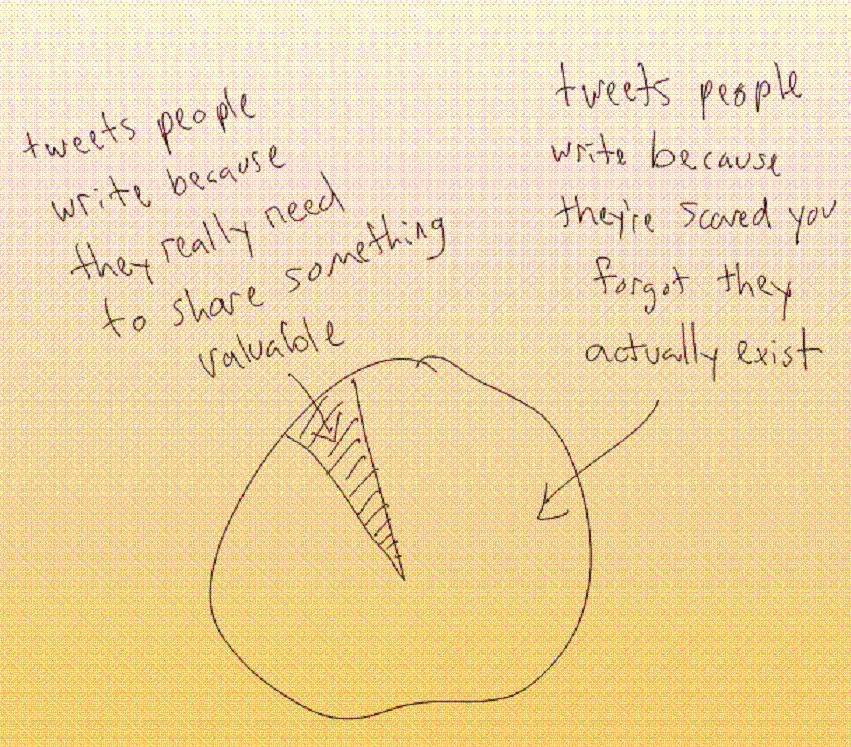
The cartoon is by @tremendousnews on Twitter, no idea who s/he is--found here....
via a tweet by @Larryferlazzo, who also pointed out Herbert's column this morning: "Tweet Less, Kiss More".

Wednesday, December 30, 2009

Moving on up!


We start evolution soon.

I've already had enlightening literature left on my desk:

If you reject Jesus, your Creator, that will be your worst mistake ever! You'll be in the lake of fire with billions of others who believe we evolved from monkeys.


I never tell anyone we evolved from monkeys, because it's simply not true. Half of teaching descent with modification is unteaching the nonsense people already believe. I'm not talking about religion; I'm talking about bad science.
***

Again, I will start with a seemingly simple question: which is more evolved, a sophomore high school student or an earthworm?

It's a trick question--humans and worms have been descending from a common ancestor for a long time now, but neither holds an advantage in time.

I suppose the correct answer would be that neither is more evolved than the other. Since earthworms have had more generations to evolve, though, I'll give the edge to them this year.

That will go over well at dinner--"Mom, Dr. D says earthworms are more evolved than you are."

***

Our universes collided yesterday, human and earthworm. I was doing a human thing, diverting water using my brains, my fingers, and my credit card. The earthworm was doing its thing, munching through soil, warmed by the composting earth I just dug up to bury a discharge pipe.

Which of us is better adapted for its environment? Which of us will successfully reproduce ten thousand more generations?

***

The mysterious appearance of Moving On Up, as creepy as it is, does have a bright side--at least a few of my students will be unusually attentive, looking for chinks in my armor.

Hey, they're only 15 years old--there's hope.

I fear more for my students who believe in evolution, and try to rise to my defense when the monkey muckers start tossing pamphlets at me. Their smug acceptance of a theory they do not yet grasp is ultimately more dangerous.

The heart of Darwin's work, the dark and terrible beauty that makes On the Origin of Species such a powerful work, is the overwhelming evidence that natural selection is sufficient to explain speciation from common ancestors.

Chance variations in heritable characteristics separated me from the earthorm, both of us from a common ancestor, both of us now reasonably suited for our respective habitats.

When you grasp this, your universe shifts.

Best I can hope for now is to expose my kids to the evidence, and at least keep monkeys out of the equation.

I don't need believers. I need skeptics.

Maybe I'll even shift a universe or two.

Saturday, October 17, 2009

Teaching the controversy


Charles Darwin wrote On the Origin of Species by Means of Natural Selection almost 150 years ago. Most people who debate its merits have never read it, and here in the States, his work has been reduced to whether one "believes in" evolution, as though it falls in the same category as astrology, elves, and Santa Claus.


To understand Darwin's work, you need to understand his reluctance to acknowledge his own conclusions. Evolution per se was not the difficult part--heck, Darwin's grandfather Erasmus published that decades before Darwin's work, and it wasn't original then.

If you grasp why Darwin was so torn by his own words, then you get the controversy.

***

We make connections, even (or maybe especially) when we're children. The universe revolves each of us.

Rally caps, inside-out pajamas, horoscopes, and sidewalk cracks--all have power. We spend our time living in supernatural universes that do not yet (nor ever will) exist.


Starfish were designed to eat clams, alas....


We look at creatures, and of course they were designed--the dolphin has flippers to swim, the bee has a stinger to sting, humans have brains to think and thumbs to grasp tools. Every species alive today fits very neatly in its niche, as though designed just to do so.

Any child paying attention can reasonably conclude that organisms as complex as lightning bugs and robins and catfish were designed to be a part of the world, a specific part of the world.

That much is true. No matter what side you fall on, critters are obviously designed for their environments.

You can know this and not believe in the supernatural.

***

The crux of Darwin's theory, the crux of the controversy, is this--natural selection reasonably and completely explains the diversity of life here on Earth.

This upset Darwin. It upsets a lot of people. It's a big deal.

You cannot fully explain Darwin's importance if you do not understand what the fuss is all about. Most of my students enter their sophomore year believing that Darwin formulated the theory or evolution.

He did not.

He developed a reasonable explanation for the diversity of species through natural selection alone. Others had similar ideas, but his work was cogent, concise, and readable.

On the Origin of Species by Means of Natural Selection reads as though it was written by a man trying very hard to convince himself he was mistaken, but failed to break through the chains of rational thought. The man Darwin was trying to convince was himself.

The theory of evolution removes the need for any other explanation for the diversity of life here--supernatural or otherwise. It requires no further layers to explain how species form.

***

On the Origin of Species by Means of Natural Selection does not, however, preclude a Creator. It does not explain how life began, nor makes any attempt to do so.

One of the first people to read the book was the Reverend Charles Kingley, a writer and a Protestant priest, who sent a note to Darwin congratulating him on his treatise. In the letter the Rev. Kinsley noted:

I have gradually learnt to see that it is just as noble a conception of Deity, to believe that He created primal forms capable of self development into all forms needful pro tempore and pro loco, as to believe that He required a fresh act of intervention to supply the lacunas which He Himself had made. I question whether the former be not the loftier thought.

***

As for the "controversy," the attempt by a few folks with a perverse interpretation of the Gospels to create a scientific curriculum that includes Intelligent Design, well, I present the thrust of their argument--that organisms clearly designed for their environment require some sort of intelligence behind the design--without presenting their motives.

It's the way my sophomores think anyway--they're still children. Heck, it's how we all think.

The whole point of Darwin's work is that it demolishes the need for a designer. The Intelligent Design hypothesis is not a scientific alternative to the theory of evolution--it is that very idea that Darwin destroys in his book.

Calling Intelligent Design a scientific alternative to evolution is like recognizing the Flat Earth Society as a reasonable alternative to a round Earth.

I wish Darwin was wrong. I wish Santa Claus still brought me presents. I wish people would start thinking.

And I still wish upon stars....just not in science class.


*Even more important, you can know this, believe in the supernatural, and still accept,
indeed embrace, the theory of evolution, without any appeal to the supernatural.


Oh, my thoughts on a Creator? On cosmological origins? On energy? On mass? All great mysteries.
Let the mystery be--once you try to explain a mystery to me, you're no longer dealing with a mystery but a myth.


Sunday, October 4, 2009

My UbD essential question of the day

The 150th anniversary of Darwin's On the Origin of Species is coming up November 29.


Do you believe in evolution?
Nope.

Are you a Bible-thumpin', gun-totin' wingnut?
On most days, nope.

Do you think descent with modification goes a long, long way towards explaining the unity and diversity of life on Earth?
Yep.

Are you a tree-huggin', granola totin' wingnut?
On most days, nope.

According to Darwin (or today's biologists) did humans come from chimpanzees?
Nope, no rational scientist in her right mind said this.

Am I related to the toe fungus growing on my Aunt Millie's foot?
Yep, I accept that we're (very) distant cousins.

So far no real controversy--I can hold on to a very strong theory that explains just about all we know in biology, I can dabble in the Gospels (and you might best run away if you see me walking around mumbling about Mark reasonably ending at 16:8), and anyone who spends time outside knows life is weird enough that everything that respires just might all be cousins.

Here's the big one, though, and one that cuts across the boundaries.
Were humans inevitable?
This is where hubris takes a hit.
This is part of why Darwin spent a lifetime trying to find cracks in his own work.
This is why teaching biology can change a student's world.

Any thoughts?

Monday, August 31, 2009

Trumpets descended from trombones

Some parents in Sedalia, Missouri, are upset at a band t-shirt designed to promote the Smith-Cotton High School marching band's show, "Brass Evolutions 2009."


The school administrators decided to pull the shirts off the backs of their students, leading the local paper, the Sedalia Democrat, to post an editorial:

"School administrators overreacted to the pressure from some parents who obviously saw the image as promoting the theory of evolution and a threat to their own Christian beliefs."

The editors go on to say:
"We find nothing wrong with the T-shirts and believe the students should be able to continue wearing them if they choose to."

It is easy to bash the superstitious, the irrational, and even, at times, the religious, and "learned" folks do it all the time. That the editor's last name is Satnan only adds to the fun. I, for one, want to thank the parents who objected.

Do I think the parents were right? Nope.
Do I think evolution is a lousy theory? Nope again.

So what's my problem?

We did not evolve from monkeys!


We share a common ancestor. That's a huge difference.

That so few folks busy shoving the Constitution up the nostrils of their fundamentalist neighbors understand the theory of evolution themselves makes me want to pray for our country's future.


The photo is from the Sedalia Democrat here.
A thumbs up to BL Rag for picking up the story.