Sunday, October 30, 2011

Doritos and daphnia

In the middle of the snowstorm yesterday, I scrambled out to my tiny pond, a mud puddle, really, to fetch as much elodea as I could for school. Elodea is a lovely water plant that plays well with microscopes. I also scooped up about 5 gallons of pond water full of critters about as ill-prepared for the storm as I was.

Two buckets of pond water now sit in the kitchen--some will overwinter in the basement under fluorescent lights, some in the windowsill of our classroom. (One year I had mayflies in January.)


The classroom pond water has been there for years now. I should really start it over--as the years go by, the evaporating water leaves behind traces of salts, and eventually it will be too salty for pond life. For now, though, the water fleas still dance among a few translucent snails and the knolls of blue-green algae covering the bottom. All sorts of microscopic critters flit through the duckweed.

I could start over, dumping my windowsill pond down into the drain, starting fresh. Starting over without consequences, though, is a tricky thing, possibly impossible, in life, human or otherwise. Everything we do has consequences.

So I work with what I have, and what I have includes the great-great-great-great offspring of daphnia from my backyard summers ago.
***

The metaphysical (or at least the anti-reality folks, or ARFs as I shall call them) crowd has me worried. The Daily Show ran a piece with an ARF, Noelle Nikpour, yipping away against science:

The Daily Show With Jon StewartMon - Thurs 11p / 10c
Weathering Fights - Science: What's It Up To?
www.thedailyshow.com
Daily Show Full EpisodesPolitical Humor & Satire BlogThe Daily Show on Facebook


I have several children who know more about the Mayan calendar than they do about evolution. I have more than several children who do not know their connection to the earth. We tell children that our planet is round, and that Doritos are junk food, without offering a shred of evidence for either.

I'll concede that the Earth is round. Took me awhile to believe it, but after years of looking at boats disappear over the edge of the sea, shadows change over the seasons, and photos from satellites, it's easier believing it's round than flat.

Doritos, however, are miracles, a sophisticated blend of complex organic molecules fused together by plants using the energy emanating from the sun, itself a miracle, fusing hydrogen into helium. They're food, and pretty good food at that--and all food is biology at its gory best.

I get one shot to teach children biology--for most of my kids, this is the last time they will study biology in any formal sense, ill prepared to face years of propaganda via the Noelle Nikpours, Rick Perrys, and Rick Warren (what is it with Ricks?) of the world.

Tomorrow I will haul a couple of gallons of water almost a mile, as my ancestors did (though for a different reason), to bring more "real" life to my biology classroom. In the end, I cannot hope to compete with the propaganda fed both inside and out the school by the monied interests who know more about demographics than democracy, more about profit than people.

My hope is to give children a taste of just how large this universe is, how wonderful, how deeply ingrained we are with it, and it with us.

A bucket of pond water holds more life than most of us can imagine.

It starts with a single drop.


Or I could just teach to the state test, and put the microscopes away.

Saturday, October 29, 2011

Exploding trees

The trees are exploding.

We're getting a wet, heavy snowfall, and the broad leaves of our deciduous trees are catching snowflakes as well as they catch photons.

Their vessels are still swollen with sap, carrying nutrients back into the ground, stored in the massive roots of the underground world we fear.

Water starts to expand as it nears its freezing point--that's why ice floats. Still, I've never seen trees explode because of an early frost, so I'll blame the snow.


I stood out in the snow watching my daughter play football. The scene was surreal--several players had dressed up for Hallowe'en, dinosaurs chasing ninjas, Goldilocks chased by a pirate. Some players wore overcoats, a few dressed only in shorts. The snow was blowing sideways.

*CRACK*--a large limb fell from a massive tree just a few feet from me.

Had my brain caught the branch, I would have regretted not finishing a few things, but that's the way it goes. I worked for years in hospitals. Massive trauma, tempered by unconsciousness and ungodly jolts of endorphins, is about as good as it gets for one's final moments.

Now, a few hours later, my numb feet warm again, my skin dry, a few thoughts:
*My daughter turns 29 tomorrow. My son will be 26 in December. Watching her intensity playing football, hearing her laughter across the field, reminds me my biggest job is done.
*Had I been brained, the last thing anyone (I cared about) would have worried about would be an unfinished curriculum being written just to meet the demands of some acronym (QSAC) emanating from Trenton.
*We're finite, focus on what matters.

It continues to snow, I continue to breathe. But I appreciate the reminder.


Photo via Baristanet.

Tuesday, October 25, 2011

A jelly story


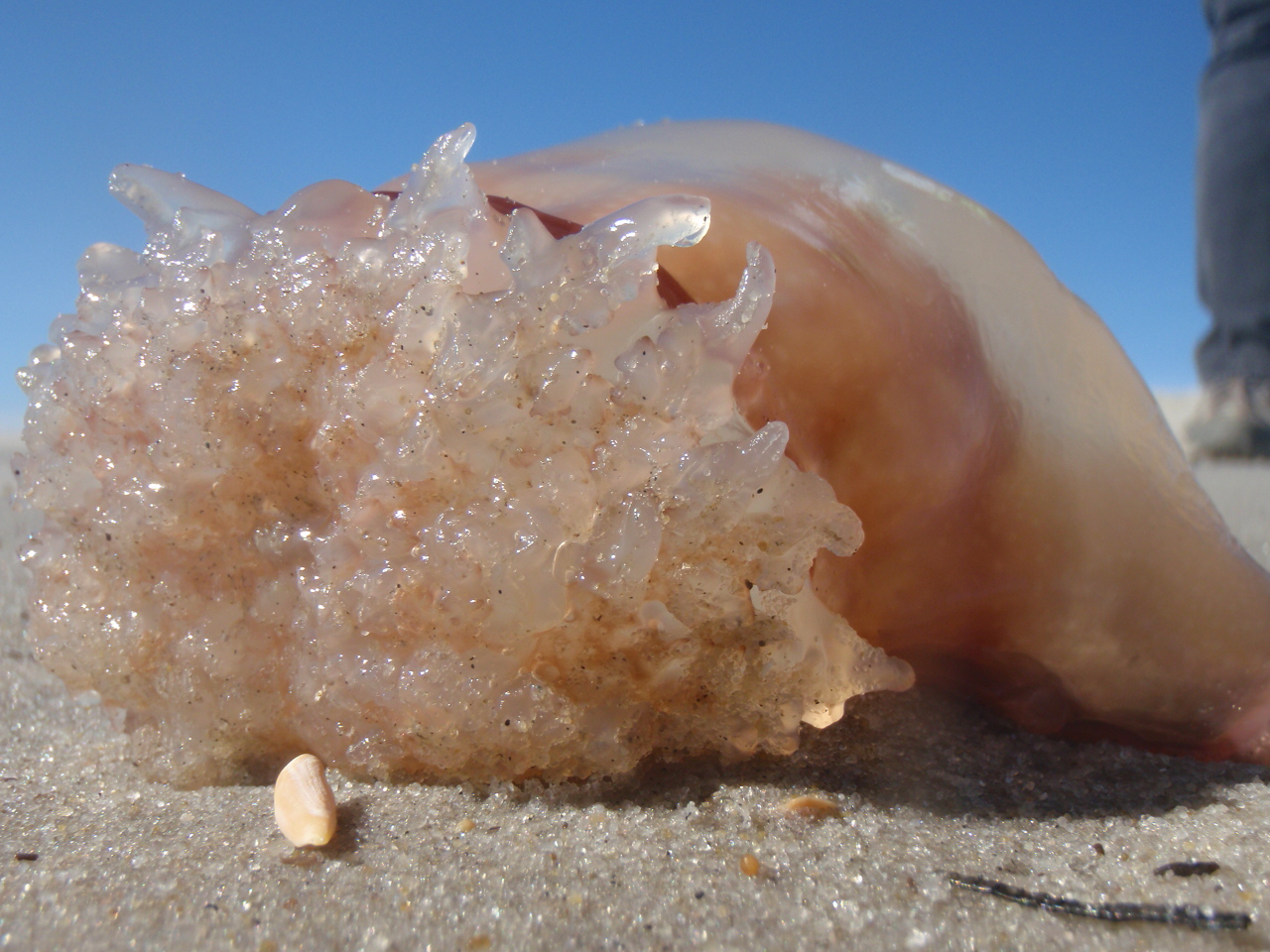
When looking at a jelly lying at the sea's edge, a critter that uses the same genetic code as pretty much anything that has suffered the indignity of DNA analysis, it's hard to get worked up over nonsense.
  • A physicist says that we, like the jellyfish, are mostly empty space.
  • A priest says we have dominion this dying jelly, over all that lives.
  • A chemist says that the orderly appearance of this critter, and us, does not deny entropy--the sun's slow collapse into chaos feeds our lives.
  • A business man says the jelly is hard to sell, and loses interest.
  • A poet say the jelly has a soul, and notices the cyan halo of sky around it.
  • The astronomer ponders the angle of the jelly's shadow, a telling sign of winter to come.
  • A geologist studies the angle of repose of the grains of sand, failing to see the critter at all.
The jelly faded back into the sea, now dead, its story as interesting as mine, as yours, our stories share a common end.

I almost missed this jelly, anxious as I was to catch up on something for somebody due somewhere before Monday's sunset. Now it has become part of my story.


We found the jelly a week ago, and a moment later, dolphins distracted us.
I meant to put the jelly back. I did not.
I had a chance to change the story.

Monday, October 24, 2011

Mr. President, we "learn to live"

The 2nd repost today, again more for me than anything else.


"Through this plan we are setting an ambitious goal: All students should graduate from high school prepared for college and a career – no matter who you are or where you come from."

President Obama, March 13, 2010


Mr. President, can we cut through the crap?

I'm a retired pediatrician. A lot of children are damaged--some by bad luck, many by bad choices made by others.

Yes, the photo is unsettling, yes, too many children have been lost because we did not acknowledge their potential, but your rhetoric is fanning a dangerous fire.

I teach healthy children, and I teach damaged children. I teach wealthy children, and I teach poor children. I teach children with fancy orthodontia, and children with rotting teeth.

I teach America, Mr. President. If you cannot see America from your perch in D.C., please spend a weekend back home in Chicago and remember the man you once were, or pretended to be.

Come to Bloomfield--our motto here is "Learn to live." Some of us have careers, some of us have jobs. Some of us went to college, some of us were apprenticed. Most of us are happy, even the good chunk of us who have neither careers nor degrees.

Focus on getting the jobs back, and towns like Bloomfield will fill them well. We send soldiers to war--our street signs carry the names of those killed and missing in action. We have young folks overseas now. We helped process uranium during World War II, and have the contaminated useless land to show for it.

Learn to live. Not learn to earn, not learn to serve Microsoft, but simply learn to live. Most of my students will leave BHS with decent academic skills and decent decency skills.

All the degrees in the world won't fix the plumbing. All the degrees in the world will not land a job that's now in Asia. All the degrees in the world will not make you a better citizen, friend, or lover.

Learn to live, Mr. President, and let us go about our business doing the same. And if you need the name of a decent carpenter, a decent bakery, a decent school, give me a call. We got them right here in Bloomfield, the America outside the Beltway.


The disturbing photo from Temple University is real, and it's human.
The classroom photo is from Bloomfield, 1914, found here, shared at the Bloomfield Historical site by David Petillo.


Teach truth, joy follows

Because sometimes I forget...this one's from August, 2010--I needed to see it again.


So what do you do?

What do you do when major sources of information provided to children come from corrupt human sources?

What do you do when the adults around them believe whatever lights up their amygdalas the most?

What do you say when the actions of those in power, those with money, those that command the messages, no longer work in the best interests of our children, all of our children?

I work for the government. I get that.
I also work for your children, and others get that.
The two interests are becoming less and less compatible.

***

I overstated that.

I work for the people of Bloomfield--they pay most of my salary, and if I could remove the yoke of Arne and the Governor by rejecting the small percent of my salary covered by New Jersey and D.C., I would.

I would be a better teacher for it, I would have more class hours dedicated to sharing science with my charges, and my students would be better prepared to care for their children when the time comes.

Maybe my lambs won't act like the sheep who are training them, and will act in the best interests of their children when tough decisions are made.

Maybe they will refuse to proctor exams that ultimately harm their charges instead of just grumbling in the teacher's lounge or on Twitter.

***

What am I going to do?

I am going to teach science.

I trust the natural world, I trust my senses, I trust logic, and I trust the intelligence of my lambs. I let them know these things.

I do not hope (nor would want) to influence their "beliefs," whatever they may be. I do not proselytize, which would be near impossible anyway, since I know nothing. I do not take sides in many of the silly "science" either/or debates raging in the media, because there are no sides to take.

I want my children to think. I want my children to see. I want my children to trust themselves when they know "two and two is four," even when others scream it's "FIVE!"

The ones I reach, and I reach a few, will see the world differently when they leave in June. I leave them with power, they leave me with hope.

***

The natural world exceeds our imaginations, but our imagination exceeds its limits. Our cultural inability to grasp this leads to hubris, to dreams of infinite growth, ultimately to annihilation.

I am not going to tell children an economy dependent on ever-increasing consumption cannot be sustained for more than a few generations. I will talk about primary productivity and limits imposed by the finite sunlight that bathes the Earth.

I am not going to tell them that a lot of what they believe to be true is bunk. I will drop a huge textbook and a paper clip from the ceiling and let them see which one hits the floor first. It surprises me every time I do it.

I am not going to tell them that school is important because they're competing with the Chinese or Indians or Icelanders for the same jobs and America needs an educated work force to keep our economy strong. I will share my love of life, of the local, of the edges of knowledge we can never truly grasp. We'll study bugs and daphnia and radishes.

We occasionally have moments of joy, even in a classroom.

***


Here's the secret--once a child trusts her senses, trusts the joy she feels when exploring a world that is as much hers as Bill Gates' or Rupert Murdoch's or any of tens of thousands of strangers who want to shape her life, she becomes her own master.

She becomes autonomous in a world of automation.

She might even dance to her own tune in a culture of technique, a culture that worships men like those pictured above. See their smiles? Trust them?

I don't either.


The Bill Gates photo is from the UK Telegraph here;
the Rupert Murdoch photo is from What's Nextt: Innovations in Newspapers website.

Sunday, October 23, 2011

Milking Albert Pujol's big game last night

Albert Pujols hits a lot, and gets paid well to do it. He seems like an all-around decent guy, but truth be told, I know nothing about the man other than what his people want me to know.

Last night Mr. Pujols again did his thing, and many people paid money to watch him do this. All of this is fine, what folks do with their spare time and money is not my business

We have a bigger than life poster of Mr. Pujols in our cafeteria, wielding an over-sized sledge hammer and a milk mustache.


I teach. What happens in my school building is my business. And a huge poster of a sports idol promoting a food that may be potentially harmful to many of my students is bad practice.

The poster promotes drinking the bodily fluids of another species fed an artificial growth hormone (a practice banned in just about every other developed nation), fluids that do not sit well with most of the human population older than a couple of years, in order to boost the profits of companies that do not know my students.
***

The USDA, the National Dairy Council, and various corporations have a stake in promoting cow's milk consumption here in the States. They often cite an article by the American Academy of Pediatrics from October, 2006, to assert that adolescents need to drink 4 glasses of milk a day to get enough dietary calcium.

What the article states is that is how much milk children would need to drink to get that much calcium, but the authors never state that the vehicle for calcium must be milk.

Here are a few things the authors do state [and all the bullets below are quoted verbatim]:

  • Although dairy products are the most common calcium-dense foods in Western diets, there are no long-term follow-up data that demonstrate that they are superior to other sources of calcium in promoting bone health.
  • Virtually all the data used to establish this intake level are from white children. Few data are available from other racial groups. There are data indicating that compared with white adolescents, black adolescents use dietary calcium more efficiently and may achieve comparablepeak bone masses with less calcium intake.
  • Orange and apple juice may be fortified to achieve a calcium concentration similar to that of milk. Limited studies of the bioavailability of the calcium in juice suggest that it is at least comparable to that of milk.
  • Breakfast cereals also are frequently fortified with minerals, including calcium, and this form has been shown to be very bioavailable

So if you're a white kid who gets plenty of exercise, have a source of cow's milk from well-treated cows not fed artificial growth hormone, and you can stand to drink the stuff with most of the fat removed, well, milk is one way to get the calcium you need.

For the rest of us, I suggest you do a little more research than an Albert Pujols poster....


Full disclosure: I may be a tad lactose intolerant.
Fuller disclosure: I still eat a lot of ice cream at the risk of losing friends.
Fullest disclosure: If we're going to behave like sheep anyway, I'm founding the Nat'l Sheep Milk Council. (Talk about a baaa'd joke....)


The Pujols poster came from Ehrl the Pearl's site--if there are copyright issues, I'll just take a pic of the one in our cafeteria.

    Saturday, October 22, 2011

    How many teachers does it take to say "screw the lightbulb"?

    NJ World Class Standard:
    8.2 Technology Education, Engineering, and Design

    All students will develop an understanding of the nature and impact of technology, engineering, technological design, and the designed world, as they relate to the individual, global society, and the environment.

    On this day not so long ago, Edison switched on a reasonably bright incandescent bulb using a carbon filament, and it lasted long enough to read the next evening's newspaper. (It was also the first time in history Samuel Ogden Edison, his Dad, shouted those immortal words "Shut off the damn light, Tommy, you think money grows on trees?!")

    I mentioned this to class yesterday, then added that I thought Edison had done more to cause human misery than just about any other human ever born, largely because of this invention.

    I said this on a dark Friday morning, with 22 pupating humans in front of me, sitting under the buzz and barely perceptible flicker of fluorescent lights, which, to be fair, were not Edison's thing (though he dabbled with them before an ex-employee  made a commercially viable version.).

    A couple students giggled, but I was serious, and finally one asked why. I turned the question back on them. How would life be different without articial light?

    I won't betray their words here, but I will say this--if you give young'uns a tiny bit of space to call their own, they can think. Deeply.
    ***

    We lost any real connection with what happens outside our windows generations ago, and lose any semblance of connection when we abandon our religious rituals, the last vestiges of our pastoral (OK, pagan) past. For many of us, our biggest connection to seasons is shopping and sports, both poor substitutes for living.


    I can use prepackaged glossy corporate curriculum "aids" designed to mislead, I can use textbooks tamed by fear of market loss, I can use all sorts of "educational" websites sponsored by folks with a vested interest in a particular way of thinking.

    Or I can tell them what I think is true.

    And no, I do not claim to have any special relationship with "truth"--I do have, however, a healthy respect for it, which means looking at what we do and teach with a critical eye, using logic and love, to explore the world around us. It means being wrong a lot, too.

    In science, we're used to being wrong--our goal is to be more right today than we were yesterday, but if we ever figure everything out, science would no longer exist.

    When we continue to ignore truth, though, we not only lose science, we lose ourselves.


    Saying Thomas Edison invented the light bulb is like saying Christopher Columbus discovered that the world is round.
    They both did really cool things, and both caused a lot of damage to a lot of people.

    The Edison lamp drawing is from the National Archives; the jelly taken last week at Cape May.


    And we wonder why 11% of American adults are on anti-depressants....