Tuesday, June 21, 2011

Solstice graduation

"The eye of man hath not heard, the ear of man hath not seen, man’s hand is not able to taste, his tongue to conceive, nor his heart to report, what my dream was."


Except in June.

Just about every day this week I grabbed a few small, dark cherries from the small trees lining Liberty Street--just the right bitterness to counter the almost too rich fruitiness. The sun seems to have frozen in the north, teetering a week or two before starting our slow plunge back to darkness.

Life brims mid-June, feeding on the energy that bathes the Earth this time of year. The energy starts to dwindle tomorrow. Tonight I put my shoes away for the summer,unless, of course, there'a a wake. I took them off as I left our graduation ceremony. The ice returns in just a few months, as inevitable as the wakes that keep my shoes busy.

If you pay attention to these things, the dwindling light, the mad dancing of organisms in the June dusk, the aroma of honeysuckle drifting through your skull, the incessant buzzing of hundreds, thousands of critters aware of you, you'd go mad, of course, a Mid-Summer's Night Dream kind of insanity,

And many of us do--pay attention and go mad--mid-June, midsummer, when living requires little, as fine a time as any to toss a class of young adults out into the world.

And how many are "college and career-ready"? Not sure what that even means.

But I am sure of this--several hundred children from many different cultures, from many different lands, from many different circumstance, left our building tonight having an idea of what is possible, of what democracy can look like. A lot of them left our building "college ready" for schools they cannot afford, and "career ready" for jobs that left north Jersey a generation ago.

They are kind, they are brave, they are bright, and they are now adults entering a world Arne does not (or will not) recognize. As we turn inexorably to November, to darkness, to fear, I hope that a child's new-found knowledge of how the natural world gives her pause before she plunges into cynicism, or to self-loathing.

It's a beautiful world out there, but a world defined by limits imposed by our sun, our soil, or water. Our children are of this world, so long as they live. This matters more than any games imposed by wealthy gentlemen governing from hundreds of miles away.

Congratulations to our Class of 2011. This is your world, get to know it beyond the boundaries imposed by human words and limited ideas. Embrace it like you own it.

Because you do.


Teaching matters.
The print is Titania, by Joseph Noel Patton, 1850.

Saturday, June 18, 2011

June ramblings

I'm reading Umberto Eco, a June indulgence. He's bright, and interesting, and mostly right, but he's also, well, um, a professional dilettante. I have nothing against dilettantes. in another lifetime I'd consider being one, but in a time when honest folks can't find a job, dilettantes seem obscene.

But if you have the time, he's worth a read.
***

In Language and Lunacies, he argues, among other things, that we believe, "as factual truth, that the chemical composition of water is H2O." We teach it as such, but it's not true.

Imagine a solitary molecule of water--what properties could it possibly possess? It would have to be gaseous, since it has no connection with its neighbors, and even then, alone, it really has no special qualities.

Water behaves as water because water has an unusual attraction to itself--the Brittney Spears of molecules. We call this hydrogen bonding, but no matter. Without other water molecules around, the concept of H2O is a human conceit. (To be fair, it's a human conceit anyway, but not in the sense that Mr. Umberto recognizes.)
***

I will bore the love of my life with this tonight--I will prattle on, so I will save you the grief. But I will say this much.

If you think you know anything about water because you call it H2O, you are mistaken. Calling it "H2O" only means that you know it takes two parts of hydrogen for every part of oxygen, and few of us take the time to accurately measure how much water gets generated every time we blow up some hydrogen.

We practice a lot of pseudo-science in education. We encourage an Asperger's Syndrome culture, spouting off "facts," without any connection to the ground that's under my bare feet as I write.

We really know nothing, and that's OK, so long as we remember that the stories we tell are resurrections of the stories told by pretty much any vertebrate with a brain. "I'm here! I'm here! Listen to me! Listen to me! I have a story to tell!"
***

Which brings me to the Big Bang. This is a wonderful story--we have characters and drama and intrigue--but ultimately it is absolutely (and I do not use the term loosely) incomprehensible. If you tell a child that the universe erupted from a single point, and that child dutifully records such nonsense in her notebook, and you let her without letting her in on the secret, then you may as well teach astrology.

And a lot of us are teaching astrology.

Astrology's interesting, but not nearly as interesting as a teaspoon of soil, a drop of water from the Delaware Bay, the purple shit of a common robin.


If science does noting else, it should remind a child that the universe exceeds our imaginations, and that the stories derived from the natural world , our stories, exceed the stories about humans alone.

Most cultures know this. Our culture mastered metallurgy, and weaponry, and we forgot. God help any culture that is bold enough to remember. We destroyed the Amerinds, the Incas, the Aztecs, the Afri. Don't screw with us. We shoot, then let God sort out the souls.
***

As I write this, a robin dances a couple of yards away from me as I water the garden. He's a couple of years old--he knows me, and I know him. I could make up a tale, anthropomorphize him, but that would require a huge assumption, that I know more about him than I do.

If you're going to teach in any way that matters, you're going to have to challenge assumptions.

So this is what I know.  When I water my garden, he eats worms that erupt from the earth. He's alive, I'm alive, and we share the same mitochondria, the same ribosomes, the same ancestors. We're cousins.

If you internalize this, you're less likely to wipe him out. If you're less likely to wipe him out than the Eurodescendant next to you, you're less likely to have a seat at a boardroom table.
***

So I teach.

The commissioner of education in this fine state calls me an "ankle biter." I doubt that Arne knows who I am, but I also doubt that his view of me would be any more flattering than our commissioner's. '

At least one robin loves me, a few mature humans, and maybe even a child or two.

That a child even needs a gateway to the world, the natural, real world outside the pixels that damn her to a life of drudgery and limited choices, is sad. But she does. And I consider it an honor to be that gateway.

Arne doesn't know this world, nor does Bill or Eli or the Acting Commissioner of Education here in the Garden State.

But I do.

And so will every child that walks into my classroom.


I love June. I'm brave in June
Lord, please, let mebe brave when the sun runs away again....

Thursday, June 16, 2011

Arne in June

Mid-June.

The blueberries are still mostly green, just blue enough to remind me of Uranus through our scope.

Raspberries and snow peas and basil and purple beans explode in our mouths, in our brains.

Light, light, and more light floods us daily--anything is possible in June, anything. There's enough energy for all of us who survived the past winter, more than enough.

"Enough" is a wonderful word foreign to many of us. If you know "enough," you know "content."

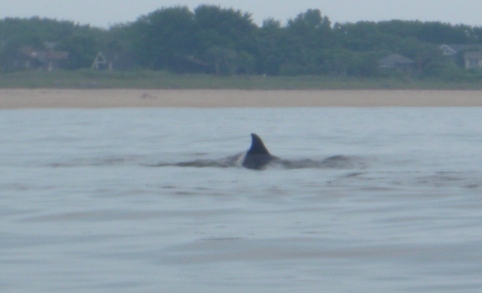
Less than a week ago, a dolphin eyed me, and I eyed it back. Not much to say, even if we could speak the same language. It's June, and there's more than enough to go around.

***

I am reading Science for All Americans, the AAAS book describing Project 2061. The second paragraph starts with this:

Education has no higher purpose than preparing people to lead personally fulfilling and responsible lives. For its part, science education...should help students to develop the understandings and habits of mind they need to become compassionate human beings able to think.

Amen.

Are you listening, Arne? Bill? Eli?

In June, the words of the powerful sound silly--but come November, when darkness falls and fear, again, prevails, Arne will cast his spell again.


Without fear, Arne loses his grip. Without fear, we can teach again. Without fear, we can resume this great experiment.

Puny men can only rule through fear. I'm done worrying. I'm going to teach science.

How about you?


The key to all this is recognizing our own mortality.
Get that down, and Arne's just another semi-pro basketball player with connections.

Why "Johnny Appleseed"? It's June...why not?


And no, Chris Cerf did not invite me back. 

Monday, June 13, 2011

A modest proposal

The Science Goddess recently wrote a powerful post pointing out that we're not going to get far with the wolves running the show unless we put on some wolf's clothing.

I save that kind of entertainment for Bleeker Street late October. I got snowpeas to harvest, clams to rake. But she makes a good point. What we're doing isn't going to work.


If more than a few of us get really good at what we do, and our lambs learn to think critically, we're going to be OK. If not, we're toast.

If it's testing the Feds want, let's give it to them:
Test teachers every two months for content knowledge. Heck, test them every two weeks if it keeps the bean counters happy. Most of us will do just fine. The few of us that don't know our stuff, well, time to go.

Put cameras and microphones in our rooms. Put them in the hallways. Install a toilet-cam for all I care. Watch what we do. If you have a better plan, let me hear it. If I'm not reciting state standards while washing my hands in the bathroom, dock me an hour's pay and give to Pearson or ETS or whomever--as long as you leave me alone when I get it right.

Let's make the student testing truly high stakes--if a child fails, off to the gallows! Everyone wins! The district sheds the stragglers, the parents shed a lifetime of debt owed to child's college, and the child does not face a life of shame knowing he let the United States down because some child in Burma kicked his arse.

I doubt Arne's been paying attention, but the obsjay have been ippedshay overseasay. Maybe we can get export Arne's job over to Finland.

This song's been ripping through my head, not sure why, my cortex hasn't caught up with my amygdala, but I suspect The Science Goddess' post has something to do with it:


Joe Strummer's dead, and will be for a bit.
I'm not, not yet, and hopefully won't be for a bit.

I'll take truth wherever I can find it these days.


Truth will out.

Sunday, June 12, 2011

Obvious, but not intuitive

Frank Noschese and Rhett Allain have a good on-going discussion on the Khan Academy's  work with physics. Some excerpts:


Science is obvious, but it's not intuitive. Obvious in the sense that we can observe what we observe, even as our brains refuse to accept it.

Intuition kept us alive for thousands of generations. There may be real survival value in accepting cultural illusions, even when they conflict with our empirical data. The concept of god(s) long preceded our worship of data.

We forget this at our peril. We did not survive as the simians we are by applying logic; we survived through intuition. We feel we are right, even when we're not.
***

The past three years, I have started class the same way. I climb up on a lab table, holding a paper clip in one hand, an old edition of the CRC Handbook of Chemistry and Physics in the other. I feel the heaviness of the ancient book, over 2000 pages being pulled towards the Earth. I barely feel the paper clip.

The kids (predictably) assert that the book will hit the ground first. I know in my gut that the book will hit first.
They both hit the floor simultaneously. I am surprised, as I always am. Obvious. But not intuitive.

Even after hundreds of trials, I still  feel cognitive dissonance. I'm an odd duck--I like cognitive dissonance.
 ***

The visceral trumps the cerebral in our culture. One of the ironies of Achieve.org pushing for their new science standards is that their preamble eschews reason:

"There is no doubt that science—and science education—is central to the lives of all Americans."
No, not true. Not even close. But it feels right.

Science is at the heart of the United States’ ability to compete and lead, which of course means that all students—whether they become technicians in a lab, PhD researchers or simply consumers—must all have a solid K-12 science education.
Science matters, but not because of some abstract flag-waving piece of jingoistic nonsense. The second half of the sentence is a non sequitur--unless our being "simple consumers" both requires a solid science education (I would argue otherwise) and leads to the heart of America's "ability to compete and lead."


Science also drives innovation, which in turn drives the economy.
Science certainly drives some innovation, and some innovation has some effect on the economy, but we're still bound to the earth, to the air, to the water more than we are bound to the kind of abstract economy the Achieve.org folks appear to worship.

If we're teaching children science simply because we're holding them accountable for the success of our economy, we are guilty of abusing our children.


Just a few hours ago a pod of dolphins snorted just a few feet from our kayaks.

Nowhere in the preamble does Achieve.org speak of the wonders of this natural world, of the joys of discovery, of our human need to lift up stones to see what lives underneath.

If I do my job well, that is, if I teach a child science, she will scoff at the premises Achieve.org holds as sacrosanct. If I do it really well, she will scoff at any premises I hold sacrosanct.


Is there no joy in Mudville?
Photo by Leslie--looks like a shot of Nessie, true, but we were both too excited to take a straight shot.

Slow science

"[I]t is quite the rushing through and pointing at.... "
A wise woman's words upon reviewing Newark's 2nd grade science curriculum


If you spend most of your time doing things you like, there is no reason to do things quickly. I like slow. Deep, thoughtful living takes time.

Slow gardening. Slow teaching. Slow clamming. Slow cooking. Slow down.


The Framework For Science Education will be released in the next week or so. It is currently "undergoing a confidential external review by a group of independent experts," but given the track record of Achieve, I doubt much will be changed. And that's a shame.

There's a whole lot of "rushing through and pointing at."
***

We keep confusing attainment of benchmarks based on science content with learning science. The persistence of the flawed concept of  a STEM (Science/Technology/Engineering/Mathematics) curriculum shows how little science is understood.

Science is making sense of the natural world by telling stories using specific rules. Models, hypotheses, theories, simulations--all stories dependent on observations of the natural world, the world perceived by our senses, the dancing shadows in Plato's cave.

The heart of science, what separates it from other forms of story-telling, is its reliance on observation. Each and every one of us can see the shadows dancing on the cave wall, and each can challenge the stories of another, by pointing to the wall. Even children. Maybe especially children.

We underestimate the power of naming, a real danger in our early grade science curriculum. I hold sophomores spellbound describing the mysterious force savallah. a mysterious force recognized by my ancestors in western Ireland. I might even light a candle as I tell the story. I explicitly describe what gravity does, but call it "savallah." Every particle of matter tugs at every other particle that exists.


Not one student believe savallah exists. Not one. But they all "believe in" gravity.

Young children do not need to "know" gravity--the word should be banned before high school. They do not need to know engineering. They do not need to know algebra.

They need to practice observing until they trust their perceptions enough to challenge the misconceptions of others.

***

I spent last evening on the ferry jetty. I saw an eel swim languidly by, rising from the depths, as the gray clouds started spitting on the water, an eel perhaps never seen by a human. The world is far larger than we can imagine.

Learning science is not linear--children need not (and, at any rate, cannot) grasp STEM concepts in carefully chunked modules divided by grades. If a child learns how to observe, truly observe, she can tackle most of the standards proposed in the late elementary grades in less than a month in high school.


If she also learns how to think, truly think, she can tackle pretty much anything. Anything. Content in science becomes old news because it will always remain an incomplete story. We teach it anyway, superficially, and we test it anyway, superficially. Efficiently, cheaply, and superficially.

We don't need children who can recite the stories, we need children who can write them.

In the end, technology will not save us, nor will engineering. Seems the height of insanity to trust the methods that got us into this mess.

What will save us is a generation of children who learn how to observe, to tell stories, to know enough about this marvelous world to love it, and to care for it.


Science isn't intuitive--if it were, we'd still be ruled by a slew of false gods.
Because we do not teach it well, we are still, alas, ruled by a slew of false gods.

Photos ours, use as you will--two of Galway Bay, one from Delaware.

Friday, June 10, 2011

The Toryfication of America

I teach for two reasons:
One, I have a ridiculously passionate attachment to watching the world, the one that exists whether (or not) humans exist. It's ultimately unknowable,despite its teasing patterns, and we're all part of it, all of us, no matter our status.

Two, I have a ridiculously passionate attachment to this experiment called America. What Jefferson started is still salvageable, though less so year by year. I only have a decade or two left help Jefferson out. 

A few remarkable things happened this week. I stole ripe cherries from a tree on an urban street, cherries eyed by a few birds but no humans, because humans in this part of the world conjoin "edible" with "supermarket."

And I got called an "ankle-biter" by one of the most powerful men in our state, a man charged with promoting education. Affectionately. I hope.
***

Governor Christie thinks it's a good idea to allow private companies to run public schools. 

I'm not surprised. He used to be a registered lobbyist for Edison Schools, back when our current Acting Commissioner of Education, Chris Cerf, also worked for Edison Schools. Edison Schools took on the Philly School System, and, well, got their butts kicked.

Mr. Cerf has a lovely office encased in glass, overlooking the Delaware River, the same Delaware River that feeds my bay. My bay. It can be your bay, too, if you care enough to get to know it.

The most important lesson I teach to my lambs is that pretty much any part of the world out there is theirs, if they care to get to know it.

The same could be said for our country.

If we continue to approach education based on some abstract notion of international standards, we will raise a generation suited for the suits, a generation that chases abstract ideas for abstract ends, leading to abstract results.

I pray one of my lambs stopped by a cherry tree today, plucking its burgundy fruit, spitting out the pit a few feet from the life-giving tree.
***

Most of us would choose the sidelines if we could. We love what we do, this teaching thing, and those of us who get past the second or third year are (mostly) pretty good at it. Our profession has a huge attrition rate, but given our charge, a huge attrition rate is not a bad thing.

I did not look for a fight. The governor approached our school, the commissioner approached me.I will do pretty much anything to help kids. Sometimes I get paid well to do this, sometimes I don't. Anyone who gets to do what they want and makes a decent living is blessed. And, Lord knows, I have been blessed.

But I am not just an "ankle-biter"; I am a pit bull if you mess with my kids.  Just sayin'

And I will be marching in Washington July 30th, with a pack of pit bulls because I am blessed, and because I care.

A little over 200 years ago, our Founding Fathers took on the Tories, and won. The Tories have regained control.

It's time to reclaim our country.


I just want to teach. Well. Finland, anyone?