Saturday, February 12, 2011

Dr. Seuss, science teacher extraordinaire


We have tiny newborn fish in our classroom. Life happens.

The critters are tiny, and regular fish food won't do. They survived the first couple of days on their tinier yolk sacs, but sooner or later, living requires taking life.

I projected a drop of our class pond water  through our microscope camera. Tiny creatures darted across the screen, startled by the sudden bright light beneath them.

The kids got it right away--put some of the pond water in with the tiny fish. And I did. I'll see Monday if any survive.
***

The pond water has sat by the same window for three years now, generations upon generations of daphnia and snails and paramecium live out their lives, fueled by light caught by the plants and algae.While some of the students are amazed by the occasional birth of snails or the frantic journeys of daphnia, none are startled by the microscopic life anymore.

That's not to say that they are blasé--it's just that they expect to see something under the scope now.The living world is larger now than it was in September. Doubt that the state exam will test that in May, but that's not why I teach.
 ***

Through a combination of good luck and a wonderful supervisor, I am sitting on a committee that will help develop early elementary science curriculum in our district.

The idea is use the combined expertise of high school and elementary teachers to create a program that better prepares students for what awaits them in high school.


I am not an expert in early childhood education. I am, however, a retired board-certified pediatrician. I know something about child development, even raised a couple of tadpoles of my own.

Today I reviewed a science learning site designed for K-6. It has garnered awards, and, by golly, you can invest in it on NASDAQ. Maybe I don't know enough about readers but there was a lot of repetitive sentences with only 1 word change in each. For example, "Some live where it is...." was repeated four times with hot/cold/wet/dry. It may be pedagogically correct, but if that's what kids are required to read, little wonder some kids run away from books. 

As I read through this stuff, some of it factually wrong (no, not all animals move), I wonder how any child can even pretend to love what schools label "science."


If our goal is to get kids to see the natural world and to teach them how to read, why not Dr. Seuss' Horton Hears A Who? That would tie in well with the invisible worlds swirling in a drop of pond water.

Why not Green Eggs and Ham, a story about a hypothesis (you would like green eggs and ham) with multiple variables tossed in (in a house? with a mouse?)?

Why not One Fish, Two Fish, Red Fish, Blue Fish, a classic introduction to taxonomy?
From there to here,
from here to there,
funny things
are everywhere.

As good a lesson as I can hope to teach a curious kindergartner about the our natural world.


The company, nameless for now, does not make awful stuff, but why not aim for greatness? 
Why not get it right? I doubt getting it right would cut into the stock value.

Happy Darwin Day!

"Nothing in biology makes sense except in the light of evolution"
Theodosius Dobzhansk

There is beauty in symmetry, even among the dead. Maybe especially among the dead.

One of the defining aspects of life is its organization, an organization that seemingly defies entropy. Of course it doesn't--energy flows through the system, creating a temporary order, but it's only temporary.

My lambs do not know this yet, and many adults refuse to face it.
***

 Imagine the fear, the loneliness, Charles Darwin felt as his ideas fell into place. Darwin did not come up with evolution--heck, even his grandfather Erasmus got that far. Darwin's genius was realizing that life's great variety and great sameness could all be attributed to natural selection.


Once life started, we no longer needed a God to explain it. Everything, everything, in biology makes sense in light of descent with modification through natural selection. Very little makes sense otherwise.

We may just be a happy accident.
***

Leslie and I walk along the beach a couple of times a week, every week, no matter the weather, no matter what's happening in our lives, pretty much no matter what.

We see and smell life, we see and smell death, both exposed on the tidal flats.

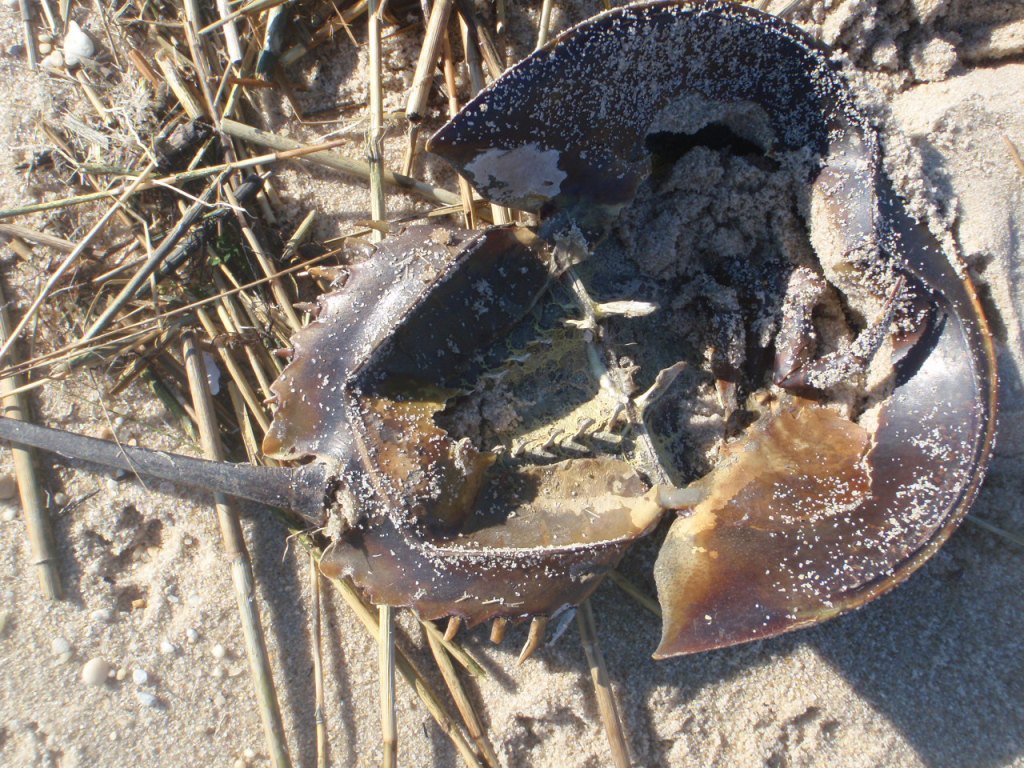
We see gulls pecking at the gills of an overturned horseshoe crab, her tail flailing uselessly. A week later we find a dead gull near the same spot, perhaps one of the gulls that stripped the life away from the horseshoe crab just a few days earlier.

There is not enough light in February to support the life created in June. Cracks form, lives shatter.


The horseshoe crab has wandered along this bay's edge long before humans, and may well creep along its shores long after we're gone.

They are magnificent critters, with multiple eyes with multiple functions, frightfully ornate shells, each spike, each hair with a purpose, and a plodding, purposeful movement that that reflects a philosophy older than language. They live  because they live, and they do it well.


The beach fly above is sitting in in the sand-filled shell of a dead horseshoe crab last week. There were several of them around, picking at the remnants of flesh of the horseshoe crab left behind by the gulls.

The beach flies know nothing of entropy, though they know plenty of things I cannot imagine.


If Darwin's ideas do not send a shiver down your spine, you may not be reading him right.

Each and every organism alive today--the bacteria in your gut, the fungus on our toenail, the tree outside your window--all came from common ancestors. With enough time, natural selection alone can explain our differences.

And there has been more than enough time.


All photos taken last week in North Cape May.

Wednesday, February 9, 2011

Spontaneous generation?

Explaining the daphnia was problematic enough, then came the mosquitoes. Now I got a tank full of fish fry darting about with no adult fish in sight.

Yes, of course, I do not believe in spontaneous generation. There must be a reason, and I have a hypothesis or two to explain where the fry came from.

But what do I tell the children?


Children who never saw a carrot develop from a seed before this year?
Children who never saw saw slugs before?
Children who are just starting to trust me when I tell them that the world that matters is the world that they can observe?


I'm not going to tell them anything. An empty tank now has a couple dozen fry, really just eyeballs with a tail attached, cute as can be and not likely to survive the week. I'll let the students figure it out.

My lambs crammed together around the tank, marveling at the tiny critters that started their lives right here in Room B362. They see what they see.

If I tell them what they're supposed to think I'll ruin the whole thing.


The fish fry photo taken from ExoticGolfish.net here.

Sunday, February 6, 2011

Grace

Crocus spears erupting through last autumn's maple leaves, North Cape May, February 6, 2011


Every year, every single year, this surprises me.

So long as I see myself as an organism, a being distinct from the world around me, I suppose it will.  I need to work on that.

In the meantime, though, I'll bask in the joy that suffuses my soul when I see the year's first crocus stand erupting from the earth.


Photo by us.

Saturday, February 5, 2011

February barnacles


We got our first decent beach walk in since the flu knocked me off my feet a couple of Saturdays ago. The February light was spectacularly gray. The brown-gray bay faded into steel-gray fog.

A few huge oyster shells littered the beach--I have yet to find the bed off our beach, but I will. Plenty of smaller oysters have chosen to live on the local jetties, a few destined to end up in our kitchen pot.

Clumps of reddish seaweed strewn at the tide line reeked of wet dog, unusually rank. A seagull sat on the beach, not bothering to move, maybe hurt, maybe not.

On the way back we stumbled on a piling tossed up just beyond the water's reach. Barnacles covered its lower half, some still alive, but not for much longer, bound for life to this piling.

No sense trying to figure out the why of the barnacle. It spends its early life swimming around until it finally glues itself to something, anything. They keep themselves protected with trap doors that snap open when conditions are right, allowing them to comb the sea for food. I've wiled away good chunks of time watching them sweep the water.

When we talk of barnacles in school, if we ever do, we talk of the wonderful adhesive that stick to varied surfaces, of its potential commercial value. Or we talk of they're unusually long sex organs. We might mention that Darwin studied them for 8 years, as if that should hold a student's interest.We could calculate the damage they do to the shipping industry.

We show the photo, maybe a quick video of barnacles eating or mating, then move on.


Few of us dare talk about barnacles just being barnacles, nor would most of us let a child stare for hours at a barnacle on a jetty, at least not during school hours. In the end, what we learn nothing about barnacles, although we do learn a little bit about humans--how we classify animals, how we use animals, how we reduce knowledge to trivia.

And in the end, it may not matter if a child is acquainted with barnacles or not. But I will say this much--if I take a tiny strand of my DNA, and spliced it into the DNA of a barnacle, the barnacle could conceivably make a human protein. If I take a tiny strand of the barnacle DNA, and place it within mine, I could conceivably make a barnacle protein.

We share the same basic DNA structure, the same sorts of amino acids, the same kinds or organelles--we are more alike than we are different. I learned little about the barnacle while in school, but I did learn a little while staring many living a foot or two below the surface of the bay.

The barnacles did what they needed to do, no more, no less. They ate when they could, clammed up when they needed to, reproduced when they wanted to, and eventually died.

As they have since before I was born, as they will long after I die. Barnacles as they relate to humans hardly interests me--I know almost as much about humans as I care to know. But barnacles as barnacles fascinates me, and they fascinate children who stumble upon them in the wild.


The drawing is by Darwin himself, found here at The Complete Work of Charles Darwin.

A February horseshoe crab


I love this picture.

My wife has tiny feet--that is the tip of her tiny shoe. The tracks were made by a tiny horseshoe crab last February. Chances are pretty good no one else has seen this particular horseshoe crab, and chances are pretty good it is no longer alive.

But it might be. It might be just a mile off our beach, poking along mud 30 feet below the bay's surface, bigger now, munching on whelk. No way to know.

If it lives a few more years, it may return to our beach to mate. A curious child may squat next to it, an ignorant child may run away screaming. A fisherman may snag it with a morsel of squid, his hands washed in creamy blue blood as he struggles to dislodge the hook. A wave may flip it over, and before it rights itself, a gull may peck at its gills as it flings its telson (not a "stinger"),  into the wet sand, trying to right itself.

But last February, it sauntered along our beach, no more than an inch long, feeling its way along a world I cannot imagine.
***

Horseshoe crabs see light we cannot. They have 10 eyes, the two obvious ones sitting on top of the shell--they are used to find mates in the gloom of the bay.

They can "see" light with their telsons, their "tails." They have tiny eye-spots on the front of their shells, designed to see ultraviolet light from the sun, from the moon. They know when the moon is new, when the moon is full. Such news is obvious on the edge of the shore, of course, but not so obvious deeper in the bay. The horseshoe crabs time their orgies to the moon.

They also have eyes underneath, next to the mouth--to see what?

We can pretend to know what it means to have 10 eyes, to sense UV light, to rise from the depths to mate under moonlight, but it's all pretending. We cannot know the universe of the horseshoe crab. But we can know that it exists.
***

I have a classroom set of netbooks, from very generous donations by the Roche Foundation, by the Bloomfield Education Foundation, and by our local Home and School Association.

I love what we can do with them: students can collaborate on projects, we can grab information on the fly, and there is a huge gee whiz factor built into these tiny machines that can liven up a classroom. They are not, however, a window into the world.

The only world visible on a monitor is the human world. Even high resolution photographs of exotic life are just that--human inventions, pixels flashed through electronic streams. They are not real.

A human framed the moment. A human cropped the photograph. A human machine translates the signal into the image on the screen. It is flat. It is manipulable. It is not real.

Oh, but think of the children who do not have access to these wonderful creatures!

I'd rather think of our reluctance to let the children get access to what lives among us.


My daughter, very young at the time, once found a pigeon's nest under the creek bridge that led to our closest park. She watched it for weeks, first eggs, then tiny critters, then fledglings, then gone.

She wrote no reports, took no photos. She just watched.

We keep roly polies ("pill bugs") in our room--harmless crustaceans that bumble around in a few of our terrariums, going about the business of the living, sometimes doing a whole lot of nothing.

My kids can learn all kinds of facts about them from the internet, but the only thing they really need to know for now is what to feed them, how to keep them healthy. Kids ask me, and I explain that I really don't know, because, well, I really don't.

We see that they only shed half of their shells at a time. We see that they tend to hang in groups. We see their antennae busily working the world immediately in front of them. Occasionally some die, occasionally new ones appear.

No pixels, no chips, no pressure. Just our classroom companions, who will be brought back to the outside world when the sun returns.
***

And what do the children take home with them? I do not know, I'll have to ask them years from now.

I do know that if the kids do not see life beyond the human walls now, it is unlikely to happen later.
I also know that most children (and most adults) confound the world we created with the world that exists. Our economy depends on the fantasy.

So I teach biology. Life. And life cannot be found in a chip.


Great article on hoseshoe crab eyes and other bits of anatomy can be found at the Maryland DNR here.
Photo by Leslie.

Friday, February 4, 2011

Hokey Smokes that was close!


A small asteroid was discovered today, hours before it passed within 5,000 miles of us. "Us" as in the critters on Earth.

It was tiny, as far as asteroids go, and it didn't get a whole lot of press, but it was a literal reminder of how little we control. It wouldn't have done any damage, our atmosphere would have smoked it before it smacked Eath, but still, no one knew about it yesterday.


I think our children ought to know how little we actually control, but even adults fail to see our limits. You'd think that death would put things in perspective, but we avoid the whole issue.

If you believe our time here on Earth matters, and that that time is finite, act on it. Sooner or later our planet is going to get smacked up pretty good by a large rock now hurtling in space. Chances are pretty good you'll be gone long before that happens, but either way dead is dead.

I don't recommend that you start each day by proclaiming the ultimate demise of each of your lambs as they  saunter into class, but I do recommend that you plan your lessons with that in mind.

Every thing we assign takes a piece of a child's finite lifespan. Make sure the piece you take is worth what you give back. And no, word searches do not qualify.....


Photo by G. Sostero and E. Guido, Remanzacco Observatory,Graphics by NASA--we paid for it, so I figure it's in the public domain.
found here,