Tuesday, December 7, 2010

A December crankfest


Prokaryotes have no membrane bound organelles, but they do have ribosomes, organelles needed to make proteins. Do ribosomes have membranes?

While the answer to this may seem stunningly obvious, a few students of mine had perfect scores on a quiz today except for this question.

And that scares me.

So here's the question.

I am a science teacher. My students are not likely to learn logic in History or Art or English or Music, nor should they. I have a state competency test breathing down my neck.

Do I stop everything to address a more basic need? Or do I keep pursuing my version of the race to the top.
***

I have a nice set of netbooks in my classroom, the coveted 1:1 that's supposed to save education.

Several organizations paid good money, about $8000, to make this happen. My kids grab their computers at the start of class, and a lot of good things have come from it.

I have a nice set of whiteboards in my classroom as well.
They seem to work best when used as a 2:1 tool, and I paid good money, about $26 not including the $2 tip to the Lowe's guy who cut them for me. My kids grab them two or three times a week, and a lot of good things have come from them.

I know I'm a bit of a crank, not to mention cheap, so I am clearly biased towards my low tech boards. Still, I am in a bit of a bind now.


The computers are everything advertised--they advance learning, they're powerful when used correctly, and I am better off having them than not.

I have a confession.

The whiteboards do not just give me more bang for the buck. They give me more bang period.

I use both, and will continue to do so, but nobody's getting rich selling shower board to classrooms here in Jersey. Each computer sold carries more profit to Acer than the total cost of my whiteboards.

I'm not saying computers suck. They don't. (Well, OK, at the global level, where economics is reduced to how fast your computer can compete with mine in a derivatives market, they do.)

I am saying that when working with larval humans who have trouble deciphering basic logic, asking them to sift through myriad online sources for wisdom may be like asking a frog to categorize the flies it eats.
***

I am competing with false images, false idols, false ideals.

If we were immortal, we'd have time for this nonsense. I don't expect adolescents to recognize their finiteness--one of their charms is their absolute inability to do so.

I do expect the adults charged with teaching to do so.

Shakespeare matters. Picasso matters. Billie Holiday matters.
Nike and F&A and Glaceau Vitamin Water do not.

Maybe biology matters, maybe it doesn't, but the ability to figure out what matters and what does not matters.

Science is not facts, it's a way of looking at the world, a way that matters.

***

Teaching may or may not matter. Depends on what you teach, which is not the same as saying that it depends on the curriculum.

Computers in the classroom are nice, but if you can't teach using just the back of a napkin and a two bit Bic pen, you can't teach.

If you cannot imagine your own death, you shouldn't teach.

I used to be a pediatrician, and it was serious business.
Now I am a teacher, and it makes pediatrics look like peanuts.

If a child cannot solve the problem above, she loses a piece of her humanness, even if she can fake her way through a state competency test.

Where do your loyalties lie?


Yeah, I'm purty cranky come December.
The bees have nothing (and everything) to do with this post.
I love bees!

Sunday, December 5, 2010

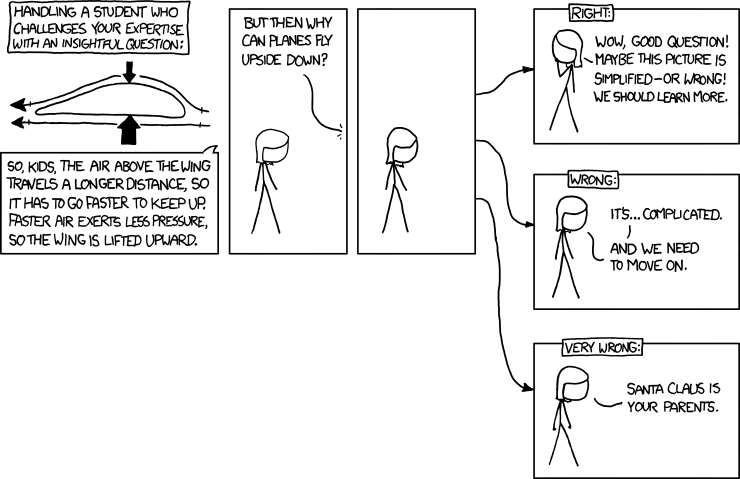
If Randall Munroe were Secretary of Education....


In any classroom, at any moment, a few students may be trying to follow you.

"It's...complicated. And we need to move on" kills inquiry, kills science, but apparently not science education.

When you present a model in class, make it clear it's a model. Science teachers are, essentially, model makers.

I'd rather children come out of school knowing nothing than "knowing" science. A child who knows nothing may still be curious.

A child who "knows" science has been functionally lobotomized.

***

When I was young, I was taught that the sun was directly overhead at noon. I remember trying to test this. I pushed a stick into the ground, expecting to see the shadow disappear at noon. It never did.

I did this over and over and over again. It never occurred to me the teacher was wrong.

Many children come to school in this neck of the woods still believing in Santa Claus, the Tooth Fairy, and the Easter Bunny. Many leave 12 years later believing in astrology, the moon landing hoax story, and false ancient Mayan prophecies of world destruction.

Few can explain seasons or tides or evolution. Many adults who think they grasp these don't. Discussing descent with modification with Creationists can be frustrating, but hearing those who "believe in evolution" toss around fallacy after fallacy is infuriating. I'm not sure which group does more harm to science education.

If you do not have a good grasp of a concept, do not attempt to teach it.

To earn a license to teach biology in New Jersey, you need to score a 152 (on a 200 point scale) on the biology Praxis test. In Arkansas, a 139 gets you in. Both scores are far below the 179 needed to earn the Praxis Series Recognition of Excellence.

There are, of course, other ways to measure teacher effectiveness, and knowing something doesn't mean you can competently teach it.

Not knowing something, though, means you can't teach it.


No one, of course, knows everything. I'm not arguing that we need to raise the Praxis passing score to 190.
Just know your limitations. If you don't grasp a point, don't pretend you do.

Randall Munroe is, of course, the xkcd guy.
He should be mandatory reading for science teachers.

Saturday, December 4, 2010

Teaching tip #324


Anyone who teaches knows that on any given day, someone is going to forget something. Homework, pencils, and notebooks lead errant lives--they spend as much time in class as the student, just not simultaneously.

My biggest daily battles used to involve pencils. Not anymore.

Asking a child why she forgot her pencil is as illuminating as asking her to describe muons. But I'd ask anyway.

Telling a child that bringing a pencil to class is her responsibility is like telling her her eyes are brown. She knows this, and reminding her will not change much, but it will elicit an eyeroll. I don't like eyerolls, but I asked anyway.

When I was about 7 years old, I stuck a pair of scissors in an electric socket. I didn't like it. I did it again anyway. I didn't like it any better the second time. I stopped doing it.

Every day I wasted a minute or two having the same conversation. Who's the idiot now?

The solution?

I tacked a Dixie cup to the bulletin board. When I find a pen or pencil, I put it in the cup. On rare occasions, I drop a few brand new pencils in the kitty. The cup's contents ebb and flow like the tides--rarely does it need my intervention.

The kids are no more or less responsible than before I reached my pencil nirvana.

We got enough nonsense going on in the classroom. Pick your battles.


Pencils are a lot cheaper than anxiolytics.

Pencil pic from wikimedia, and is in the PD.

Dying light


I tossed some metal into the Atlantic surf for about an hour today. The sun has settled low in the south. Gashes of December light broke through the wintry gray clouds. Even the midday shadows are long now.

The chilly brine bathed my feet as I cast. It may be time for boots.


The sun sets at 4:29 PM today, as early as it will for the year. The shortest day arrives in a couple of weeks.

I pulled the last tomato off the vine today, tinged pink on dull green. It froze last night, and had the consistency of pumpkin pulp. I spit most of it out, and tossed the rest back in the garden.

We're down to kale and Brussels sprouts now, then we are done.

***

I pray the sun comes back.

But just in case it doesn't, the prayer is one of thanks, for what was.
I am seeing Galway Kinnell again in just a few days.

Last time I saw him, he was the age I am now. He wrote of love, and loss, and timelessness.
Now he is three decades older, as I am, and he still writes of love, and loss, and timelessness.

He reminds those of us getting through life that there is no "through." Talking to his young daughter Maud, he talks to all of us:

learn,
as you stand
at this end of the bridge which arcs,
from love, you think, into enduring love,
learn to reach deeper
into the sorrows
to come – to touch
the almost imaginary bones
under the face, to hear under the laughter
the wind crying across the black stones. Kiss
the mouth
which tells you, here,
here is the world
. This mouth. This laughter. These temple bones.

The still undanced cadence of vanishing.
If I keep thinking of cycles and orbits and tides and the spin of electrons in invisible particles, if I keep chanting about redox equations and hydrolysis and the Gibbs free energy in the classroom, I miss what is herenow.

I tried to capture a December rose in the fading light with a camera, to share. But I can no more share this than share time itself.

Galway reminds me of this every time I read or hear his words.

He knows, he knows, and yet he writes of what we cannot believe.

We all make the same mistake, we all "commit...the error of thinking, one day all this will only be a memory."

***

Leslie worries that I might someday wander around barefoot too long on the beach, in the snow. She's right to worry, of course. I can get distracted outdoors long enough for incipient ice crystals to tear open my cells with their intricate patterns.

I don't need to worry yet. The water temperature is still in the high 40's--my feet feel warm when washed by the sea when the air is as chilly as it is today.

Back inside, I worry about what might have been. When I am outside, there is no "what might have been." Just sound and light and smell and touch.

I'm not sure ""Little Sleep's-Head Sprouting Hair In The Moonlight" would have made much sense to me the last time I saw Galway Kinnell read, decades ago, shortly before I held my own child in my arms, before the filament of life passed from me and Leslie to two lovely people who, should our prayers be answered, breathe long after we're dead.

It makes sense now.


The lines by Galway Kinnell come from "Little Sleep's-Head Sprouting Hair In The Moonlight," from The Book of Nightmares.

A response to a technophile


Whenever I post about the ludicrousness of using tools at inappropriately young ages, I get animated responses with similar themes. These replies are often anonymous, and often thoughtless.

I got one from my previous post that was neither anonymous nor thoughtless, and I thought it was worth carrying the discussion out in the open. Thank you, David!

Computers are the most powerful tool we have at our disposal and you want our kids to be ignorant of how they are used?

"Computers are the most powerful we have at our disposal" is dubious at best--I'd argue that the power of the tool depends on the task at hand (try hammering a nail with a mouse--yes, I'm an idiot).

But let's suppose for a moment that the computer is indeed the most powerful tool we have. Is its innate "power" your argument for why young children should be taught how to use them?

My car is the most powerful way for me to get around, but I'd rather the children keep away from the wheel until they can peer over the dashboard.

Do you think kids' parents, most of them anyway, have any clue how to use a computer as a tool?

Yes, I do, insofar as they need them for what parents do day to day, which is to say, live.

To be fair, they use computers every time they drive, use a microwave, an elevator, a video game, or EZ Pass, each a different task.

Maybe I am misunderstanding the thrust of your question. I do that a lot.

If you mean more esoteric stuff, like designing a database from scratch, well, maybe not. We got high school for that. I'd rather teach the kids how to bake from scratch--as in here's a bag of seeds, bake me a pie in 9 months, but I tend to be a bit extreme.

We do spend too much time in front of computers, this I agree with.
How do we fix this? I cannot control what happens in the child's home. What is the damage done by this? Are we contributing to the damage by reinforcing the activity in school?

However, what's the difference in health between sitting with a computer in front of you, or sitting with some paper to take notes? In either case, you are sitting instead of moving.
A great question--there's a couple of distinct points there, and I'll take each in turn:

Neither has great risks aside from physical inactivity that we know of--I suppose you could stab yourself in the eye and get paper cuts with the pencil and paper, and there have been case reports of children causing damage to their thighs from prolonged contact with hot laptops, and more than a few visits to the ER after tripping over wires, but I know those are not what you mean.

Some real longterm concerns may exist--two big ones in the past, monitor radiation and carpal tunnel syndrome, have been ameliorated. Longterm exposure to light may be a subtle issue not adequately explored, but again, I know these are not what you mean either.

There is a difference, though--a child pursuing an activity on paper has only the paper to deal with. Paper is mostly quiet unless you rustle it, and doesn't have flash or sizzle or anything else except sit there. It has, alas, no bling.

A child, when not doing her paper homework, will get up and do something else wrestled to the ground by an adult, both of which expend energy. A child on a computer wanders away, too, to online games, to FaceBook, to ESPN, to a whole shiny digital world that distracts her like a magpie.

The real crime is the number of physical education programs which are being cut and the lack of outdoor education programs in most schools.
Here in New Jersey, physical education remains mandatory. Getting kids outside is, indeed, important. There are only so many hours in a day. If we both agree that children are spending too much time on computers and not enough time outdoors, well, it doesn't take a computer to mesh out a rational solution to that.

I agree completely, by the way, with Stephen Downes 10 things that you really need to learn. I work in a school where those 10 things are our primary curriculum and our content is secondary to them.
Do send a link to your school--while I am blessed to work in a great department in a wonderful school, we still have the state curriculum and an annual end of course here to contend with.

And yes, I accept emails.


That's King Ludd in the picture--I assume it's old enough to be PD.

Should 1st graders brew ale?


A lot of things I do now as an adult I would not recommend to a child for a variety of reasons, which used to be obvious, but maybe not anymore.
I love a glass (or two) of ale at dinner.

I love living with the same woman, sharing our words, our air, our bodies.

On a rare late August night I love puffing on a cigar with friends, feeling the nicotine wend its way through my brain.

None of these belong in elementary school, but the first two will prolong most lives (and add happiness); the cigars are not benign, but are rare enough (one every 3 or 4 years) that the risk is likely low.

***

A calculator is a wonderful tool for those who know numbers. It is disastrous in the hands of everyone else.

A digital clock is a wonderful tool for those who know time. It does not belong in a classroom until children get a sense of how we measure time in cycles, using an old-fashioned clock face.

A computer is a wonderful tool for people who lead meaningful lives, who know what they want, who have tasted enough of life outside the human cult to resist the online siren. (I am not one of them. Few of us are.) It does not belong in any classroom where children spend more time in front of monitors than outside--and that includes what happens at home.

If the parents act like fools, not much the schools can do, but that does not give us permission to be foolhardy as well.
***

Do children need to learn how to use calculators? Sure, but if a child knows numbers inside out, I can teach her how to use a fancy calculator in less than a day.

Do children need to learn how to use computers? Sure, but they will anyway. Let's use the mandatory school hours to learn how to live a live that's useful.

Stephen Downes, a "Canadian education technology research specialist," wrote "Things You Really Need to Learn" a stunning and succinct post now on The Huffington Post, well worth a read.

Here's Stephen Downes' list:
1. How to predict consequences
2. How to read
3. How to distinguish truth from fiction
4. How to empathize
5. How to be creative
6. How to communicate clearly
7. How to learn
8. How to stay healthy
9. How to value yourself
10. How to live meaningfully

When I make a batch of ale, tossing yeast into a carboy of hops and malted barley, I hit at least 7 out of 10.

A computer in the classroom might hit a few of them, but I'd argue works against a few of them (3, 8, and 10) as well, and in any case, is not needed for any of them.

How many do classrooms hit in a day? A week? A year?


Meanwhile, the bigger issue today--do I clam barefoot if the air temperature barely hits 40° F?
The airlock is from my melomel brewing, not the ale. Truth from fiction.

Friday, December 3, 2010

Pinch me


Shhhh....I got about as lucky as a science teacher can get, and have Mr. Fred Guterl, the executive editor of Scientific American, coming to my classroom next week.

It gets better.

We get him in our room, unencumbered with an agenda. He wants to talk to my kids. About whatever.

I grew up with two magazines by my pillow. Mad Magazine and Scientific American. Scientific American is the longest running magazine in North America.

So what did I do to earn this? Nothing on my end. We have a wonderful MAT student Susan Eckert spending time with us here--she's bright and passionate and generous. She has shared great ideas, articles, and even couple of sea critters (a chocolate starfish and a cranky crab). She made this possible.

If she represents the new face of teaching, we're in real good shape.

***

So here we are, a week away, and I am like a child waiting for Santa Claus.

As I race towards my death, as we all do, marvelous things keep happening. In just the past couple of weeks we figured out that there are a whole lot more stars than we ever imagined, that our galaxy has been shooting off incomprehensibly large amounts of energy, and that life does not need phosphorous, a key element in DNA. Mr. Guterl must be an incredibly busy man.

(Yes, Mr. Guterl was the science guy on Fox News discussing this just this morning. Did I mention I'm excited?)

So here's my question--if you had the executive editor of Scientific American coming to your classroom, what would you want him to discuss?


Pinch, pinch! I can't believe this!!!!