Showing posts with label economics. Show all posts

Monday, April 6, 2015

The knowledge economy is neither


We will pay for our hubris, as has every other civilization that presumed to know more than is knowable.

"Education is still the key to eliminating gender inequities, to reducing poverty, to creating a sustainable planet, and to fostering peace.... "
Arne Duncan, November 4, 2010

On our dollar bill, via Wikimedia

I am charged with teaching young adults biology in a culture that thrives on fantasy. Education could help eliminate gender (and race) inequities, reduce poverty, and create a sustainable planet, but in its current incarnation, it plays a larger role in maintaining the status quo.

But it's the next line by Mr Duncan where he jumps off the plane of reality altogether:
"And in a knowledge economy, education is the new currency by which nations maintain economic competitiveness and global prosperity. "

People ask me if I get flack for teaching evolution--I get some, but not much, and ignorance of our origins hardly harms any of us in the long run. Creationists get to pray for our souls, we get to chuckle in the teachers' lounge, and life goes on. To be fair, most non-apocalyptic religions recognize and trust life's cycles, recognize mortality and limits, and, until humans muck things up, have their hearts in the right places.

Here's something biology teachers should tackle head on: the knowledge economy, the mantra of the newly ordained masters of money.

Where did today's dinner come from? Where was your water a month before you drank it?
Why doesn't air get used up? Where did your shit go last time you flushed?

Where does your gasoline come from? The tires on your car?
How about your electricity you're using right now? The plastic case holding your screen?

The knowledge economy is about extracting as much goods and services from the people who do the actual work of extracting what we need.
Lewis Hine, "Power house mechanic working on steam pump" 1920.Records of the Work Projects Administration.
The most advanced genetically modified plants we know still depend on sunlight, on soil, on water, on carbon dioxide from the countless beings around us breaking down what other beings put together. And I still have a class full of kids who know more about the structure of a DNA molecule than they do about wheat flour.

Here's the dirty secret we keep from our kids, and worse, keep from ourselves. There are limits, real limits, and they will come to bear when the hubris is no longer enough. True perpetual economic growth is a fantasy.

In a land where the dominant religion has joined with the dominant political and economic forces, free market capitalism has become sacred--to say otherwise is heresy. But there are limits.
Salted almonds, via Wikimedia

California continues to water its almond groves--about 10% of its water.
Most of these almonds go out of the States--and a few Californians make a lot of money.
Our knowledge economy cannot replace the water any faster than the clouds can, yet California continues to divert water for nuts.

And the poor go thirsty because a few educated folk figured out how to extract water faster than their neighbors--"Shallow wells have run dry, depriving several poor communities of water."

Read that line again--people in our land are losing their access to water because of technology developed by educated people to serve the global economy.

The rest of us will pay for this later this year when food prices go through the roof. But we will pay, because we need to eat.

But you'll pay a little less if you learn a thing or two about biology. Here, let me share a few seeds--they cost me nothing....

Basil seeds from the garden in my hand.
Everything comes from something. Stuff comes from stuff. Our screens, while entertaining, remain just that--pieces of glass and plastic sandwiching liquid crystals. If you want to see the magic, break one.

When you do, there is nothing to see, the magic is gone, because, well, that's how magic works.


Stop inviting kids into the looking glass.


Monday, February 23, 2015

Whose stories are we teaching?


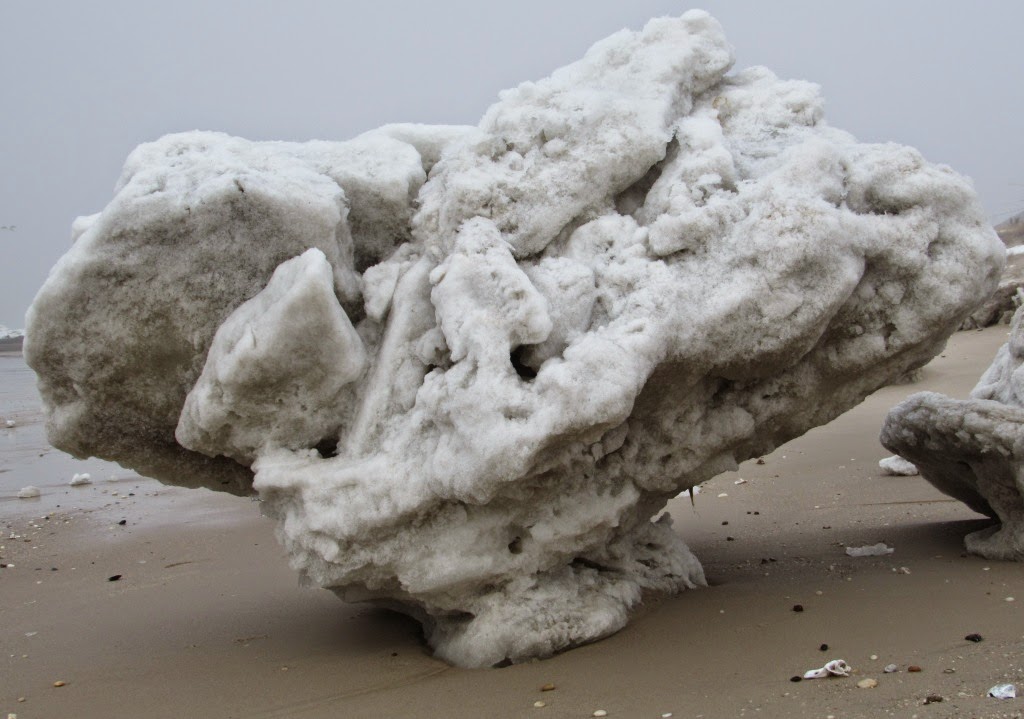
For part of  chilly February afternoon, a chunk of the frozen bay perilously perched itself by the edge of the sea.

It held my attention, this lifeless form, a half ton of water balancing on a small pedestal.

Our minds create stories upon stories, stories that help us survive, help us live, but stories are just that, and the intensity of my interest at this random block of broken berg makes little sense.

Rationally, I know that this is just chunks of ice from the fresh Delaware River above, coalescing from the forces of the tides, but it became my altar of unhewn stone, an evanescent idol.

Delaware Bay, North Cape May, February 22, 2015

We worship patterns, and see gods where none exist, but our stories have been, until now, based on the larger world around us.

We let others manipulate us and our children, replacing our stories of nature with the stories of the abstract, of global economies, of currencies, of hubris. We encourage our children to play with the screens that distort and manipulate our view of the world.


And then we wonder what's wrong with them.....

Saturday, March 23, 2013

Ungated communities

"You think you've lost your fur and your tail for a purpose spelled with a capital P and sold to you in some book that explains how everything was just a prelude until you came. If you do, you're happy I take it, and you'd be better off not to be following me or this crab or lifting up stones and looking under them."
I like to follow ghost crabs...photo by Tracy Parris, NPS

Our district is in trouble.

We're facing 10% layoffs, and the possible loss of our extra-curricular activities. We're paying to revamp our technology to enable us to take the PARCC exam in a couple of years, an exam just about guaranteed to demonstrate we're "failing" while we silence our musicians.

Few of those making the big bucks in our district live in our district. Those of us who live in town are subsidizing the lifestyles of folks who would never consider living here.

Our town is not the only one caught in the tidal change in our national economy where the efforts of folks in towns like Bloomfield pay for someone's grapes from Château Margau. Things are getting grim for many of us.

Lifted from All My  Eyes

I can take on Bill Gates mano a mano, but his dollar-driven army (and those of his ilk) will likely win in the public battles that matter. Teachers, parents, citizens have sat silent too long.
***

So why do I bother teaching "science" in a system that has been rigged to fail?

Here's why: the natural world, the one that matters, the one that feeds us, the one that brings joy, the one that was here long before words were uttered and will be here long after all of us are silent again, that world, is virtually unknown to most of us in our culture.

Know this world, the world that matters, and you can still forage for food, and know grace.
Know this world, the world that matters, and you can still lose yourself, and find peace.
Know this world, the world that matters,and you can still sleep, and feel restored.


Most of the kids I teach face dim prospects if they define themselves by the rules of Bill Gates, if they judge themselves by the shiny objects that drive them to debt, if they cannot see the larger picture.

If my lambs learn nothing else in my classroom, they at least witness the creation of food from their breath and water and little else. They are reminded of death. They are gently prompted day after day after day that there is a world larger than any of us in a drop of pond water, a teaspoon of soil.

Should I ever meet Mr. Gates, I'd give him a basil seed, a small pot of peat moss, and a prayer. I'm sure he "has people" that could do this for him. I'm sure he is reasonably happy, or thinks he is, and really, what's the difference?


 Here's the secret--there's a huge difference. 
Children who know the wild sing more robustly, dance with more abandon, sleep more soundly than children behind the Gates. 


Photo from NPS site, should be fair game...will replace with mine once I find one of the 3 gazillion ghost crab photos we've taken.

Wednesday, December 21, 2011

Not a good reason to learn science....

There are few good reasons to learn science, but if you want to know the universe outside the nutty human sphere wrapped around most of us in this part of the world, that should be reason enough.

I hear a lot of educated people give inane reasons for learning science. No, you do not need to know science in order to get through life--plenty on folks keep themselves and their bank accounts quite full knowing nothing about the natural world, and a few of them are running for President. (Anyone who advocates sustained economic "growth" needs to stick their head in the sand and get reacquainted with the Earth....)

Astrophysicist Neil deGrasse Tyson, however, offers up one of the lamest (and, alas, most common) reasons why children should study science--jobs.


The sad fact is, most new jobs being generated now require little more than a passing acquaintance with a keyboard, and evolving voice technologies will make even that minimal requirement obsolete within a decade.

If more parents had access to real jobs that provide living wages and enough spare time to spend time with their families, time to learn more about the world outside electronic screens, we would create a more scientifically literate culture.

If we ever did manage to do that, the economy as we know it, an economy that depends on churning consumption feeding insatiable desires, would collapse. Every minute a child spends at the edge of a pond watching a wriggler wend it way through its wet universe is a minute that contributes nothing to the gross domestic product.

That's fine with me. Not sure it's what Dr. Tyson had in mind.


Sustained exponential growth is simply not physically possible.
Anyone with an 8th grade knowledge of arithmetic can figure out that much....

Saturday, March 12, 2011

Take a Senator Clamming Day

A half moon hanging in the sky late Friday afternoon does not bode well for clamming in these parts. Unless my nephew gets here real soon, the clams will rest easy today (which is all clams really do anyway). Some laws cannot be broken. A late day half moon means an early morning low tide.

No matter what.
***
Every time I meet folks with a bit of power or money (the two usually travel together), and in my itinerant careers I've met a few, I come away feeling oily, not because of their behavior, but because of mine.


Senators and CEO's smile, and tend to be bright, decisive, and charming. They like you. They want to help. They share stories about their children, about their towns. They're effective because they believe their own stories, and with reason. Their stories are true.

Because their stories are true, and because I like to be liked, I smile and nod and share stories, too. And then I speak my piece, feeling off-kilter; the message seems foreign when translated into Schmoozese, it loses its strength.

I watched children slowly die, over weeks, over months, over years from our cultural madness, and I literally sputter when trying to speak of the specifics, and sputtering does not translate well in Schmoozese. And at any rate, there is never just one person responsible, never just one organization, and the few times it is, no one responsible gets hurt anyway.
***

I bet I could tell my stories out on a mudflat at low tide, the sweet seething smell of life assaulting the nose of a Congressman as he leans on a borrowed rake, the soft sound of waves lapping at his feet, awakening parts of his brain he last used when he was a child playing outside.


Our stories, true stories, become real outside, as any stories about life do. There's a reason board rooms look sterile. If board meetings were held outside, we'd have a kinder culture (despite lower stock portfolios).


***
A few things are certain.
Something happened a long time ago, a something we will never grasp.
The tides will rise and fall in tune with the moon. 
And each of us will die.

I remember this at particularly bad times, like the day I watched the city burn from across the river, waiting for wounded that never arrived, or the few awful moments telling a mother her child will never hug her again. And remembering these certain things do help.

Most days, however, I forget what's certain, as most of us "living" in this culture, and the consequences are devastating, if not apparent.


My sister never forgot this, and danced every day. She also moved mountains. She could see the person behind the sheen. She could bring the mudflats into the boardroom, and she did.

I don't ever want to make people uncomfortable because of what I said. I just want them to understand the consequences of what they does. With the exception of psychopaths (and a few of them exist), people can, and do, change.


***

I'll leave lobbying to the professionals, those who can speak without sputtering, and not stare (or giggle) at the well manicured hands of the elite. I can't speak rationally in any room that won't support a plant.

Meanwhile, I'll take my nephew clamming. We catch live critters, and we kill live critters. If you do this fully aware of what you're doing, it changes you. At the very least, it will get you fresh food and spoil your appetite for the stuff that passes as fresh in the supermarket.

If any Senator or CEO wants to try a hand at this, let me know. The only condition is that you don't reveal my secret clam bed. We'll rake clams and` eat them before the next tide rises. I'll even break out the homebrew.

I promise not to talk politics. After years of trying, I know my words won't change you. But the mud might.


If you ever get a chance to dine with the elite, goodness, taste their wine. 
While food from our kitchen rivals anything the ultra-rich eat, I have to admit they drink some mighty fine wine.

Saturday, January 8, 2011

Pension tension

(A heads up--this is local and has little to do with science, unless economics counts.)

We're in the dead of winter now, the last few days of the darkest six weeks of the year. My crank-o-meter needle is dancing on the right side of the dial (yes, it's analog).

Last year Governor Christie skipped a 3.1 billion dollar payment to the pension fund, one of the few truly bipartisan acts we get these days--preceding Democratic and Republican governors had done the same for over a decade!

Our fine money managers managed to blow huge chunks of the money that had been put in, losing "almost 9 billion dollars in October [2008]," and over 20 billion dollars the same year. (In 2008, the total payout by the state was 5.2 billion dollars.)

Yesterday, on a snowy Friday when folks were busy shoveling, the NJ Senate President Stephen Sweeney, a Democrat, joined forces with Assembly Speaker Sheila Oliver, another Democrat, to announce the end of the current state pension plan.


Those of us not yet retired, all of us, are affected. Those of us with less than 5 years of service are affected more--we will lose cost of living adjustments.

Those of you retired are safe.

This is the best case scenario. Sweeney and Oliver are doing this to help us.

If you are looking for a teaching position in New Jersey, great news! Any rational teacher vested in the pension system has a hard decision to make. Some will stay because they love (and live) for teaching, and never planned to retire anyway.

Many will need to leave because as much as they love teaching, they love the idea of eating and keeping a roof over their heads during their retirement years.

I entered teaching way too late for this to be disastrous news--the newer members of the profession were already getting hammered while local unions strived to protect the dwindling benefits for their more senior members. Property taxes were already becoming unsustainable.

Anyone with even a modicum of economic sense saw the massive market bubble was about to burst the year I entered teaching. (The state market managers used the ol' wing and a prayer strategy--oops....)

The only thing I trust for my retirement is that the seeds will still grow, and that clams and fish will still be in the bay. I trust the laws of nature more than I trust the laws of humans.


Monday, December 13, 2010

Uncle Arne Pennybags


But the findings, I'm sorry to report, show that the United States needs to urgently accelerate student learning to remain competitive in the knowledge economy of the 21st century.
Arne Duncan

And I'm sorry to report that our knowledge economy--our bankers, masters of derivatives; our brokers, masters of the 30 millisecond trade; our mortgage lenders, masters of the liar loans; our MBA's, masters of the mega-mergers--is what got us into this mess.

We still grow a lot of corn, wheat and soybeans. We still have abundant sunshine, decent soil, and plenty of people willing to work.

We still have an aging infrastructure, plenty of iron ore and coal, and plenty of people willing to work.

We still have thousands of miles of coastline, sturdy boats, and plenty of people willing to harvest the grace of the sea.
***

The only things worth even a nickel in a true economy come from the earth. Water. Wheat. Lumber. Ore. Corn. Petroleum. Cotton. Wool. Soybeans.

The only things worth even a nickel in a true economy are tangible. You can hold them. They are not abstract.

Real gross domestic product--the output of goods and services produced by labor and property located in the United States--increased at an annual rate of 2.5 percent in the third quarter of 2010.

A lot of knowledge-based professionals made a lot of money the past few months extracting money from the "real gross domestic product," money made from the incredibly fruitful land under our feet here in the States.

The unemployment rate "edged up" to 9.8% in November, according to the Bureau of Labor Statistics.

Fewer people working, more money made.

I live a few miles away from the Goethals Bridge, the Lincoln Tunnel, and Port Newark. No one pretends to hide the infrastructure in urban areas; the deterioration is obvious.

"More than a quarter of the nation’s bridges are structurally deficient or functionally obsolete. Leaky pipes lose an estimated seven billion gallons of clean drinking water every day. And aging sewage systems send billions of gallons of untreated wastewater cascading into the nation’s waterways each year."


While those in power continue to siphon the goods of a growing economy, using fancy paper from fancy schools to lead fanciful lives, we keep telling the kids education matters because it will get you a good job.

Teaching a new generation of children how to take a piece of the pie they did not bake themselves will not make us stronger.

We do need children who can think, who can create, who can see the fallacies spewed by those now in charge by virtue of birth or connections or money.

A decent public education goes a long way to creating that kind of citizen. Education matters, even if Arne is confused as to why.


Monday, October 11, 2010

Infinite jest


I am very careful not to tip my hand in class. While I am responsible for teaching my puppies how to think, I am loathe to tell them what to think.

I trust that most humans with open minds and reasonable tools for observation are kind, rational, and loving, and I have yet to see anything that demolishes my hypothesis.

My job? Keep their minds open and teach them how to observe.

It doesn't make any difference how smart you are, who made the guess, or what his name is - if it disagrees with real-life results, it is wrong. That's all there is to it.
Richard Feynman

Why does this come up now?
I'm teaching our interdependence unit, ecology.

Not the hippy-dippy squirrel-kissing tree-hugging VW lovebug version (as much fun as that might be) but the real thing--interdependence.
***

It's a hard unit to teach, not the least of which is the creeping hubris that wanders into any discussion about "solutions."

Life changes the planet. It makes messes, it continuously molds the environment, often making it unliveable for myriad species. Heck, we polluted the atmosphere with a strong oxidizing molecules over two billion years ago when our ancestors were single-celled cyanobacteria.

Humans appear to be particularly good at changing things--we're in the midst of the Sixth Great Extinction, but life will muddle its way through, even if humans choose to step out of the party.

Still, it's not something I want to throw at sophomores before their 4th decade on Earth, and most of them will have graduated from high school by then.
***

We are consuming more calories than our green cousins can capture from the sun, literally living on borrowed time, energy stored over the millenia by organisms now reduced (that's a bio pun, son) to petroleum.
Should I share this?

Our current industrial agricultural practices are unsustainable for more than a few generations.

Should I share this?

Economic "growth," a cornerstone of our Federal policy, ultimately depends on what the Earth can give, not on what we can extract, no matter how much we posture. (We've just about made "capitalism" and "democracy" synonymous, no?)

Should I share this?
***

I do share this much.

Life requires an influx of useful energy, just about all of it coming from the sun. The amount of sunlight hitting the Earth daily is finite.

Ultimately we are, too.

None of us will live forever, shocking news to a sophomore, and no doubt I'll be a bit surprised, too, when my cells give up the ghost.


If by the end of the year my puppies realize that limits exist, unforgiving limits at that, yet still see the joy in the flutter of a swimming scallop, well, I've done my job.


The crab took us on just a couple of days ago.
He was, apparently, the self-appointed guardian of the Delaware Bay.
After I took its picture, we wandered away, but he continued his steadfast defense.
I think it's an Asian shore crab--any thoughts?

The scallop video was uploaded by Cas1920.

Saturday, July 31, 2010

Ozzie and Harriet and Arne


"The days of telling kids to go home at 2:30 and having mom there with a peanut butter sandwich, those days are gone....the hours from 3 o’clock to 7 o’clock are a huge anxiety, and that’s why we have to keep our schools open longer."
Arne the Scarecrow

Many families have limited choices.

Daddy's working. Mommy's working. Grandma's in the old people warehouse.

And we need kids to improve their test scores so that they can compete with the children in India and Sri Lanka, to make more goods few of us need, to keep Mommy and Daddy at work even longer.
***


Maybe Arne should take a peek at Bob Herbert's column today. Arne keeps talking of moral obligations. Herbert today is talking of sin ("A Sin and a Shame").

"At the end of the fourth quarter in 2008, you see corporate profits begin to really take off, and they grow by the time you get to the first quarter of 2010 by $572 billion. And over that same time period, wage and salary payments go down by $122 billion.”
Andrew Sum, PhD
Director of the Center for Labor Market Studies
Northeastern University

That's called a clue, Arne.

If you want families to raise healthy, educated, well-rounded children, at least one adult needs to be home during a child's waking hours.

An adult who can show a child how to sow, how to fix things, how to enjoy life outside the classroom, outside the office, outside the car. Maybe even how to love.

Want to raise school performance? Raise minimum wage to a level that allows a child to see an adult family member for at least half the time she's conscious, doing something worthwhile besides "earning a living."


The Ozzie and Harriet photo is from a website that sells the videos.
And yes, Duncan's quote is sexist, but it's so stupid I doubt he's doing any harm with it.
I'll get back to teaching science again soon.

Wednesday, April 28, 2010

Wall Street Transparency and Accountability Act of 2010

"We have to educate our
way to a better economy."


There's seems to be a very basic confusion here, the kind of confusion that separates the wrench from the rhetoric crowd.

If Arne means the extractive economy, where access to dollars and power leads to more dollars, more power, well, the clever will win, as they have, as they will. We have as much a distribution as a production problem here in the States, and even if a degree from the Katharine Gibbs College held the gravitas of sheepskin from Yale, not all of us can run our own mutual fund company.

I agree our kids need a dose of financial literacy. I'd start by bringing in a bowl of dollar bills, buttered, salted, and fried to a nice crispiness, then ask my students to snack on them.
Dr. D, you're weird....

What do you need?

Oxygen. Water. Food. Shelter. Warmth.

Money helps fit you into the distribution system--everything listed above costs you something except oxygen, and some day that will be marketed as well.

A college degree will help you gain access to the money world--you do not need to know a blessed thing about how life works to join the fray. I got a tiny jolt of comfort learning that the Wall Street reform bill starts in the Senate Committee on Agriculture, Nutrition and Forestry.

If Wall Street can be held accountable to anything, it will be the laws of nature. I'm not holding my breath--that'd be unnatural--but if the Senate cannot fix this, the limits of biomass production will.

Thursday, April 8, 2010

New Jersey Environmental Federation


Miners die for our sins. That they get paid reasonably well to do this does not disconnect us from our responsibility to them. Miners' lives are cheap, so coal can remain cheap. Cheap as in dollars. Cheap as in life.

We mostly lead cheap lives. If we thought about what we do moment to moment, thought about the consequences to our neighbors, to our babies, to our babies' babies, most of us would stop. The few that wouldn't would go to jail.

Most of us don't think. Most of us. Yesterday I got to meet a hive of activists who know a bit about water and they think about what they know. Even more important, they do something vastly more useful than wringing their hands. They ring doorbells instead.

***

Yesterday I got to talk to a group of aware young adults, canvassers for the New Jersey Environmental Federation--Clean Water Action. I talked to them about clamming, which is dependent on decent water, and while clamming is one of my passions, it's not something most 20somethings spend a lot of time contemplating, but they were polite, and nobody fell asleep.


They work for us and the Earth. They are passionate, knowledgeable, and obviously happy to do the work they do. They do important work, work that matters, and they do it well.

They are not Pollyannas. They make connections. They can see where current cultural practices will lead us. And despite this, they seem, well, happy.

If someone who know a bit about water rings your doorbell, listen to them. Handing them a check for their work keeps them employed, but if you really want to see them glow, listen to what they have to say. They're passionate and knowledgeable, and they believe they can change the world.

And if we pay attention, they will.


Yep, my son is in the picture.

Wednesday, February 3, 2010

Gatto got it


Schools were designed by Horace Mann and Barnas Sears and W.R. Harper of the University of Chicago and Edward Thorndike of Columbia Teachers College and other to be instruments for the scientific management of a mass population. Schools are intended to produce, through the application of formulas, formulaic human beings whose behavior can be predicted and controlled.

John Taylor Gatto
NYC's Teacher of the Year, 1989


If public education truly created a thinking citizenry, it would be outlawed.

Arne wants CEOs to run schools. Arne wants 15-year-olds to save the economy. Arne grasps desperately at gravitas.

I want a dying republic to toss off the corporate crap. I want my kids to learn how to think. Mostly, I just want to teach science.

Not technology. Not engineering. Not complaisance.

I want assertive, thinking, engaged children who will tell me (eloquently, I hope) to fuck off once they're ready to remove their training wheels.

Democracy is dangerous. Thinking is dangerous. Public education should be dangerous as well.


(Yes, I've gone over the edge into full crank mode--if I don't find a crocus soon....)

Saturday, October 31, 2009

Education, the economy, and the Second Commandment

I used to be Oirish Catholic, eventually wandering over to the local United Methodist Church (where my wife and our children worshipped). I left that when my pastor appeared (to me, anyway) to hold the words of Eli Siegel, the founder of the cult-like Aesthetic Realism, on the same plane as the words of The Christ.

Along the way, though, I've found a lot of good things in the Good Book. The things that most interested me were the bits that directly contradicted the words of the folks leading us in prayer.

The Second Commandment takes on a variety of forms--heck, major Christian divisions cannot even agree what the Ten Commandments are--but here's the start of the King James variety:
Thou shalt not make unto thee any graven image, or any likeness of any thing that is in heaven above, or that is in the earth beneath, or that is in the water under the earth.

It goes on to describe a jealous God ready to spew all sorts of venom at even the great-grandchildren that dared to cross the line.

Well, we crossed it, and He's spewing venom--welcome to the 21st century.

Well, that cleared the room in a hurry.


***

Arne Duncan believes that education is going to save the economy.

It's the educated folks that got us into it. An MBA from a decent business school was the ticket to riches. We live in an extractive economy, and with the right pedigree, you were once guaranteed a huge disproportionate slice of the pie.

We can give out 300 million advanced degrees in this land, and it will not change how many bushels of corn an acre of land will yield in Topeka this year. It will not change how many billions upon billions of water molecules will seep into the great aquifer below our heartland. It will not affect how many pounds of honey will be produced by the bees in Michigan this year.

The custodians did not screw us. The bus drivers did not blow us. The plumbers did not eff us up. The family farmers (all 17 of them left) did not crap on us. The pump jockeys did not rip us off. The cashiers did not piss on our mothers' graves. The women working the line did not job us. The fruit pickers did not rook us.

We were (and continue to be royally) screwed by the functionally literate, the monied, the educated class.

Yep, I'm part of the problem class--but I am not going to pretend that more people like me are going to solve anything.

If you wonder why a lot of "uneducated" folks get a little rumbly every time someone takes a cheap shot at their official schooling, take a look at who's doing the useful work around here.

***

The Second Commandment was written before the printing press, before the camera, before television.

"Graven" might be the loophole, but "any likeness of any thing" seems pretty tight.

Also seems pretty impossible--but it's not. It's only impossible if you choose to live in our culture.

It was a lot easier when you lived in a nomadic tribe. It was easier to go pick a handful of flowers and toss them back to the ground when they wilted than it was to lug around a painting of the same flowers.

Still, it's unlikely that the commandment was developed as a way to ease your luggage woes. ("Really, Micah, you really have to leave the Dogs Playing Poker behind--Moses says so!")

***

Images have tremendous power. We intellectually know a photograph is not real, but we respond viscerally anyway. If we did not, the gaming industry would collapse in a day. Most of us spend a good chunk of our days living in worlds that do not exist outside our own skulls.

This is a dangerous way to live. The ancients knew that the more we turn away from the world, the less we know.

We've become a nation of educated fools.

***

Our recent economic disaster was entirely predictable by many of the uneducated. If you run up debt beyond what the Earth gives us in a lifetime, it does not matter how you account for the debt--you can inscribed it in stone, write red numbers in a book, or store it as binary language in the soul of a machine. You cannot cash a check the Earth cannot produce.

There are odd exceptions, of course--some people would rather have a lump of gold than a bushel of wheat. So long as most of us fall under the same illusion, the gold holds power.

Me? I'd rather have the bushel of wheat. It's easier on the digestive system.

We are lost--we are lost in a world of graven images, of iPods and monitors and internal worlds that will not matter the moment your neurons stop sending intricate, pointless signals inside your skull.

And yes,I keep fiddling while the world keeps burning. Time to go out and catch dinner--the tide is ebbing, the clams will be waiting.

The stock market dropped a chunk yesterday--the DJIA sank by 250 points. Not one clam bothered to check.

The Earth will feed us if we let it. The clams are eating tiny critters that ate tinier critters fueled by the sun, the closest thing to God we can see.

We have enough sense not to stare at the sun--it will blind us.
Staring at the monitor screen will blind you as well.


Moses with Tables of Law by Rembrandt--he's not available anymore for permission.
The Dogs Playing Poker by C.M. Coolodge.
Both are in the public domain.

Yes, the DPP was part of an ad campaign.
Yes, it's the cultural epitome of tacky.
I like it anyway.

Wednesday, August 19, 2009

Dollars and sense


"The best thing we ca
n do is educate our way to a better economy."


"Consumer spending accounts for about 70% of all demand in the U.S. economy."


Our last economic boom was fueled by greed and ignorance, as our next one will be, but should we truly educate our children to focus on what matters, on what makes a good life, to critically analyze their choices, well, there's going to be a lot less "consuming" going on.

A deep understanding of "the economy" requires knowing some biology and a lot of agriculture. You can only get so many turnips out of an acre of ground, and we can live the way we have lived, borrowing and borrowing, for only so long. Biologists recognize limiting factors to growth.

If by the economy, Duncan means a grasp of how we obtain and allocate the things we need to live, recognizing our limits, factoring in the cost of our wastes, then yes, he is right--we can educate our way to a better economy.

If, however, Duncan means The Economy, the abstract world of huge numbers flickering in the CPU for milliseconds, wheat futures based on an unpredictable climate, and the myth that the new economy keeps us immune from Malthusian catastrophe, well, then our Secretary Education shows that even a Harvard education can go terribly wrong.

Saturday, July 4, 2009

Arne Duncan, meet the Declaration of Independence


“The best thing we can do is educate our way to a better economy."
Arne

I try to keep catechism out of my classroom, and not just the Christian sort. If you think you can learn science from a textbook, or from an interactive computer program, or from packaged lab activities, you are teaching catechism.

I also try to keep religion out of my classroom, but pushing the limits of what we know can lead to "dangerous" thoughts among my tadpoles.

"You're competing for jobs with kids from India and China. Schools should be open six, seven days a week; eleven, twelve months a year."
Arne again, talking to students in Denver

Perhaps Arne did not pay attention during biology classes. Or maybe he did. It is quite possible to ace an introductory level biology course without understanding much.

The Earth teems with life; life teems with energy. Our existence depends on the flow of energy through organisms--that's why we eat.

The Earth receives a finite amount of energy each finite moment, gifts from the sun. We are gulping up millions upon millions of years' worth of sunlight stored in fossil fuels, again finite.

We, as part of this teeming community dependent on the sun's light, have limits.

I am confident that we are on the right course as the Administration implements a comprehensive cradle-to-career education agenda to prepare our citizenry to compete in the global economy.
Yep, Arne

The religion of the global economy, however, does not recognize limits. "Economic growth" drives the world economy.

We cannot continue economic growth indefinitely--we are ultimately tied to the land. If I can teach one thing to a child, it would be that we came from the dust, and we shall return to the dust. Our cultural mistake, our cultural tragedy, is belittling the dust, and the energy that allows the dust to swirl and change forms.

Science only works when we seek to get beyond the world inside our heads. Grasping the world outside, however, depends on creating representational worlds inside our heads. Sadly, we confuse the latter with the natural (or the universe or reality or the mystery, or whatever word you choose to use--science cannot tell you what that great mystery is).

Thinking we can grow or exploit our way out of an economic crisis reveals a fundamental misunderstanding of basic biology.

Community colleges like Miami Dade are going to be an extremely important part of restoring the economy over the next few years and ensuring that our students can compete not just with their neighbors down the block, but also with their peers in China and India.
Arne

I have a hypothesis:

Should we ever raise a generation of knowledgeable children, grounded in natural world, capable of thinking for themselves, not surrounded by the constant commercial hum defining success (money, bright teeth, money, large home, money, fast car, money, firm thighs, money, multiple degrees, money, executive privileges, money...) the gross domestic product would come crashing down.

That would be bad news for most of us in the States. We would lose a few digits in our electronic portfolios. Our tidy retirement funds set aside to provide us with the finest nursing home care might evaporate. We might not be able to travel far from our backyards.

On the plus side, such a generation could grow food, dress themselves, repair engines, darn socks, bake bread, build homes, unplug a toilet.

These investments [American Recovery and Reinvestment Act of 2009] are the surest way to provide long-term stability in to our economy. With these funds, we will educate our way to a stronger economy.
Arne again

The point of public education should be to promote a functional citizenry. And the point of government? Today's as good a day as any to ask. We got a pretty good answer to that question back in 1776.


We hold these truths to be self-evident, that all men are created equal, that they are endowed by their Creator with certain unalienable Rights, that among these are Life, Liberty and the pursuit of Happiness.--That to secure these rights, Governments are instituted among Men, deriving their just powers from the consent of the governed.


For all the talk of the economy, for all the talk of education, we've managed to screw up the intent of both. Arne is tying these two disastrous misadventures together, convinced he is serving a noble cause, and I cannot really blame the man--he is the epitome of what the best in education can produce today. He is not the only disaster produced the University of Chicago Laboratory Schools. His tragedy, his blindness, is ours. Few of us know what we want anymore.

So long as the sun shines, though, I remain an incorrigible optimist

Today is one of the few days Americans congregate outside. Children will chase lightning bugs as the adults will slap at mosquitoes. Just about everyone gets a chance to see the sun set.

It's a good world waiting for us outside our heads--and for a few wonderful hours, our culture will unplug itself and celebrate a country that still exists in our heads and in Norman Rockwell paintings, but that once existed for real.

It can happen again. It's why I teach.


Monday, March 2, 2009

Blame the crash on a science teacher


Word that the economy contracted at a faster-than-expected 6.2 percent pace in fourth quarter is only adding to investors' worries.

The Associated Press, 3 days ago


Every time I teach a child to plant her own garden, the GDP takes a hit.

Every time I show a child how to knead bread, the GDP is adversely affected.

If I convince a child to walk or bike instead of riding to school, I decrease her chances of developing diabetes, and the GDP drops (unless, of course, the child gets hit by a car).

If I make my class comfortable for children wearing hand-me-downs, or home-made clothes, or styles from last year, I admit I've dinged the GDP.

Should I teach a child how to forage for berries, for clams, for oysters, yes, the GDP drops.

If by chance my words help a child live a happy life with a life partner until death, I'm guilty of shrinking the GDP. (Divorces are so much healthier for the economy.)

If I convince a child to play outside at the edge of the bay, minimizing his exposure to television, he will likely spend less on tchotchkes, and the economy suffers.

Should the Dow Jones Industrial Average fall to nothing tomorrow, the child by the pond would still be amazed by tiny critters dancing just beneath the surface, breathing, eating, living.

Happiness is always possible. Economic wealth is not.

I teach science.
I teach children.
And I will continue to teach science to children until I am tossed out of my classroom.


The chart is by Google News.
My salary is paid for by my neighbors.

Saturday, February 28, 2009

Science can fix anything, and other fantasies


Uh-oh.
Mission: Scientifically literate students possess the knowledge and understanding of scientific concepts and processes required for personal decision making, participation in civic and cultural affairs, and economic productivity.

NJ DOE's 2009 Standards Revision Project


The state board of education believes that "a quality science education fosters a population that applies scientific knowledge, and skills to increase economic productivity." (The sentence is not grammatically stable--the comma is theirs, not mine. Committees love commas. )

At least it says as much in the Vision Statement for our proposed state curriculum standards.

I can understand the concern panic. Wall Street needs help, the state's staring down an economic abyss, and, well, if science can put a man on the moon, then this should be easy. We have a knowledge-based economy, science advances knowledge, bada-bing, bada-boom.

Houston, we have a problem.

Let me toss out two premises for discussion:


1) Our economy is not a knowledge-based economy.
So long as we are mammals, our economy remains tied to the land. Getting filthy rich might require knowledge-based data-mining skills, but the overall economy still depends on Earth's blessings.

Food. Water. Fiber. Fuel.
Wheat, rice, corn, pork bellies, cotton, hemp, wool, alpacas, coal, sunlight, oil, wind.

I'd be the first to concede that growing wheat, raising sheep, digging a well, and harnessing wind all involve intricate knowledge, but I doubt that's what is meant by a "knowledge-based economy." A look at the particulars of the curriculum confirm this.

2)
A "growing economy" based on exponential extraction of natural resources cannot last.
The United States agriculture depends on extraction--we put as many calories into farming as we get out of it. Our food is cheap because oil is still cheap. It is also finite.

Capitalism as currently practiced (Adam Smith wouldn't recognize it) depends on economic growth; economic growth depends on increasingly efficient methods of exploiting limited resources.

Exponential growth is unsustainable. Humans, like any other critter borrowing water and oxygen from this land, have a finite carrying capacity.

Acknowledging these premises does not make me a Marxist, but might mark me as a science teacher. It puts a dent in my ability to foist the state's agenda on my kids.


I hope someone at the state level sees the inconsistencies in the proposed standards.
If nothing else, could someone in Trenton be kind enough to fix the grammar?