Showing posts with label autumn. Show all posts

Saturday, November 26, 2011

Last Saturday of November

Raked some leaves, then some clams, then some charcoals to cook the clams. New moon tide in late November on a spectacular day makes for good living, at least for me. Can't say the same for the clams now in my belly.

In between the leaves and the clams, Leslie and I kayaked up a local  creek. The cormorants are still here, soon to be replaced by the loons. The osprey are gone. We say a flock of surf scoters--a sure sign winter is coming.

The zinnias now put up tiny flowers, so little energy now available from the sun, but they're still trying.

I saw a few lazy bees hang onto the cosmos flowers--they were pretending to scoop up what little nectar remains, but they were mostly slumming in the sun. The only animals in these parts that cannot see the obvious are the H. sapiens sort.


The sun is dying. Long live the sun.

We can pretend to thrive under the fluorescent hum of madness, or we can settle into the patterns of the seasons. Biology is all about available sunlight.

If my lambs get that much, it will be enough.


Grace.

Thursday, November 24, 2011

November nirvana

There are mornings when the mind is flying, neurons remapping as I try to put things together. Rapid leaps of thought spin hypotheses rapidly ground down to nubbins. Whole theses are created (and often dismantled) during the mile or so walk to school.


Then there are mornings like today, a drizzly November morning, shades of gray broken up by crazy patches of yellow and orange leaves scattered on the ground, the hickory smoke smell of fall wrapping around everything.

It was cheerfully gloomy. I managed to forget everything and, briefly (though time was oddly suspended), felt everything. We were mammals long before words made us something else.

Science is interesting because the world is interesting, not the other way round.


Happy Thanksgiving!

Saturday, November 5, 2011

Life on a limb

We got smacked last week--I still step over a downed line when walking to school, and the curbs are lined with life-like tree limbs. Just seeing all these leafy zombie branches edging the asphalt gives me an odd joy.

I wonder if other biology teachers feel the same way.

The storm was a great reminder why trees scurry to drop their leaves in the fall. Trees that dropped their leaves before the storm, ceding the dying sunshine to their leafy neighbors, stand smugly over the debris of their neighbors.


A couple of mornings ago, on a gray morning so still I felt like an intruder, I stopped to watch a leaf slowly wobble its way to the ground, silently rocking to a lullaby, as though choreographed by a Great Designer.

Watching the leaf fall, its season done, was an obvious reminder of what awaits, but it did not fall for me. The leaves littering the ground suggest that leaves fall all the time without my awareness.

It was the day after the Day of the Dead.

The idea that a leaf's gentle fall cold be choreographed by some Great Designer is a comforting conceit, and could serve (for some) as evidence of אהיה אשר אהיה --as gentle and powerful a description of whatever this whole whatever is.

But all that's unknowable, and I only have so many hours to play, so my mind wanders back to the biology, to what we do know, enough for me. More than enough.

***

There is much to be learned from  observing a leaf. A young child can easily discern the thickening at the base of the stem, the veins traveling through the leaf, the various shapes of leaves, the similarity of leaves from a given tree.

That same child can see that some trees give up leaves before others, and that some never seem to give them up at all.

To do this, though, the child needs time to do what looks like nothing. Untestable nothing. Not a whole lot of money can be made from children doing nothing.
***


If you look at the end of the stem of a fallen leaf, it will be smooth, as though the leaf were designed to be sliced off.

As the light fades and the leaf no longer has the energy it needs to make new chlorophyll, the green pigment that catches light, cells actively work to prepare for a leaf's end. The break is not accidental. The leaf remains attached to its twig by the remnants of its main veins. That the vessels are called xylem, and that we require children to memorize xylem, tells us nothing about life, nor biology.


What might interest a child is that cells actively prepare for their own death. What might amaze the same child is that our cells do the same thing--it's part of how we develop fingers.


I happened to be walking by a tree on a still day when the thin threads of xylem finally gave way, at an age when death feels more real than it did decades ago.

A child walking by the same tree might rather run through the leaves already fallen, rustling through the warm leaf smell that reminds her of Halloween, of Thanksgiving, of Grandma--but not death.

However a leaf affects a child, she must first be aware it exists.

Last time I looked, there was not a hint of a leaf's leafiness in our textbook.


The fetal hand is from the Gerontology Research Group--they got it from an IMAX movie "The Human Body" produced by BBC et al.

Tuesday, October 25, 2011

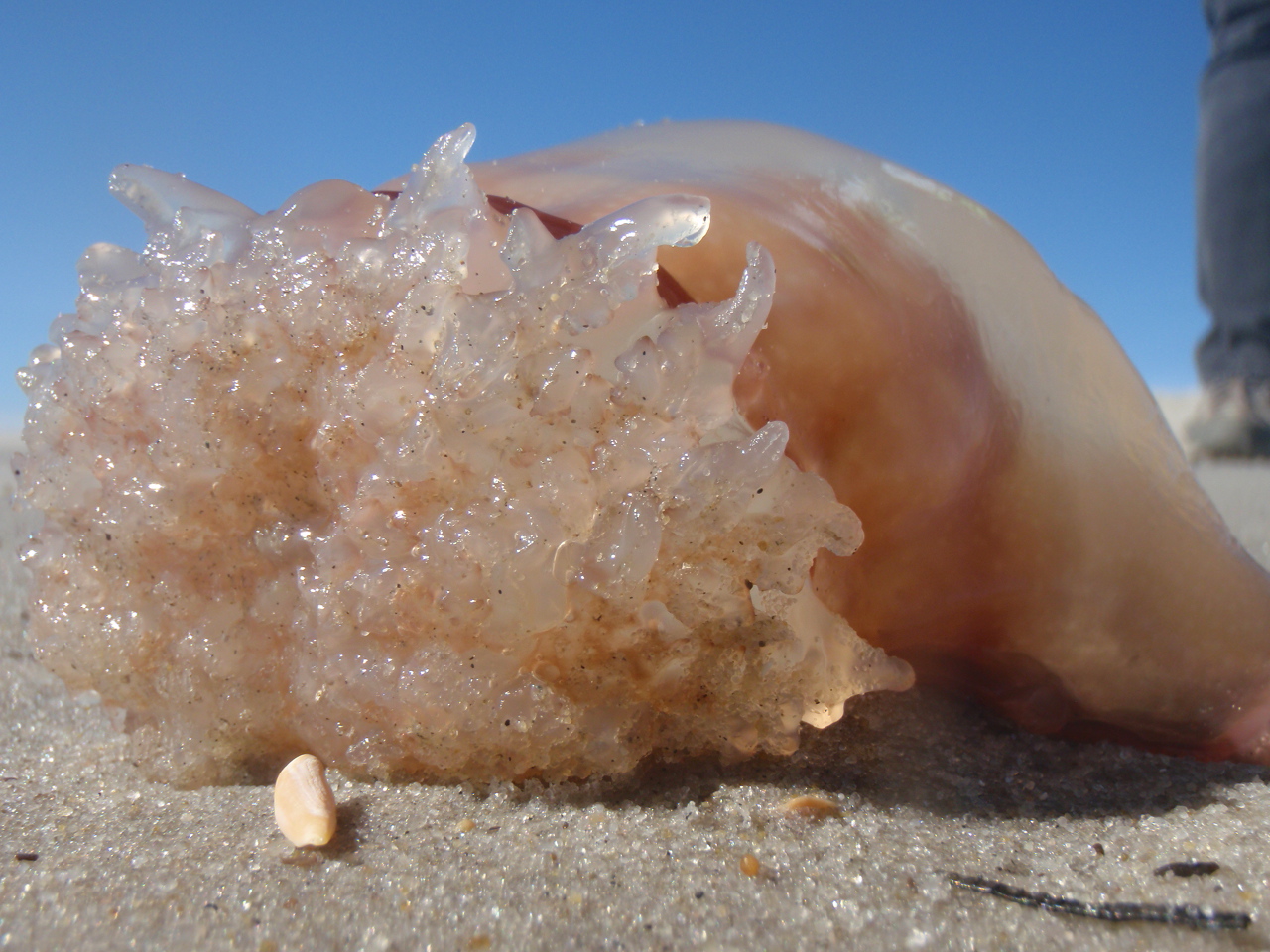
A jelly story


When looking at a jelly lying at the sea's edge, a critter that uses the same genetic code as pretty much anything that has suffered the indignity of DNA analysis, it's hard to get worked up over nonsense.
  • A physicist says that we, like the jellyfish, are mostly empty space.
  • A priest says we have dominion this dying jelly, over all that lives.
  • A chemist says that the orderly appearance of this critter, and us, does not deny entropy--the sun's slow collapse into chaos feeds our lives.
  • A business man says the jelly is hard to sell, and loses interest.
  • A poet say the jelly has a soul, and notices the cyan halo of sky around it.
  • The astronomer ponders the angle of the jelly's shadow, a telling sign of winter to come.
  • A geologist studies the angle of repose of the grains of sand, failing to see the critter at all.
The jelly faded back into the sea, now dead, its story as interesting as mine, as yours, our stories share a common end.

I almost missed this jelly, anxious as I was to catch up on something for somebody due somewhere before Monday's sunset. Now it has become part of my story.


We found the jelly a week ago, and a moment later, dolphins distracted us.
I meant to put the jelly back. I did not.
I had a chance to change the story.

Sunday, October 9, 2011

Two neat things today

We found a monarch butterfly with a tag on it--PBB 518. He hung around the zinnias for over an hour.
.
Getting to Mexico is tough enough, especially for butterflies, but getting there on unbalanced wings is well nigh impossible. I doubt PBB 518 is going to make it, but he seemed to be enjoying the nectar and the sunshine today.

And when you get down to it, today is all any of us have....

Our 1994 Dodge Caravan started today, and since we happened to have our 10 year old kayaks on top of it when it did, we drove a mile to the beach to enjoy this ridiculously beautiful day on the water.

While were out on the bay, a large pod of dolphins came by--four rose in unison so close to Leslie's boat I was sure she'd be dumped. Dolphins are really big animals, and look even bigger when you're sitting in a 16 foot long piece of plastic over a quarter mile off the beach.

I could teach science 23 hours a day for three years and not get close to awe we felt in those short moments.

ADDENDUM

A science guy commented that you need to note the location of the monarch in order for the tag "to be meaningful"--I took the liberty of posting my reply here:


Dear Ento Mike,

Oh, no worries, the location has been emailed to KU. We know the drill. 1-888-TAGGING.

Even so, the monarch tag is meaningful. It says a lot about humans, about etymologists, about adhesive technologies, about bias in studies (this critter was unusually comfortable around humans).

It made us wonder about energy costs to the butterfly, about balance about mass.

And since we are surrounded by butterflies here this time of year--sometimes seeing hundreds in an hour--finding ol' PBB 518 an hour later tells me that at least one monarch butterfly has a tendency to hang around zinnias for at least an hour, and that the zinnias must be reasonably tasty when its usual sources of food are all over the place here.
(We're talking North Cape May. We got almost as many butterflies as we do mosquitoes this time of year.)


Photo of PBB 518 coming.
Photo of the dolphins was never taken--hard to think when a ton of sea mammals heads towards your boat.

Friday, September 30, 2011

September light

Been busier than a bumblebee in May, mostly chasing my own tail, and just about missed September. If anyone checks, though, I got state standards sitting next to some lesson plans on some hard drive somewhere.

How many Septembers do any of us have?

Suppose you live to seventy, and that's a huge suppose. The first few hardly count. Your first September you were likely surprised whenever your fist appeared in front of you face. Your second September you were too busy trying out your legs to notice anything else.

The third and fourth Septembers were nice, but then you got tossed into school. Then work. Deadlines, duties, and data streams.

You think you'll catch September next time around with its soft light and crisp apples, the edge of decay in the air reminding us our bodies belong to the earth and the worms. Maybe when you retire?

That leaves you five Septembers. If you get more than that they will find you in the body of an old man, a body abused for decades, a body ready to quit.
***

I saw three of our local "residents" cackling away on a park bench late this afternoon, as I rambled home through the Green. One was screaming "You're nuts," to the other two, and all three convulsed in hysterical laughter, because they were, indeed, nuts, have been certifiable for years, and they were outside on a late September day, a gorgeous day that almost allows me to forgive fall, and they were happy as the fat squirrels who waddled around the same bench, hoping for peanuts.

I want my students college and career ready, true, because they have no land and can starve if they fail to play the game.

But I also want my students to see the beauty of late September light with its earth smells, to laugh at the absurdity of the dying light, to howl at the moon, to play, to wander and wonder, to be the mammals that we are.


If the heart of science is observation, and I believe that it is, and if my teaching carries any influence, as I believe it does (why else teach?), then our town will continue to have fools cackle on park benches in the dying summer light.

And if I'm lucky, I'll spend a September or two cackling right along with them, our wise fools of the park, no longer pretending that the matters of man matter more than the ginkgo that shades the bench.


Photos by us. Go us! CC and all that. Boats in Galway, mud field in Cae May.

Friday, November 5, 2010

November harvest


The sun may be dying, but its energy rests in the bonds around us, enough to keep most of us alive until the sun returns.

We are almost a week past Samhain. The bonfires have been lit, the dead done wandering. In the olden days, each clan took flame home from a shared bonfire to carry them through the winter. Animals were slaughtered for the coming winter.

Time to hunker down.

Here near the coast, the air tempered by the warmth of the sea, we get to stretch summer a few more days.

Today we harvested tomatoes and basil from the garden, and clams from the mud. The water is still warm enough for me to walk through the ripples, looking for keyholes that betray the quahogs below.

Tomorrow we may cull the kale and the Brussels sprouts. I may nibble on the few leathery beans hanging from the near dead vines--a reminder of what's past, and hope for the future.

Tomorrow I will gather dead flowers, harvesting seeds.

I will bring some of the seeds to class. A student has asked for a clam shell, one from a creature I have eaten.

Seed by seed, I hope to show my kids what lies outside the windows.


Photos ours, taken today.

Sunday, October 31, 2010

UNIVACuous


We have it all backwards

Kids should be required to have cell phones in school. Heck, schools should issue them instead of text books. It's the natural evolution of the UNIVAC, the beast of a machine that predicted Eisenhower's victory 58 years ago.

Let the kids roam the Internet. Let them ChaCha ("powered by people"), Skype, Poke ("Facebook helps you connect and share with the people in your life"), Tweet ("without a doubt the best way to share and discover what is happening right now"), and Google (who knows more about you than you do) their way to Network Nirvana, entering a state of High Holiness that prepares them for whatever standardized tests stand between them and the Glory of our Homeland.

And then, when the last bell rings, make them check them at the door. No phone, no net, no GPS, no electronic tether to the adult world that forgot what the Earth smells like in autumn.

Disconnect our children from the technological teat of tedium, let them wander around lost in the smoky November air. They will scrape off skin, break bones, maybe lose a tooth or two. They will do things that would make their mothers keel over (but will have enough sense to keep quiet).


They will squash bugs, torment cats, chase squirrels, and tease dogs. They will break windows with errant baseballs, and hearts with errant words. They will wreck good clothes and develop bad habits.

And through all this they will learn how to live in a world larger than themselves, a world larger than any of us.

And when they do, they will feel the weight of the first UNIVAC in their hands as they grab the now loathsome machines, sauntering back into the building full of professionals who try to mold them into something more than machine, but less than human.


Photo from the Library of Congress. Not sure where the guy's nose went--an alien, maybe?
Hops and morning glory mine, from yesterday.

Saturday, October 2, 2010

October light


Spent a good chunk of the afternoon on a kayak bouncing on the waves left by Nicole. Most of the power boats are gone now, so you can hear the water, the wind.

The shadows are growing long.

October, again.
***

The bees are cranky. The flowers give up less nectar as the sun gives up less light. For the annuals among us, this is it. We can learn from them.

My cosmos are exploding with blossoms. My squash still flowers, an exuberant waste. Dying puts things in perspective, even for a squash plant.


We only get so many October evenings. For a few years, each one finds you stronger. For a few years.

I'm not going to figure this whole thing out this lifetime. That used to bother me.

It doesn't anymore.
***

Last night I saw a million stars, a few thousand distinctly, the rest blended in as the Milky Way. The north wind chased errant water molecules down to Dixie, and we got treated to a show.

I can tell you what we think each blazing point of light represents, and I can get my students to parrot this.

Parrots do well in our culture.

If I could truly share what I think I know about this star or that one, as I end each day with fewer functioning cells than those I had at dawn, my classes would dwindle.

If I could share what I think I know, a few of my lambs would wander under the open sky, chasing light, chasing dreams.


It's October. Most of the world is dying. I teach the few who are growing, who believe they will always keep growing. If they knew otherwise, the school system would fall apart.

We pretend otherwise, we all do.

But the cranky bee never lies. The light is fading, winter is coming.

For all of us.


Two of the photos are from Dublin, one from my backyard. All are mine.

Saturday, August 21, 2010

August light


We lose over two minutes of sunlight a day now. We'll have lost 17 minutes by next weekend, well over a half hour in two weeks.

We're losing a couple of hours of light a week now.

The room was chilly this morning. The gas molecules zinging around the room are a little less energetic. The yellow jackets are crankier. Fall is coming.

Except for the very young, every winter takes its toll. And for the old, death becomes tangible.
***

The students return to the classroom as the light fades.

They sit under the hum of fluorescent lights, studious learning about "three" states of matter as the most common state in the universe, plasma, lights the words they are reading.

Go ahead, ask your child how many states of matter exist. Ask her how a fluorescent light works. Ask her why it hums louder before it blows.

We use our godly gifts without thought, without fear.

The God of Abraham spoke: Let there be light.

וַיֹּאמֶר אֱלֹהִים, יְהִי אוֹר; וַיְהִי-אוֹר

I am not going to debate the intricacies of the Hebrew Bible here, and I am not a literalist. Still the Creation stories shed light on what mattered to the people that preceded us.

We turn on lights every day without thought, without worry.

Every. Single. Day.

***


Outside, the fading light has dramatic effects. Annuals toss off seeds as though there is no tomorrow. Perennials move sugars back to the roots, bunkering down for the winter.

Animals fatten up, or migrate, or lay eggs that will carry the life force long enough to last through the dark days.

And humans in these parts? We force children to break their natural rhythms, as we break ours.

It's rare when I have to sit through a whole day of classes, but even when the presentations are wonderful, my brain is rattled by the forced attention. I am exhausted by the end of the day.

And what do I do when I get home? I grab a beer and a cup of coffee.


What would happen if kids wandered outside more, went to sleep when night comes, and lived mostly under natural light?

(Yes, of course I know it's ridiculous, I'm not a complete moron--think of it as a thought experiment.)


The whole thing would fall apart, no?
***

The whole thing does fall apart, every year, as the life sustaining sunlight dwindles towards short, gray days.

Various organisms fall away when the dark descends, and the living slow down, waiting for the light to return.

The light will return.

But we won't notice. We cannot. We've forgotten how to see the dark.


Photo by Leslie