Showing posts with label gardening. Show all posts

Saturday, January 13, 2018

January lettuce

January lettuce, from the garden.
Yesterday marked the last day of the darkest 6 weeks of the year.

The cold snap wounded the rosemary bush, but enough of the lettuce hung on in the cold frames to share with friends tonight. Winter around here is hard on all of us, but the light is returning to put the pieces back together again.


Halfway between the solstice and Imolc, back into November light. 
And we're still here.

Sunday, December 17, 2017

Solstice salad

Late autumn sunset on the Delaware Bay
I do not do well with the shorter days. Chances are, you feel the same.

Despite bathing in the glow of electric light, the sun still matters physiologically and psychologically (and that great gray area between). And it has been disappearing slowly for several months now.

Lettuce in the cold frame.

With less sun I grow more tired and less food.

I cannot control the sun, but turns out a lot of plants are tougher than I realized. With no help, the parsley, arugula, and Brussels sprouts are doing just fine through the dying sun. They're taking things a little slower, of course, but there's pretty good advice for all of us with the dying light.

I've got lettuce and baby kale tucked in the cold frames I made back when I had a bit more energy, and even a very determined bean plant that's plastered itself along the cold frame window.

So last night we ate from a mid-December garden.


Saturday, November 18, 2017

The pleasure of feeling

A reminder for me....

Backyard basil in September

November crept in on us again, as it will. The shadows lengthen as the daylight dwindles. We talk about the cold and the rain, but we rarely dark of the darkness. Many of us don't see it, our eyes fed by the steady glow of pixels.

Those who see shadow, feel it deep in our bones, have learned not to talk of it. Among the dying it feels rude to talk about death.

Gardeners know.

Countertop sweet potatoes last week


I had a small patch of sand in back, tossed in compost and manure last June, and threw in a few slips of sweet potatoes, bought cheap because bought late, just to see what would happen.

Sweet potato leaves are lovely to look at and almost as lovely to nibble on, and sweet potatoes need about as much care a a patch of dandelions (also lovely to look at and nibble on).

Summer rolled into fall, the sweet potatoes sprawled out of their patch, even flowered at one point. I left them alone, occasionally watering them, more out of habit than out of need. 

I pulled a "test" plant out late October, found no tubers. I set the roots in a bottle, and it sits on my sill for winter now. The first hard frost was coming a weeks later, so I left the rest alone.

Windowsill sweet potato this morning

Last Friday, with the hard frost coming on in before the next sunrise, I went out to my tiny tater patch, not particularly hopeful, but I had already gotten more than I earned. The air was chilly, but the ground still warm and welcoming. 

I pulled up a plant--scraggly roots, no tubers. Oh, well.

The warmth invited my fingers to dawdle in the dirt. I was already on my knees, in no hurry to get up, and digging in dirt with the sun warming my back was what I wanted to do at that moment.

So I did.

And there it was--an inch or two deeper than I expected, the unexpected flesh. I tried to pull it out. It held its ground much as a clam does, snug in its world, not resistance its only defense.

I wiggled it out and ran to get Leslie, and a minute later two happy and excited humans rooted through the dirt, finding tuber after tuber, joyfully sharing our finds with each other.

Fresh dug sweet potatoes

I grew up hearing the Aesop's tale of the dutiful ant and the lazy grasshopper. The ant worked and worked all summer, the grasshopper played. The shadows lengthened, the days grew chilly, the grasshopper knew it was in trouble.
"Making music, were you?" the ants cried. "Very well; now dance!" And they turned their backs on the Grasshopper and went on with their work.

The moral? "There's a time for work and a time for play." It's an awful parable because of its awful message, and it took me decades to throw off its chains. 

There is no need to distinguish work from play or play from work. Turns out the things in life that bring me the most joy mingle  together, and fingers feeling the earth need no justification.


But we will enjoy feasting on the sweet potatoes just the same....


Sunday, April 16, 2017

Kale soup

This one is for me.


Misty March day, with an occasional tease of sun reminding us what's possible. Perfect day for clamming but for the tides, and one cannot negotiate with the tides,

The kale and Brussels sprouts have survived the winter, as they do, and have not yet bolted, as they will. They're different versions of the same plant, in the same way a dachshund and a bulldog are versions of the same animal, and both tolerate south Jersey winters.

Our parsley plants (mostly) got through, too, and the rosemary bush is now about seven years old, flowering through much of the winter when most everything else is dormant.

We also have some Simpson lettuce growing in the cold frame, planted way back in December in the basement, then moved outside late January or so, when the light was just returning.

We decided to pretty much throw everything together, and it was good.

In the iron skillet, warm up some olive oil, then toss on 4 or 5 sprigs of fresh rosemary. Let the rosemary sizzle in the oil a few minutes, then remove. (Yes, it's wasteful, we've been spoiled by our perpetual rosemary bush).

Add the chopped onions to the oil, let them simmer a couple of minutes, but do not let them caramelize. (I guess you could if you want--maybe I will next time)

Toss the wine into the skillet, then add the chopped kale--it looks like a mountain, but will ease itself into the wine soon enough.

Add the parsley, a dash or two of Tabasco, then salt to taste. Let this simmer for about 10-15 minutes.Add a dab of butter while simmering.

Meanwhile, heat up Leslie's veggie broth, toss in a couple of chopped potatoes, and let simmer. Once the potatoes are oft, dump the skillet goodies into the pot, and let this all simmer another 10 or 15 minutes.

Mmmm....


Tuesday, March 29, 2011

Clam rake vs. pickle dish

At the end of the day, the hallways are cluttered with abandoned papers. I picked one up.
Quadratic equations, lots of them, scrawled out with the tentativeness of an adolescent's hand.

I'll rake for clams this weekend, fish for striped bass, then bumble in the still chilly garden for a bit.

Which means reading tide charts, currents, and dirt.

I can't tell you how many times I got hit with quadratic equations, electromotive force charts, trig tables, and that freaking pickle jar in Ethan Frome way back in high school.

Then I'd go home and go fishing.

Not saying school wasn't useful--I may still have a decade or two to stumble upon a situation where I might need to decipher broken pickle dishes--but I learned a lot more useful stuff staring at the surf than I ever learned in school.


1:1 computers doesn't change this.

Monday, March 21, 2011

Mud and blood

First full day of spring today. I've used up well over half allotted to me in this lifetime.

Got some serious planting done yesterday. Every year I am surprised at how muddy mud can be, then surprised again as I wash my hands in the sink, the dirt tracking into the drain, dark and sinuous, like blood from a deep wound.


The difference? There's a lot more life in a handful of decent dirt than in my veins.

I don't recommend that every child see her own blood washed down the drain, but I do recommend a life where that remains a possibility.


Photo by Leslie.
Now that's a lot of mud.

Thursday, March 10, 2011

Time to plant again

A few days ago I plucked a few more morsels off the Brussels sprouts. I'll get a few more yet before they bolt, shedding seeds for next year, as they have, as they will.

Tonight I mixed water and peat, getting ready to plant again, as I have, as I will, so long as I can. Tomorrow I sow the pepper seeds, in two weeks the tomato seeds.

And so it starts again.
***

I pray that my students remember this much--that they were able to grow food in class, with little more than tiny seeds, light, and water, that they are part of this miracle of life, that ultimately the things that matter are ours through grace.


Not through government, or cash, or the gametes of a couple of wealthy Americans who happened to get together.

A child learns that she is part of something bigger than mere human culture becomes someone to be reckoned with. 


No matter what happens on Wall Street today, or in Trenton today, or in D.C., water will start to seep into the seeds I sow, and awaken an embryo every bit as alive as I am, and it will ache to reach the sun.

Everything we eat comes from the ground, and everything we eat will return to the ground, as will each of us.

***

This week I got to meet a couple of folks with a whole lot more human power than I'll ever have, or ever want, folks who rule over abstract concepts using abstract ideas, tossing around abstract half-truths that they either believe (bad) or not (worse).


Planting last fall's seeds into the ground with my hands, a very human act, reminds me of my place. We are all all bound, literally, to the earth. Holding a handful of good soil does me good.


Plants above grown in Room B362, by my students.

Saturday, July 17, 2010

Death and the web


Promissory Note
If I die before you
which is all but certain
then in the moment
before you will see mebecome someone dead
in a transformation
as quick as a shooting star’s
I will cross over into you
and ask you to carry
not only your own memories
but mine too until you
too lie down and erase usboth together into oblivion.
Galway Kinnell
Strong Is Your Hold

***

Cross-striped cabbageworms have devoured my Brussels sprouts, leaving shredded green skeletons in my garden. (Sister Barbara Mary awakes in the deep recesses of my memory--the stripped plants look like a mad painter's vision of Calvary Hill.)

We all kill unconsciously...all of us. I do not like to kill consciously, but I will when necessary. I pick off the worms and squish them, one by one. I squish the head first--I've no reason to prolong their pain. If the Brussels sprouts get to the point where's there's no longer any point, I will stop killing the worms.

I almost slaughtered a croaker yesterday, a frumpy but delicious fish found off our jetties here. Croakers "croak"--think Lauren Bacall at two octaves lower. (Well, OK, they sound nothing like Lauren Bacall, but no harm thinking about her anyway....)

My frumpy delicious fish kept croaking while I as unhooking it. The soft side of my brain tossed the chatty fish back in the drink.

Throwing away food is not a good survival strategy for any mammal. Throwing it away because a critter "chattered" at me is plain stupid. Still, it speaks to the power of language in humans. Our view of the universe can get trapped in words.

***


Our online lives, for most of us, are words and a few photos we slap up there. We share references and whittle away time, giggling at absurdities while blind to the obvious one:

We do not exist on the web.

It is not a public "space." It is not a town hall or a mall or a park.
It is a linked network of users and databases.

In life, people screw up. Big time. And if Carl happened to barf at a neighborhood block party because maybe he drank too much because his dog just died two days ago, well, it's messy and embarrassing, but it's not permanent. We know Carl. We know his history. It won't be mentioned again.

We forgive Carl's transgressions.

I made up Carl, of course, because once I mention Carl's behavior here, it becomes a permanent stain. There is no forgiving silence on the internet. Forgiveness is impossible because forgiveness is a human trait, part of the same soft-sided brain that released a croaker yesterday, or that pinches worms head-first.

In life, people die. Their daily words die with them. Their misdeeds are forgotten at the wake (unless they were truly dirty rotten scoundrels, and very few of us are).

You cannot be forgiven on the web because:

We do not exist on the web.

Databases cannot forgive. Networks cannot forgive. We are neither.

***

Each of us is mortal.
Each of us will die within a lifetime.
Each of us needs forgiveness.
Each of us exists on grace.

To survive death, to become part of the great life-sustaining detritus I walk on each day, that supports the Brussels sprouts and tomatoes and kale and beans thriving in my garden, I need impermanence.

Only through impermanence can I return to what I was, and am.


Poem by Galway Kinnell used without permission, though I will seek it.

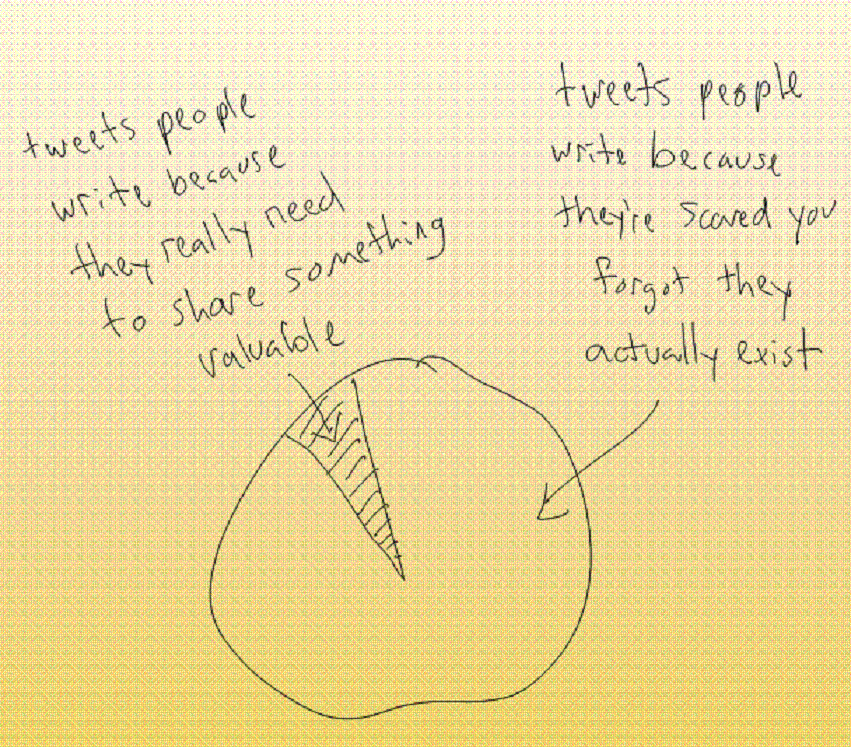
The cartoon is by @tremendousnews on Twitter, no idea who s/he is--found here....
via a tweet by @Larryferlazzo, who also pointed out Herbert's column this morning: "Tweet Less, Kiss More".

Sunday, July 4, 2010

Throw away your power mower

In 19 years of practice as a plastic surgeon and microsurgeon, some of the most devastating and disabling injuries I've treated are from lawn mower accidents. It's especially concerning when children are injured since most of these injuries are preventable.
(Disclaimer: yes, I know even manual reel mowers can cause injuries--
I managed to tear up a thumb pretty good last year--but my thumb is as good as new.
I sliced it up again yesterday while cutting a hose.)


200,000 or so Americans are injured by lawn mowers each year, and over 80,000 end up at the hospital.

Lawns are an aristocratic English tradition. We signed the Declaration of Independence on this day 234 years ago, independence from the British and their obsession with mono-cultural pre-pubescent grasslands.


Ironically, the American Garden Club, no doubt run by British agents, promoted this unhealthy practice: "a plot with a single type of grass with no intruding weeds, kept mown at a height of an inch and a half, uniformly green and neatly edged." The Doyle Garden Club pulled out another chunk of front lawn this week.

A gasoline powered mower is loud, dirty, and dangerous. It costs money to run. It stinks.

A manual reel mower is quieter, cuts better, produces finer mulch, and is much less likely to maim you.

Better yet, screw the aristocrats, and plant a garden. A real garden full of odd, sexually active plants sprawling all over the place. If your neighbor raises an eyebrow, give him a fresh Brandywine tomato, If that doesn't placate him, give him a copy of the Declaration of Independence.

Time to go pursue some Happiness....


Painting by Fernand Khnopff, 1889, found at The Victorian Web.

Sunday, June 13, 2010

Then and now...


Gardening in 1910:

  1. Observe damage. Obviously something's eating the plant.
  2. Find culprits--ah, green caterpillars!
  3. Pick and squish the critters.

Gardening in 2010:

  1. Observe damage. Obviously something's eating the plant.
  2. Google "Brussels sprouts" and "damage" and, oh, look, a new post by John Spencer....Remember why I turned on computer. Spend half hour reading about cabbage moth caterpillars, their economic damage, the identifying characteristics, their life cycle. Learn what cabbage moth eggs look like. Note that they're laid a single egg at a time. Google best way to control them.
  3. Find culprits--ah, green caterpillars!
  4. Pick and squish the critters.

Saturday, February 20, 2010

Eating in science class

Religion is about origins, stories about why we're here, great mythologies to explain greater mysteries.

I teach in a public school. While religion is not shunned as much as professional haters would love you to believe (it is perfectly legal for kids to pray in school), I do make a conscious effort not to tip my hand on matters of myth, even myths I happen to believe.

Still, when you dance with energy and life, you rub shoulders with the inexplicable.


If my lambs learn nothing else, they learn that food comes from the air (CO2) and water, molecules joined together by plants, using energy from the sun. We have a riotous collection of assorted (and often misidentified) plants sprouting all over the classroom.

I needed to thin my jungle of basil this week. As I plucked out a small seedling, the roots still holding on to bits of peat moss, I (again) reminded them where plant stuff comes from. The leaves I was about to eat were formed from carbon dioxide that was formed in the deepest recesses of their cells, inside mitochondria deep in their brains, in their muscles, in their bones.

The warm moist breath each student releases every few seconds carries this evidence of this primal act, food back to water and carbon dioxide, so we may live.

As I eat the leaf, I hear a stifled ewww.... My world briefly dissolves into riotous deliciousness that surprises me every time I eat basil. I hope my eyes do not look unfocused. Professionals do not exhibit ecstasy in the classroom.
***

There is nothing to eat,
seek it where you will,
but the body of the Lord.
The blessed plants
and the sea, yield it
to the imagination
intact. And by that force
it becomes real,
bitterly
to the poor animals
who suffer and die
that we may live.

William Carlos Williams, excerpted from The Host

I teach biology. And while I thrust nonsensical sounds and cycles at the children--NADPH and Calvin and ATP and Krebs--the miracle happens around them, as they breathe, as they eat.

They live in biology--they piss and eat and shit and breathe and some even fuck, all acts tied to life, and we reduce it to safe, nonsensical syllables, which will be tested by something as abstract as "the state" in May.

The simple act of eating a leaf in class becomes a memorable moment because it is tied back to life, to who or what we are.

It's a rare thing in class, going back to origins, and it is a dangerous area in a world where folks kill each other over which myth matters most. So I teach the religion of empiricism, of reductionism.

But even in a public high school science class, using a standardized curriculum polished to a safe sheen through decades of catering to political and religious influences, reductionism occasionally fails to hide what's true.

In moments of clarity for those who pay attention, the world can become incomprehensibly (and beautifully) connected even in a boring science class, taken because you have to, because the old folks around you said so.


The photo is from last summer, fruit from our gardens. A gazillion basil plants, and I can't find nary a picture.

Sunday, December 27, 2009

Ordering seeds

The week between solstice and the New Year, I stare at seed catalogs, gardeners' pornography.

The sun set a tad later yesterday than it did the day before--while this has been going on for a couple of weeks now, last evening was the first time I felt it in my bones. Time to order seeds.

(Yes, I know I can gather my own seeds, and I do--I have thousands of seeds scattered all over tarnation tucked in baggies, many with indecipherable code. Stamp collectors buy stamps they'll never lick, anglers buy lures they never cast, I save seeds I'll never plant.)

A seed is about promise, a tiny being put together by another, not without cost. Each seed has some stored energy, a few sleepy enzymes ready to be activated, and a tiny embryo.

Within this tiny, living plant rests strings of nucleic acids, with instructions for how to create living mass from air, from water. Mostly from thin air.

There is wilderness in a seed--reminders of the edge of life that we depend on yet cannot control.

Monsanto is the world's largest seed seller. Monsanto can (and does) manipulate the world's food supply. Monsanto is a publicly owned American company. As such, its primary duty is to maximize profit. If you want to read hard-core plant pornography, go visit Monsanto.

In the meantime, I'll continue to use Pinetree Garden Seeds for my seeds, one of many small privately owned companies that exist to sell seeds. I'm sure they make money, too, but I'm also sure that they won't sue me if I save some seeds next year.

Plants will be making seeds long after Monsanto crumbles. On a late December day, when the world outside waits patiently for life-giving sunlight to return, it's good to remember what matters, and dream of Carouby de Maussane pea flowers dancing in an early June breeze.

Tuesday, March 24, 2009

"I will show you fear in a handful of dust...."


April is the cruelest month, breeding
lilacs out of the dead land, mixing memory and desire, stirring dull roots with spring rain.
T.S. Eliot

My seeds are sprouting. I put seeds in peat moss, water them, and the miracle happens.

I do nothing to deserve this. Nothing.

Grace.


***

We have long lost our commons. We are now close to losing anything public.

We are heading towards a brand new day in education. The corporate interests are winning. The monied class is winning.

Public is an honorable word, derived from the Latin publicus, which sprang from an even older word poplicus, a variant of populus, or "people." Public literally means "open to all in the community."

Still, a tiny portion of my town's public monies goes to buying peat pots and seed starter, lights and seeds. My kids get to plant in one of the few remaining public spaces left--school.

I will plant most of my seedlings on private land because we no longer have a commons. Back when folks knew that land meant food, this caused concerned. Today the connection of food to land seems as quaint as telling time using a sundial.

If I had to give up watches or sundials, I'd give up the watch. I own a working sundial. I do not own a functioning watch.

***

I dreamed last night of death, as I usually do in spring. The sun swings ridiculously quick to the north these days. Everything I do that matters requires sunlight.

Everything.

Without an influx of energy, things fall apart. At my age they fall apart anyway. My telomeres, cellular hour glasses, keep shrinking.

I pretend otherwise. I am bathed in light from my monitor, powered by coal stripped off the face of this Earth by huge machines powered by petroleum.

Graceless.
***

If you want to keep a plant alive in a classroom, you need to pay attention. You need light, you need water. Our breaths provide the rest.

I can rattle on about cytochromes, about chemiosmotic potentials and ATP synthase. I can make my students mouth off fancy phrases--we have post-graduate education classes designed to teach me how to keep my charges in check, to convince them that testable knowledge holds value, that they need the diploma to be complete human beings.

Preparing young people for success in life is not just a moral obligation of society. It's an economic imperative.

Arne Duncan

I know a lot of very bright adults. I know a lot of very educated adults. Sometimes an adult can be both. The most interesting adults I know all know where food comes from.

The most interesting adult I know outside of my immediate clan never finished high school. Don't worry, Arne, he's done his part to support our economy. He's produced far more than any superintendent or politician ever has, though he had help from the bees and the sun and the land.

He's a farmer, and a good one.
***

Farmers know death, and farmers know grace.
Hard to accept one without the other.

***

New Jersey tests all of its biology students in May. By then, a few of my students will have bean stalks hanging from their bonsai bean plants struggling to survive in a classroom.

If you own land and cannot afford the time to plant a bean, something is fundamentally wrong. People sense that things are fundamentally wrong, and we have good drugs for this--Zoloft will make you feel better, and might even help you on the state exam.

It won't, however, make you a better gardener.

When things settle down in this part of the world, when we remember what made our land and The Great Experiment such a source of joy, we may get less excited about telomeres, and more excited about beans again. Death will no longer be such a surprise.

Planting a bean in class will not help any of my students pass a standardized test.

I do it anyway.

Saturday, March 21, 2009

Guerrilla gardening


Spring, finally.

Again.

I tend to wander away from the monitor once the sun heads north. In January puny words sustain me--in April germinating seeds do. I will become more scarce here as the sun arcs higher in the sky.

Leslie and I wandered along the edge of the world again today--a small flock of loons hunting by the ferry jetty called to each other. A bit later, a crow grumbled at us as we approached.

Crows never grumble at us in February.
***

Not so long ago I caught one of my students artistically applying ink to a mailbox, which would be fine if the mailbox was his. It is not.

I live in the same town I work, which is unusual these days in north Jersey, so reporting the child to the authorities was not in anyone's best interests.
Not saying I did, not saying I didn't.

Yesterday I planted basil and zinnias and oregano and cosmos. Today I put some garlic cloves in the ground. Tomorrow I'll plant more tomatoes or maybe peppers, egg plants or maybe nicotianas, who knows.

I'll run out off ground long before my interest wanes.

My neighbors mostly plant grass. Not the good kind like wheat or oats or corn. Kentucky blue grass (which would be interesting if it were truly blue). Chewings fescue. Bermudagrass. All clipped before they give off a hint of sexuality.

Straight. Green. Inedible.

At least I can eat my dandelions and wild purslane.
***

Should the authorities wish to pursue my graffiti artist, he may pay a fine. He may spend some time in the youth house. It will cost money, my money, and not much gets solved.

I have a better idea. I am short of land, but not of seeds.

Guerrilla gardening.
***

Guerrilla gardening is like graffiti, except it results in something useful.

Find a piece of land, and surreptitiously plant something. In these parts, think Indian. Corn, pumpkin, squash, blueberries, beans, sunflower--these were all here before the Europeans came.

The Europeans destroyed a lot of things, but they have yet to destroy the climate. (Give us credit, though, we're working on it.) If you plant a pumpkin in New Jersey, it will grow. So will a sunflower or a bean or a blueberry bush. They will grow if loved, but better yet, they will grow if neglected.

Pick a property with an absentee owner. We have plenty here in Bloomfield.
Plant a pumpkin seed.
Wait.

The child gets to buck the system. The neighborhood gets a few pumpkins. Passers-by get a chance to smile at a misplaced sign that God loves us even when we're not kneeling in a pew.

I know that God or nature or life or whatever you want to call all this matters, and I know I cannot understand any of it. That's as much as I know anything, and it's enough.

We plant seeds in the classroom, and they grow. The children are amazed, as they should be. (I am amazed, too, every time it happens, as I should be.)

I do not, of course, advise my students to break the law. I do not push them into lives of crime, sowing illicit vegetables around town.


Still, John Chapman is one of my few heroes, and I would be proud if one of my students emulated him.

Tuesday, March 17, 2009

Planting season

In the next hour or two, I will be filling up cut-up orange juice containers with peat moss and vermiculite, dropping a brandywine tomato in this one, a Pruden's purple in that one, and start the cycle again.

Today I saw Ian Jukes speak--he's dynamic, bright, and he shared evidence that today's children, the native digital generation, have altered minds.

I used to work on the Newark docks, he claimed to be a pro football player in the Canadian Football League (though a look at the all-time BC Lions roster doesn't mention a Jukes), so I cut him more slack than I would most pedagogues, and even though he quoted Thomas Friedman a bit and took a cheap shot at Clifford Stoll, most of what he said made sense.

The one thing that perked my interest was his aside that the news that children are different today than a generation ago, truly different in a neurological way, frightened him. He didn't elaborate, and why should he? He makes decent money chatting it up with high-tech futuristic sorts, and he's evangelical in his approach to education, but still, he said it.

I hope someday to pursue it with him, but his blog The Committed Sardine boasts over 78,000 followers, and I have 12, so my leverage is a bit limited.

If I did ever share a pint or two with him, here's what I'd say. Yes, children are different, yes, technology has a huge role in our lives, yes, all this visual noise is uber-cool but....

If I want fresh brandywines and Pruden's purple tomatoes this year, I still have to plant seeds in March.

If I want just-pulled-out-of-the-mud fresh clams, well, I will have to climb into my kayak, head towards my sekrit place, and rake them up.

If I want music that happens to reflect my limbic state at the moment, well, I have to pick up my guitar, or one of the many scattered harmonicas, or a flute or a trumpet, and play.

No way around it.

My kids are still my kids, altered brains or not, and brandywine tomatoes are still my tomatoes, as long as I am young enough to stoop in the garden.

Which gets to the real point--I plant in March for returns in August and September. I do not believe summer is coming, because my imagination always fall short this time of year. I plant by faith.

One of these years, what I plant in the spring may need to be harvested by someone else in the fall.

That's the way it is. And a CPU can't change that.


Two follow-ups:
Mr. Jukes replied in less than an hour. He's a mensch.

More important, I tried using some of his stuff--and my class woke up, engaged as though it was the first week of school. He's onto something. More as I learn more.

Thursday, March 5, 2009

Stalking the Bloomfield dandelion


I can write about oysters and clams and life and death, and occasionally hear a voice from here, from there. Take on milk, however.....who knew cows were sacred?

No matter--the thermometer rose over 30 degrees today to a balmy 43 degrees Fahrenheit. The snow is melting, the daffodils and crocuses are reaching up to the sky, and the sun creeps upward. Brighid returns.

Any day now the tiger lilies will sprout--and when they do, I graze. Early spring is a wonderful time to nibble on plants.

I do not spend a whole lot of time discussing my spring grazing habits with my friends. I usually get an odd look, and there's no sense upping the competition.

Nibbling on greens shortens the food chain--I tear off a piece of a plant outside, I eat it. I know where the plant grew, I know whether it got dusted by pesticides, and I know the plant's story. I become more local.

Some folks worry about me. What about the risks?

The same folks will buy their food from supermarkets, trusting strangers who have no interest in them.

(I do trust my local grocery store--they want my business. I also have an ornery habit of trusting myself as well, maybe even more than I trust strangers.)

I suppose I should list the usual caveats here--don't eat something you don't recognize, don't nibble in fields that may have been sprayed, don't take advice from strangers on the internet, and make sure you wash anything you might eat. You should follow the same recommendations when eating anything from your supermarket as well.


Here's a small list of foods I graze on here in Bloomfield:


Tiger lilies:

I may eat more tiger lilies than anyone in Bloomfield, maybe anyone else in the world. Leslie loves tiger lilies maybe even more than I do, but her love is more photonic than gustatory.

How do you eat them? Find them poking out of the ground, tear off a shoot, and eat them.

What do they taste like? Sweet and tender, with just a tiny hint of spiciness.


Wild onions


If it smells like an onion or garlic, it likely is, and if it is, it should be safe (unless poisoned by humans). Euell Gibbons said all wild onions are safe, and I trust him.

Euell Gibbons is the guru of wild foods--his book Stalking the Blue-Eyed Scallop is one of my all-time favorites. He started his adventures by foraging for his family while only 11 years old--his clan was hungry.

Euell Gibbons was, among other things, a school teacher, a carpenter, a farmer, and a hobo, all honorable professions--I would be proud if my children pursued any of these fields.

What do wild onions taste like? Well, oniony, only more so. I especially love to eat the leaves.


Purslane


I (mostly) admire Gandhi's life, and one of Gandhi's favorite foods was purslane. This weed grows all over the place--I tossed it into the compost for years.

My Auntie Beth told me it's good, and Auntie Beth is always right.

It is nutritious, ubiquitous, and delicious--the flavor has been described as salty/sour, but it tastes like, um, purslane.


Dandelion


I love dandelions! You've got to get them before they start to flower, otherwise too bitter. Even then, though, if eaten raw they may be too bitter for many.

You can pay good money at a fancy grocery store, or you can forage for them in your backyard.


Should things get real tight for us here in Bloomfield, we have too little land to support our population. We have almost 50,000 people living on less than 5 1/2 square miles. Unless I develop a healthy appetite for asphalt, subsistence living here remains a fantastic dream.

Still, nibbling on greens breaking through our earth here in spring reminds me how connected we all are to our land, even here in a crowded corner of the universe.


The dandelion greens are from New York magazine.

Thursday, January 8, 2009

Our kids are being jobbed

Barry Bachenheimer ponders future jobs for our students in his latest entry on his "A Plethora of Technology." He's also putting together a conference scheduled for tomorrow that features Scott McLeod (Dangerously Irrelevant) giving the mini-keynote address "The jobs you're preparing students for don't exist anymore."

I'm getting so confused these days I can hardly tell when something's tongue-in-cheek, though a personal virtual-presence agent is no doubt over the top. Still, the exercise is a useful (and fun) one.

We may well be prepping kids for jobs that will no longer exist in a few years. We step into la-la land, however, when we to train them for imagined jobs that might never exist. I fear we are underestimating where high tech is going while overestimating how much hum
an help will be needed once we get there.

(We now have machines to solve sudoko problems created by machines designed to create sodoko problems. And people use them.)

***

I teach low-level 9th grade science classes. Most of my students hard-working kids who remain naive enough to believe that they will be doctors and engineers and game designers and NBA stars. A few will be. Most won't.

Even if every child in America was blessed with an IQ of 150, the drive of Thomas Edison, and the wisdom of Abe Lincoln himself, most would not be the engineers and the doctors and the game designers and the NBA stars.

Let's stop pretending.

I'd like to turn the question of future jobs on its head--what skills do children need to learn to survive an age when their "skills" are no longer marketable?

Here's my back-of-an-envelope list, scribbled down quickly:

1) Every child should know how to grow and grind wheat.
2) Every child should know where to find potable water within human-powered distance.
3) Every child should know how to knead bread.
4) Every child should know how to start a fire to bake the bread she has kneaded.
5) Every child should know how to build the oven to hold the heat of the fire he has started.
6) Every child should know how to build a wooden table and chairs to sit when she eats her bread.
7) Every child needs the social skills to have loving relationships to have someone to break bread with.
8) Every child should know how to sing and to play an acoustic instrument, to share sounds with good company.
9) Every child should know how to share stories.
10) Every child should know how to spin yarn, and how to knit his yarn into blankets, to keep him warm when he sleeps with his love, bellies full of bread.
11) Every child should know how a home is built, so each can share their skills when a home needs building.

(Families used to provide most of these, but most adults in this part of the world
have not mastered even half of the list.)


In our rush to create children designed to compete with foreigners to serve the good graces of international corporations, we have forgotten to teach them how to take care of themselves.


All photos by Jessica Pierce of things made by Jessica Pierce--hundreds more things can be seen here. Not all school safe, or at least not safe for teachers.

Thursday, January 1, 2009

Industrialism and clams


15 degrees Fahrenheit today--a bit too nippy to clam. The water temperature is down to 39 degrees--the clams are, well, clammed up now, waiting like the rest of us for this nonsense to pass.

Nothing new to write about on this first day of this new year. Clams eat, they grow. My rake resonates against one. I reach into the chill and scoop it up.

Never heard one say "Drat!"
***

Clamming by hand has a cost. I stir up the bottom with my rake, enough that fish will snoop in the area I just disturbed.

I occasionally impale critters not meant for the dinner table--I managed to spear two young horseshoe crabs on a bad afternoon clamming (though a worse day for them).

But I at least knew for a moment the creatures I wounded. Knowing didn't make the agony of the broken horseshoe crabs any less painful, though they at least got a prayer as they sank to their deaths.

We got ourselves tossed out of the Garden a few thousand years ago--clamming is about as close to the Garden as I'm going to get.

I do nothing to deserve the clams, they just are.
I barely need to work to get them, they're abundant at my feet.

I'm just close enough to wilderness to wonder what we lost when we decided to stay home and plant wheat 10,000 years ago.

I work over an area a bit over 500 square yards, and figure about 5000 clams live there. I'll take about 10% of them this year, and next year 5000 clams will still be there, barring any ecological disaster.

Can't think of a better definition of grace than that.

Undeserved love, but given anyway.
***

Rare clammers still make a living raking by hand. They know the critters like you know the sun.

Most clammers today dredge. Water is shot over the clam bed, creating a cloud of slurry, and the dislodged clams are dredged up to daylight.

The clammers will tell you they are oxygenating the water, feeding the fish, and at any rate, are not doing any permanent harm. Still, in a day when a clammer may take over 10 bushels (an old word), he's not going to know one from the other.

The environmentalists will tell you that the bottom of the seas are being scarred, and maybe they're right.

The few of us who can afford to live along the bay will complain about the early morning hours of the clammers, and eventually dredging in shallow waters is banned, and a few more clammers are out of business.
***

I know every clam I eat. I know where it lived. They don't travel horizontally much, maybe a foot or two in a couple of years.

If ever I get sick from a clam, I can tell the DEP where it came from, withing a few dozen yards. (Not that I would ever tell them--I don't sell my clams.)

Beyond the careless destruction of habitat, the sin of the industrial clammer is not knowing the critters he sells. Since most of us are industrial eaters, not knowing where our critters came from, I can hardly blame the clammer. He's just making a living.

I can hardly blame the engineer who designs the hydraulic dredger, nor the driller at Exxon who mines oil for his boat, nor the construction woman who paved the ramp where the clammer launched his boat this morning.

No need to blame anyone or everyone, we are all complicit since we left the Garden. Grace does not dictate the market values, and we all have at least one person to feed, to shelter, to clothe.
***

You're not going to find grace at Whole Foods--you'll find fancy foods at high prices, and a few of the slaughtered beings there may have lived a slightly fancier life than their brethren at Perdue. But you still do not know them.

You pay for the privilege of a fancier form of industry, but you had to earn your dollars somehow. For most of us, earning cash requires participating in an industry.

To know grace you need to see the life drain from the creature you are eating.

Make a resolution to eat something you slaughtered, or at least grew.
Religion has fallen out of favor, and our industrial coccoons shield us from grace.

Grace is never easy, nor cheap.
But it is possible.


Photo of clammers by N. Stope at WeLoveClams.com
Photo of early Perdue farm via the Perdue website

Wednesday, December 31, 2008

Mitochondrion

Part 2 of the last post.
I may have posted this already.


In 6th grade, you labeled your cell diagram, not quite understanding what you were doing, but enjoying picking the colors from your box of crayons, coloring the pill-shaped organelle a Crayola cadet blue.

In 8th grade, you learned that the mitochondrion was where oxidation and the Krebs cycle took place (even though oxidation and Krebs were just sounds to memorize to please the teacher). You learned that this was the cell's power plant. You imagined a tiny engine burning gasoline.

In high school you memorized the Krebs cycle, took the Biology AP Exam, and managed to slip into a decent college. You slogged through biochemistry, and eventually became a pharmacist.
***

Mitochondria reside in our cells--they are sort of us, but not really--they carry their own DNA, and they descend from other mitochondria carried by your mother. And her mother. And her mother's mother.

Coloring them was about as exciting as mitochondria ever got.
***

Three decades ago I sat in the auditorium of the American Museum of Natural History. The teacher had primed our class, so when the serious man on stage asked what energy was, I knew the right words to say.

I raised my hand.
I started to open my mouth--I knew the words, my teacher was already smiling.

I did not say them. I stared at my feet.
"The ability to do work" caught in my craw.
The words explained nothing to me, and still do not.

My teacher's disappointment was once enough motivation for me to answer a stranger's question, even if I did not understand my own words.

At least until 6th grade.
***

Oxygen combines with fuel to release energy--light and heat. The oxygen does not contribute to the energy released--it "simply" accepts electrons, allowing bonds to break and reform.

If this happens fast, you get fire. Oxygen grabs electrons and protons, forming water. Hold your hand over a barbecue--the moisture on your palm is not just sweat. Hold a glass beaker over an open flame--water condenses on the cool glass. Try it.

Oxidation can happen slowly, too. The rusting rims of your child's bicycle left out over winter warms the frigid air as metallic iron morphs into ferric oxide. Rust releases heat. Molecules vibrate more quickly as electrons shift.

I know the words, but still do not trust them.

In 1978 I shoveled iron turnings on the docks, my feet warming up despite thick work boots. Until then I did not believe that rusting iron releases heat. Even more important, I had no reason to believe it--I no longer trusted teachers.

My favorite students are those who do not trust my words now--"show me!"
And I do.
***

The warmth and movement of your lover comes from the sun.
You twist together, heat and motion.
Mitochondria hum.
***

In the morning, the sun rises, as it has, as it will.

The apple I eat courses through my veins as sugar, sugar that feeds the mitochondria.

Heat, water, and carbon dioxide are released. I step outside into the New Year chill, and see my breath. The water vapor dissipates, to return as rain. The carbon dioxide eventually feeds the spring garden, a few molecules going back to the apple tree, where the sun's energy restores a bit of order.

Leslie and I make up our shared bed, laughing at the entropic knot of sheets and blankets.

Our body heat comes from our mitochondria, trillions of symbionts stoking our fires.

If the soul resides anywhere, it resides here in the mitochondria.
After our last agonal gasp, our corpse quickly cools. The change is startling, even to experienced hands.

I've pronounced a lot of dead people, feeling for a pulse, watching for chest movement. Either can fool you. The abrupt onset of cold, however, tells the story. The mitochondria have stopped working.

You are dead.
***

The best parts of science get buried in the details.

Nicotinamide adenine dinucleotide.
Adenosine triphosphate.
Alpha-ketoglutarate pathway.

My students yawn at the details.

I try to use a 3D model. Nitrogen atoms are, alas, painted blue.
"The red balls are oxygen, the blue balls...."

My frontal lobe edits too slowly today. I have their attention now--"Blue balls, he said blue balls!"--and the room now vibrates with a different kind of heat.
***

I breathe. I eat.
I use the energy released from the food I eat today to start preparing for the spring garden.

A garden is a lovely lie--a pretense of order in the midst of organic chaos.

I teach about the Krebs cycle in a classroom without windows.
I want to stop class, run outside, show my lambs the inexplicable dance outside, where a tiny portion of sunlight happens to hit our world, and carbon dioxide and water happen to get reorganized into food, that we happen to eat, to be.

Grace. Dharma. Science.


Thursday, October 23, 2008

Late October


The morning glories stay in bloom all day--the sun too low to coax them to close. A few bursts of flowers— nicotianas, wild aster, and marigolds beckon the slow, more-bumbly-than-ever bees. The ground is cool and wet, and occasionally mud squishes up between my toes.

The tomatoes are gone. I pulled them up today, skeletal remains still hanging on their stakes as though crucified and forgotten. The basil plants, usually the first to go, stand defiant among the rust-rotted tomatoes. Too much rain this season.

A mason jar with green-tinged rainwater emerges from the bean patch, the receding leaves ratting out a watery universe of euglenas and parameciums and copepods, spontaneously generated.

When the garden looks dead, and I no longer believe life is possible, I will peek through a microscope and watch the tumbling exuberance. But not yet--let the critters toss and tumble until November, when I need to see the show.

The grapes explode in my mouth. Most huddle shriveled on the vine, scrotal remnants. Some taste like beaujolais, some need to be spat out. The ground is stained with purple bird shit, the reminders of last week's drunken choir.

When I was younger, the October garden frightened me. Honeysuckle buds that would never open, basil flowers beckoning bees that were too chilled to care saddened me. When I was younger, I suspected I was immortal... the garden whispered otherwise.

No longer. Winter is coming. My winter is coming. The irrational bloom of an annual, a flash of a fuschia the night before its last frost, makes no sense to a seedling in May. In May, the seedling has work to do--grow and flower, seduce the bee, make seeds.

Mid-October, too late to seduce the bees, to make new seeds.
Never too late to flower. A single red zinnia glows in the low October sunlight.

Leslie and I have been together 31 years. Gray hairs no longer surprise us, and we are past making any more seedlings. The leaves are changing colors.

Still, in the faintly warm light of the setting October sun, she glows. It's not winter yet. I am not ready for winter. I am starting to love autumn, though.

This was written a few years ago. Last weekend I found a tiny snow pea pod, and gave it to her. She told me it was delicious. I believe her.