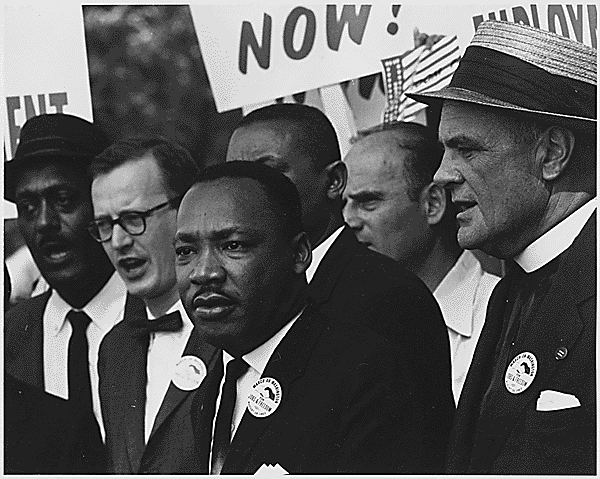
As we celebrate Dr. King's birthday today, it seemed like a good one to repeat....

Organizations love mottoes and mission statements and other sorts of committee-speak that expend lots of time and energy that might actually be used for, say, teaching.
Committees drink lots of coffee, committees fill appointment calendars, committees eventually compromise on some pablum. I never expect committees to spew anything resembling wisdom.
I teach at Bloomfield High. I live in Bloomfield. I grow vegetables in Bloomfield. I scan its skies through the urban glow to see miracles above me. We don't have a ton of money, but we have stoops and more than a few stay at home parents. Many of our children here will work in the family business whatever that may be--painting, masonry, landscaping, plumbing.
While the glorified among us search for bodies to fill the elite skilled positions in life, towns like Bloomfield continue to provide a sturdy class of citizens ready to roll up their sleeves, lend a hand, make a community work. We've got real bakeries, real pizza, real craftsmen (and craftswomen) and real stoops.
The motto for our school district reflects committee-speak:
Educating the Leaders of Tomorrow
Few folks buy it. While Bloomfield has produced a few leaders, even our town's namesake, General Joseph Bloomfield, did not actually live here.
Still, we're not a town of followers either. Connie Francis lived here, Tony Soprano died here, and Sarah Vaughn is buried here. We're Norman Rockwellville with an edge. It's a great place to rear edgy children.
The town supports its schools.
Let me say that again. Bloomfield, a decent but not particularly wealthy town, supports its schools. We pay taxes. We go to the school plays, the games, the art shows. Most of our local taxes go to support our schools, and most adults in town do not have kids in school.
We are not unique that way.
Our high school, however, has its own motto. I'm not sure it's the official town creed, but it's how we live.
So, Mr. Arne Duncan, let me toss my high school's motto your way, a motto painted boldly on a wall next to our arts atrium on the second floor, a wall painted by students on a weekend.
In three words it captures our town, and I think most of the nation not warped by the Wall Street madness that infects so much of our public life today.
It's right up there, big as day. It's not "Learn to work!" or "Learn to follow!" or "Learn to do Algebra 2! or "Learn to kick India's ass!"
Learn to live.
Next week is the HSPA testing. This week the state (again) changed its mind on the curriculum. I can't really blame them--they're trying to train students for corporate jobs that don't yet exist.
When I left school today, a few dozen students were going through our musical's dress rehearsal. A dozen more young women played basketball in front of a hundred or so locals watching our kids in our gymnasium, paid for by us.
A dozen more kids were selling pretzels and candy for the Key Club, money ultimately donated to several local causes involving local people.
Here's a list of companies and foundations not giving us money:
And if you think your neighbor is worthy of teaching your children your local history, get involved in education.
ATT isn't going to take care of you when you're old or ill, but your neighbor will.
Still, we're not a town of followers either. Connie Francis lived here, Tony Soprano died here, and Sarah Vaughn is buried here. We're Norman Rockwellville with an edge. It's a great place to rear edgy children.
The town supports its schools.
Let me say that again. Bloomfield, a decent but not particularly wealthy town, supports its schools. We pay taxes. We go to the school plays, the games, the art shows. Most of our local taxes go to support our schools, and most adults in town do not have kids in school.
We are not unique that way.
Our high school, however, has its own motto. I'm not sure it's the official town creed, but it's how we live.
So, Mr. Arne Duncan, let me toss my high school's motto your way, a motto painted boldly on a wall next to our arts atrium on the second floor, a wall painted by students on a weekend.
In three words it captures our town, and I think most of the nation not warped by the Wall Street madness that infects so much of our public life today.
Learn to live!
It's right up there, big as day. It's not "Learn to work!" or "Learn to follow!" or "Learn to do Algebra 2! or "Learn to kick India's ass!"
Learn to live.
***
Next week is the HSPA testing. This week the state (again) changed its mind on the curriculum. I can't really blame them--they're trying to train students for corporate jobs that don't yet exist.
When I left school today, a few dozen students were going through our musical's dress rehearsal. A dozen more young women played basketball in front of a hundred or so locals watching our kids in our gymnasium, paid for by us.
A dozen more kids were selling pretzels and candy for the Key Club, money ultimately donated to several local causes involving local people.
Here's a list of companies and foundations not giving us money:
Gates Foundation.
Walton Foundation.
Bruhn-Morris Family Foundation.
Capital One
Cartier
City First Bank
Comcast Cable
Donatelli & Klein
Graham Fund
Hattie M. Strong Foundation
Marpat Foundation
National Geographic
National Home Library Foundation
Payless ShoeSource Foundation
Radio One
The Sallie Mae Fund
Susan W. Agger Family Fund of The Community Foundation for the National Capital Region
Target Stores
The Washington Post Educational Foundation
If I wasn't under the NCLB gun to get my kids through the HSPA, here's a lesson I might teach my lambs--the history of oystering in the United States.
We all have property rights independent of whatever patch of land the few of us might be lucky enough to own.
We all own a piece of public land, the commons. We all have a stake in the "public trust doctrine"--we, as citizens, have rights allowing us to gain access to water and land that we do not individually own.
I can gather oysters on the Delaware Bay without interference (beyond applying for a license and spitting out $10). Without the public trust doctrine, I am nothing more than a pirate (which would be way cool, of course).
I have this right because a few folks braver than me fought on the Mullica River back in 1907. Two hundred or so oystermen fought against the few who were among the privileged.
You won't read about this in any high school history textbook. You won't read much about the coal wars fought by miners, or Tom the Tinkerer (Whiskey Rebellion). Kids learn about the Boston Tea Party without grasping its anti-corporate thrust.
A child can go through school in Jersey without learning a thing about how to get an oyster just a few miles away from her classroom while being forced to learn the quadratic equation if she wants to earn a diploma.
Oystering melds biology and history and craftsmanship and industrial arts and nutrition and, perhaps most important, citizenship. The story reminds us how we, as American citizens, serve as the foundation of the Great Experiment.
HSPA won't test this. It's not in the biology curriculum. It's not in the history curriculum. It's not in the industrial arts curriculum.
Still, it matters. And I teach in a town that still recognizes this.
Oysters live on oyster beds. They cannot live on bare sand or mud--they'd suffocate.
When I pull a few oysters off a bed, I just about always pull a few off that are too small too eat. Oysters wrap themselves around each other, and pulling one involves pulling several.
When I get a handful of oysters, I break off the small ones and toss them back to the bed. Oysters pile on top of oysters which pile on top of oysters.
The cultch is the pile of shells and debris that allow oysters to continue to reproduce. Oysters need hard surfaces, oysters need calcium. When I toss my tiny oysters back, I am helping the community to survive.
I cannot oyster on Sundays, but I usually return to the beds anyway, to toss back the shells of the oysters I ate the day before.
I could throw them in the garbage. A truck comes by every week to pick up most anything I want to throw away.
My oysters were alive Friday. I killed them Saturday. On Sunday, I return the shells to the bed. The flesh of the oysters is a true gift, unearned.
I was born in America yesterday. I reap the benefits today. I hope to give back to the children what I have enjoyed. Living in America, our America, is a true gift, unearned.
The least I can do is prepare the bed for future generations.
My bias is, obviously, oysters. The American story can be told by weavers, by farmers, by miners, by carpenters, told by soldiers.
Our story is local.
Our story is real.
Our story matters.
I do not recognize the American Diploma Project as citizens, despite the name; I do not recognize multinational corporations as American; I do not believe that CEOs of multinationals have my town's interests at heart.
I cannot think globally. No one can. It's a lie. I can imagine a village here, a city there, but imagining a global village is like imagining a million deaths--both become abstract piles of numbers . I can imagine, however, a single child dying. We all can. We're human.
Get your butt outside, get to know your neighbors. Get involved with your school district's curriculum.
I'll take care of the oyster cultch. You take care of what matters in your neighborhood.Learn to live.
***
If I wasn't under the NCLB gun to get my kids through the HSPA, here's a lesson I might teach my lambs--the history of oystering in the United States.
We all have property rights independent of whatever patch of land the few of us might be lucky enough to own.
We all own a piece of public land, the commons. We all have a stake in the "public trust doctrine"--we, as citizens, have rights allowing us to gain access to water and land that we do not individually own.
I can gather oysters on the Delaware Bay without interference (beyond applying for a license and spitting out $10). Without the public trust doctrine, I am nothing more than a pirate (which would be way cool, of course).
I have this right because a few folks braver than me fought on the Mullica River back in 1907. Two hundred or so oystermen fought against the few who were among the privileged.
You won't read about this in any high school history textbook. You won't read much about the coal wars fought by miners, or Tom the Tinkerer (Whiskey Rebellion). Kids learn about the Boston Tea Party without grasping its anti-corporate thrust.
A child can go through school in Jersey without learning a thing about how to get an oyster just a few miles away from her classroom while being forced to learn the quadratic equation if she wants to earn a diploma.
Oystering melds biology and history and craftsmanship and industrial arts and nutrition and, perhaps most important, citizenship. The story reminds us how we, as American citizens, serve as the foundation of the Great Experiment.
HSPA won't test this. It's not in the biology curriculum. It's not in the history curriculum. It's not in the industrial arts curriculum.
Still, it matters. And I teach in a town that still recognizes this.
***
Oysters live on oyster beds. They cannot live on bare sand or mud--they'd suffocate.
When I pull a few oysters off a bed, I just about always pull a few off that are too small too eat. Oysters wrap themselves around each other, and pulling one involves pulling several.
When I get a handful of oysters, I break off the small ones and toss them back to the bed. Oysters pile on top of oysters which pile on top of oysters.
The cultch is the pile of shells and debris that allow oysters to continue to reproduce. Oysters need hard surfaces, oysters need calcium. When I toss my tiny oysters back, I am helping the community to survive.
I cannot oyster on Sundays, but I usually return to the beds anyway, to toss back the shells of the oysters I ate the day before.
I could throw them in the garbage. A truck comes by every week to pick up most anything I want to throw away.
My oysters were alive Friday. I killed them Saturday. On Sunday, I return the shells to the bed. The flesh of the oysters is a true gift, unearned.
I was born in America yesterday. I reap the benefits today. I hope to give back to the children what I have enjoyed. Living in America, our America, is a true gift, unearned.
The least I can do is prepare the bed for future generations.
My bias is, obviously, oysters. The American story can be told by weavers, by farmers, by miners, by carpenters, told by soldiers.
Our story is local.
Our story is real.
Our story matters.
I do not recognize the American Diploma Project as citizens, despite the name; I do not recognize multinational corporations as American; I do not believe that CEOs of multinationals have my town's interests at heart.
I cannot think globally. No one can. It's a lie. I can imagine a village here, a city there, but imagining a global village is like imagining a million deaths--both become abstract piles of numbers . I can imagine, however, a single child dying. We all can. We're human.
Get your butt outside, get to know your neighbors. Get involved with your school district's curriculum.
And if you think your neighbor is worthy of teaching your children your local history, get involved in education.
ATT isn't going to take care of you when you're old or ill, but your neighbor will.
Photo by Leslie.




 Posts
Posts


