Friday, January 7, 2011

Faith and fear


For I took an Earthen vessel, in which I put 200 pounds of Earth that had been dried in a Furnace, which I moystened with Rainwater, and I implanted therein the Trunk or Stem of a Willow Tree, weighing five pounds; and at length, five years being finished, the Tree sprung from thence, did weigh 169 pounds, and about three ounces... I again dried the Earth of the Vessell, and there were found the same two hundred pounds, wanting about two ounces. Therefore 164 pounds of Wood, Barks, and Roots, arose out of water onely.

Jean Baptista van Helmont
Early 17th century experiment


That's how it works. You observe the natural world, take a stab at explaining it, and get it wrong. Van Helmont could have stayed on sure footing--the "stuff" of the tree did not come from the earth he used.

This week I am asking my lambs to memorize the photosynthesis equation. I have them breathe on their hands to remind them what "stuff" plants need for this (carbon dioxide and water), and the warmth of the breath reminds them that the plant needs energy to put the stuff together.

The warmth is sunlight transformed--to chemical bonds in plants, now to body heat.

The words "carbon dioxide" mean little to most, and many keep calling it "carbon"--I've broken a lot of pencils to show them what carbon looks like.

And yet I insist on teaching them that plants take it in on little more evidence than faith in me or in their fear of failing. Faith and fear may work for that old tyme religion, but it should have little place in a science class.

Which makes me a hypocrite--from the Greek hypokrites or "pretender" [Online Etymology Dictionary].
***

Van Helmont's experiment is wondrously flawed--he wanted to show that water feeds plants, but shoved 200 pounds of dirt between his willow and the water. He should have just planted the willow in plain water. (I learned this from David R. Hershey, who talks about this in a fun article "Digging Deeper into Helmont's Famous Willow Tree Experiment, " The American Biology Teacher, 1991.)

My students fear failure in class, and not irrationally. Failure kills students in public education.

We grow all kinds of things in class. Just this week, a child took home a fully formed carrot that grew in peat moss, fed by our breath and the water she gave it.

If I asked a very smart kindergartener how a plant grows seemingly from nothing, she might raise an eyebrow with an incredulous look--"It ate the water!"--how can a grown-up be so dense.

If I ask a sophomore, many will stumble, trying to give me sciency jargon. At least the kindergartner got it half right.
***

Unlearning is hard. My students have been blowing on their hands for 4 months now, since the first week, when we discussed why a candle (or anything else in the classroom) burns.

Over and over and over again I break things down into two categories--"stuff" or energy.

When you burn something, you end up with exactly the same amount of stuff you started with. Exactly, down to the atom. For all the light and heat and sound that erupt in from my lit propane torch, none of that energy cost an atom.

I sweep the propane torch on a large flask, fogging the glass with water, water that did not exist until that moment. I can talk of electrons and oxygen and energy states, but that's a lot of theory to toss out based on a little bit of fog from flame.

Faith, boys and girls, faith. And there's a test in two days. Fear, girls and boys, fear.

And why do I comply. Fear and selfishness. I love teaching, and pretend that I can slip some science in now and again. Right now the tests are winning.

***

Part of me believes that if I can get my students thinking, really thinking, they will do fine on the state exam. I'm not convinced. So long as the exam asks students to discuss invisible gases, I've got to push faith in the classroom. Ironically, van Helmont, who came up with the idea that carbon dioxide is a special kind of gas, distinct from air.

I am convinced that they will know more about the world in June than they did coming in, but, to be fair, that might just reflect a general maturity on their part.

***

I want my students to be wrong at least 5 times a class. At this point, I'll even except quiet wrongs, mistakes made on our old school whiteboards. I won't accept ludicrous wrongs unless there's a train of thought behind them.

One of the most important things I am just learning, now in my fifth year, that the truly ludicrous wrong answers have some thought or history behind them.

If a child hears over and over that photons are "particles" of light, well, then any rational child will think of light as "stuff." If a child hears over and over that plants make food from sunlight, it only confirms that light is "stuff." It's not, of course, but try unteaching this!

We spend a lot of class time unraveling bad science.

May is coming, the New Jersey Biology Competency Exam looms. Who has time for science? Trust me, lambs! Or else you will fail!

*sigh*


Ironically, van Helmont was a victim of faith and The Inquisition;
much of his work was not published in his lifetime, likely out of fear.


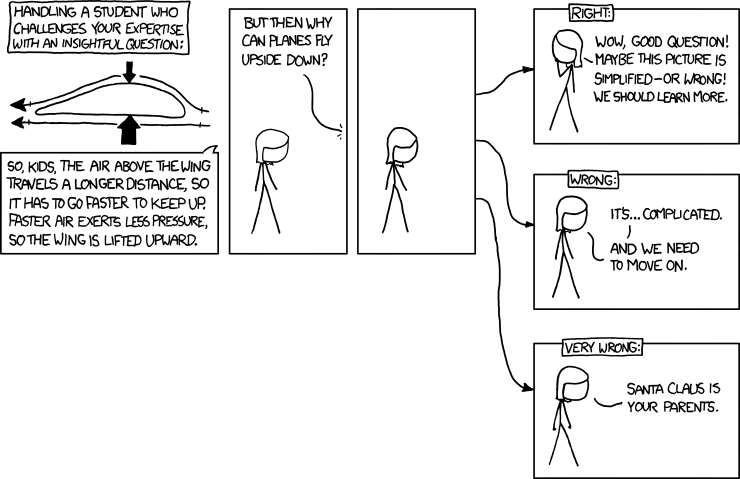
The cartoon is, of course, xkcd.


Thursday, January 6, 2011

Fun with a microscope camera

You can tell kids that plants are alive, and they nod and write it down in their notebooks, then get on with their lives. Their notebooks reflect what the system tells them, not what they believe.

You can show pictures of chloroplasts, and they nod and draw them in their notebooks, then get on with their lives. There's no reason to invest a whole lot of thought in plants.

Or you can project the cytoplasmic streaming of an elodea leaf, sitting on a microscope on your desk.


"That's a video, right...?"
No, that's what's happening under that microscope


"That's the leaf? You mean, like, it's alive?"

To a child (or most adults), if it doesn't move, it's not alive.
And on some days, even this cranky old biology teacher feels the same way.

Their faces lit up as though they were watching fireworks.

We had the added bonus of seeing the chloroplasts change shape as they muddled through the cell. Watching the chloroplasts scrunch up as they hit the corner of a cell wall, bending like the water balloons they are, shows just how squiggly membranes are.

Seeing the chloroplasts live makes it real.

Not sure anybody wrote anything in their notebooks about what they saw--no need to. It's part of their lives.


The video was posted by on YouTube by pphotoex. His (her?) blog is in Japanese.

I am going to set the microscope camera out every day now --
I'm smacking myself on the head.
Such a simple idea, with a huge return.

Tuesday, January 4, 2011

Kim Foglia


"My biggest pet peeve about science teaching is approaching biology as a second language — making it an exercise in vocabulary memorization — rather than an approach to questioning how the world works and on the flipside an understanding of interwoven concepts explaining how the world works."


I learned tonight that Ms. Kim Foglia, the most generous teacher I never met, died today. I learned this from a post by one of her students, whom I never met, though did share a few words. I am glad I got to thank her for her help.

I kept a letter of hers in my pocket, written for struggling AP teachers like myself, trying to satisfy the College Board while guiding young adults through a dense curriculum. She reminded me (and so many others) why we teach, and that the why matters as much (or maybe more) than the what.
***

Kim also taught through her cancer. She shared her story as a teachable moment, but it never defined her.

She shared everything, everything!

We will miss her help, her words, her lessons, and her silly penguins.

Monday, January 3, 2011

Today's wheat prices


Wheat prices pushed past the $8/bushel barrier today, the same day my some of my students discovered wheat berries growing on their young wheat plants.

While a few wheat berries growing in Room B362 will not affect the futures price of wheat, they do tell a story.

The class plants were small brown kernels just a few weeks ago, and now stretch towards the lights, long, green stalks topped with new wheat kernels, still green, still growing.

Each wheat berry sown gets us a dozen or so new wheat berries, for the cost of a quart or two of water and a few hundred hours of fluorescent light. (We could save on the light and just use the windowsills as spring creeps closer).

Where did the "stuff" of the wheat come from? Water, cheap and plentiful here, and carbon dioxide, otherwise wasted breath in a classroom.

It's that simple.

So while my lambs will struggle with NADPH and the Calvin cycle, trip over cytochromes and chemiosmosis, they will at least get the gist of this whole photosynthesis thing.

Light, breath, and water form our daily bread from a simple wheat berry.

Even at $8/bushel, wheat costs less than 14 cents a pound.

An iPod classic weighs 4.9 ounces, and checks in at $249, a bit over $800 per pound, and it won't do any good to water it. For the price of an iPod, you can get 3/4 tons of wheat.

Yes, of course, my bucket of wheat can't play music. But it sure tastes better than an iPod.


The lovely wheat spike picture is by from Texas A&M University
and the Soil and Crop Sciences Department found here.

Sunday, January 2, 2011

Wanton wilderness


To see a world in a grain of sand,
And a heaven in a wild flower,
Hold infinity in the palm of your hand,
And eternity in an hour.

A robin redbreast in a cage
Puts all heaven in a rage.

William Blake, from "Auguries of Innocence"


We fear wilderness, and understandably so. We prefer edged lawns to thistle, Lord Byron Tennyson to William Blake, textbooks to open and changeable sources.

A wild child fails in our culture. Thankfully, we do a pretty good job at school, curing our children of natural impulses, of wanton behavior.

***


Wanton is an old word, now infused with ill will. It comes from wan, or lack (as in "for want of"), and togen, or pull. The roots literally mean "unpulled." To be wanton means to be unbridled. The word used to mean "sportive or frolicsome, as children or young animals."

As we dive deeper and deeper into a culture of efficiency, a culture dependent on artificial standards and goals, a culture that defines joy on its terms, we have less tolerance for the wild ones.

***

The wild ones got us here:

Isaac Newton (the same man who predicted the Apocalypse may fall as early as 2060, a man obsessed with alchemy and the Bible) "seem[ed] to have shown little promise in academic work. His school reports described him as 'idle' and 'inattentive'."


Einstein, an excellent math and science student despite the myths, believed that “it is a miracle that curiosity survives formal education."

The history of science is littered with bright folks sticking things into places where they don't belong, just to see what happens. At this moment, deep underground in Europe, we are trying to find the "God particle" as the Large Hadron Collider bangs together particles at ungodly speeds.

If you already know what's going to happen, what's the point? School is designed to protect the order of things, to keep us safe, to tell us what is going to happen.

Except for science class.

Sparks fly, test tubes erupt and spew off foam and flames, white flies spontaneously generate among rows of peas and carrots that look so incongruous in a government building. Occasionally our high school gets evacuated because of our lambs wandered into the occasionally unpredictable world of science lab.

Stains on the ceiling, cracks in the world, and incident reports in central administration remind us that wilderness exists, even in a building where young lives are pre-planned, curricula set, protocols enforced.

If you teach, guide your lambs to the ledge:
  • If you teach language arts, push the wilderness. Read Blake with passion; you grasp that all this is miraculous, and that all this will end. Let your children see you bleed.
  • If you teach history, let the smells and sounds of battle waft into your room, let fear and hope swirl in your room as it swirls around us in the world. Let your children taste the blood that has spilled.
  • If you teach physical education, push a child to feel what reckless abandon feels like, when the body is allowed to break from the human forms of chairs and desks and burst into motion. Let the children fall and bleed.

We do not shed enough blood in the classroom, and there are good reasons for that. We fear lawsuits, we fear unruly classrooms, we fear chaos.

I think we most fear the wilderness. Order is seductive, civilization seduces us all. Schools produce the graduates we deserve.

Civilization matters, of course. I like my hot showers, my iPod, my tap water, my clothes. I like order and the daily insulation from death and entropy. I do not plan to paint anarchistic slogans on my walls.

I do hope, though, that I am a little bit more courageous sharing the wild with my students this coming year.


Yes, I know, we adore Blake now--he is safely dead, tucked in a dead and long ago age we call Romanticism. If you can read Blake without wanting to scream and run off naked into a July thunderstorm on the edge of the ocean, you're missing the point.

The Newton page predicting 2060 as our end is from, fittingly, Armageddon Online here.

William Blake's The Great Red Dragon and the Beast From the Sea found here.

Thank you to Josie Holford for helping me out with the poets.

Saturday, January 1, 2011

Back to the future

With all the clitter clatter of folks rushing to toss out last week's toys for the new and improved 2.0 version, here are a few things now obsolete, but well worth bringing back:


1) Chalk
You cannot draw well with markers; it's even harder to draw with an interactive whiteboard. Subtlety matters. While a 256 color Powerpoint of a beating animated heart garners plenty of woo factor,

It's cheap! A dozen chalk sticks will run you less than a dollar; the same number of erasable markers costs a magnitude more.

It's therapeutic--snapping a piece of chalk in two satisfies the amygdala. Try breaking a marker in two. If things get really bad, you can eat the chalk as an emergency substitute for TUMS.


2) Overhear projectors
Using an overhead projector well requires a strong grasp of the material you are presenting. It has the added bonus of allowing you to face your students, your visage lit up eerily like a bad scary movie.

An overhead projector is a great source of light for biology teachers--I still dig one out when I want to show that chlorophyll fluoresces, or to test light's effects on oxygen production in plants.

(I won't even get into my talent for shadow puppets....)


3) Analog clocks
I still have no idea why they left--an analog clock gives more information than the digital variety, hands down. I guess you could argue that they cost a smidgen more--I do have to invest in a new battery every 3 or 4 years--but even I can spare a dollar or so a year.


I do not hold onto the old for old times' sake. I hold onto tools that work well, until replaced by something that works at least as well, everything else being equal.

Spending a lot on an interactive whiteboard does not make you smart, only your wallet.


Don't eat the chalk. Really.
Einstein photo from Seattle Weekly here.


Last day of 2010


Our last beach walk of the year. Much of the ice has melted, the animals can scavenge again, feasting on horseshoe crabs and blue claws dredged up by the grim grinding ice. Dying comb jellies glistened on the beach, ignored by the gulls.

I found a small whitish clam panning the beach with its foot, perhaps a young surf clam. I tossed it back into the bay, my last clam of the year.

The last day of the year is a human construct.,

Today will be a little different than yesterday, true. The sun will hang in the sky a minute longer today, angling a hair higher in the sky. High tide will be almost an hour later, and a few inches higher.

I teach indoors, obviously, in 48 minute chunks. Biology happens outside, in millennial chunks. Transferring knowledge of life is a Sisyphean task.

I condemn others' acts of hubris while ignoring my own, trying to stuff minds with abstract shadows of what can be found just outside the classroom window, if we took time to look.

The word "education" comes from educere, "to bring out, lead forth." My best days are those when I lead the students out the door to the real world outside, the one that created us, the one we cannot hope to fully grasp.


Photo by Leslie, December 31, 2010